
Collecting and Exchanging Medical Recipes in the Age of Print
Recipe Manuscripts in 19th and Early 20th Century China
2019–2025
FNT07
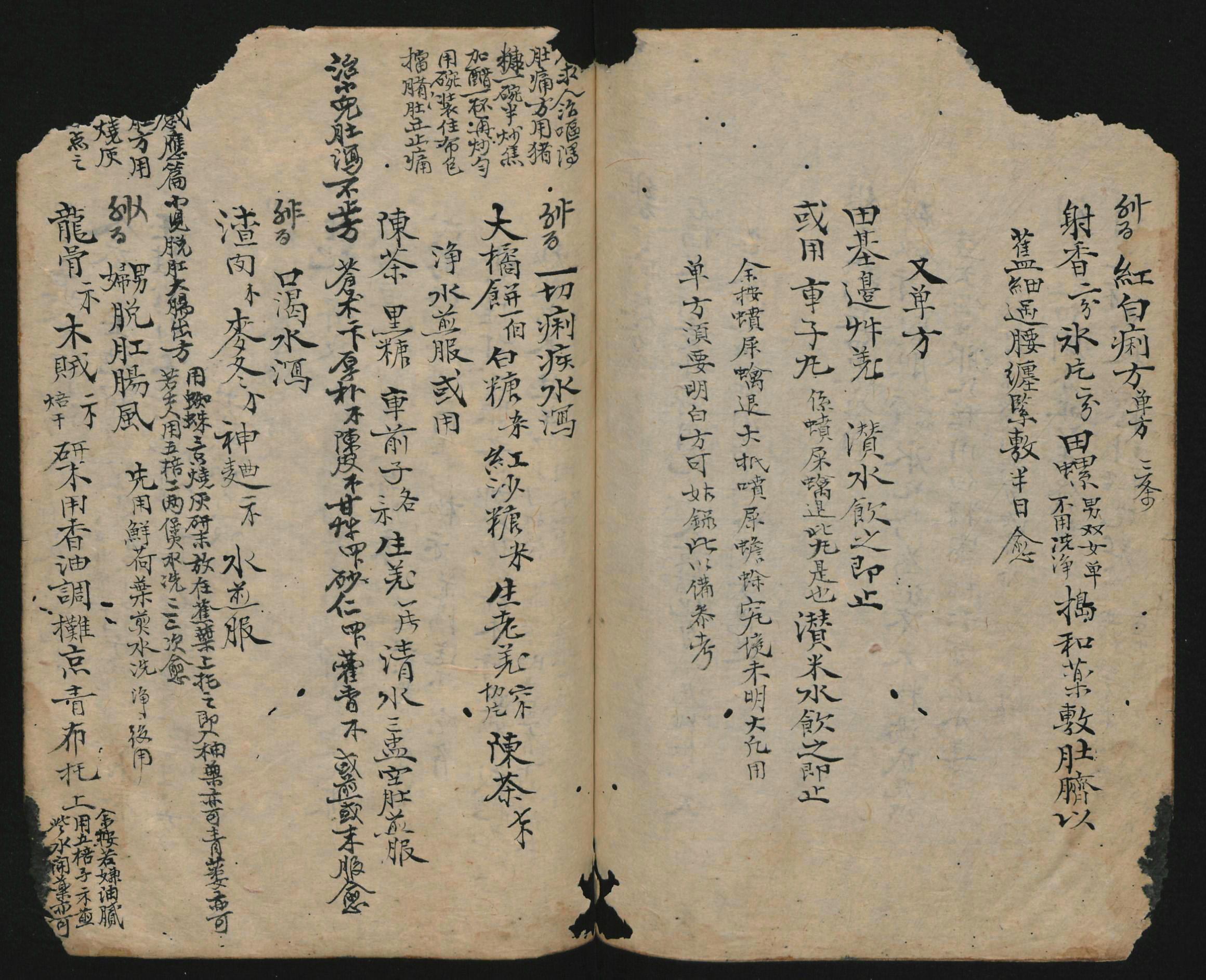
Recipes have long remained marginalised sources that rarely raised interest beyond the narrow confines of culinary and medical history. More recently, however, they have become a hot topic in the fields of history of science and knowledge. Researchers have not only drawn attention to the crucial importance of recipes as an ‘epistemic genre’ for the production, exchange, and transmission of knowledge and to their ubiquity in various cultures from ancient times until today; they have also begun to acknowledge the research value of recipe books – collections of individual recipes – as physical manifestations of these practices. This is particularly true for recipe manuscripts, since their contents and physical features yield a wealth of information about the ways in which recipe collections were produced and used. Recent research on early modern English recipe manuscripts has already provided numerous stimulating results. In contrast, the study of Chinese medical recipe manuscripts was almost uncharted territory, especially for manuscripts from the nineteenth or early twentieth century.
To shed further light on the socio-cultural history of recipe collecting and exchange in China during that period, this project investigated recipe collections in manuscripts and prints. It analysed one particularly extensive recipe manuscript from nineteenth-century Canton in depth (Staatsbibliothek zu Berlin, Slg. Unschuld 8051; for a brief introduction to the manuscript, see this issue of the ‘Artefact of the Month’) and conducted a survey of other relevant manuscripts and prints from the same period and area.
Focusing on recipe attributions and inserted paper slips as well as on the temporal ‘layers’ and the content structure of recipe collections, the project uncovered practices of recipe collecting and exchange (networks of persons involved in recipe exchange, growth patterns of collections, the importance of individual paper slips for recipe circulation, etc.), which will be published in a monograph. Some of these results have been presented at the ‘Recipes and Recipe Books Across Manuscript Cultures’ workshop at the CSMC as well as at the 16th International Conference on the History of Science in East Asia. The comprehensive investigation of Slg. Unschuld 8051 also included the capturing of infrared reflectography images in collaboration with three colleagues from the natural sciences. This led to the discovery of a title that had been inscribed on the bottom edge of the manuscript but which was barely visible with the naked eye (see this dataset as well as the presentation of the results in two blogposts).
The project has also dealt with the topic of provenance with regard to the Unschuld collection of Chinese medical manuscripts as a whole. Based on a study of archival documents and a personal, yet unpublished, acquisition notebook of the collector Paul Ulrich Unschuld, it was possible to obtain provenance data for roughly 500 of the overall 977 manuscripts now held at the Staatsbibliothek zu Berlin (see this dataset and the discussion in this paper). The results of this research were also presented within the series ‘CrossAsia Talks’, which is hosted by the same library.
The project’s focus on recipe books as multilayered written artefacts has also given rise to close involvement with the Cluster’s Research Field D: ‘(Re-)Shaping Written Artefacts’ on various levels: besides serving as spokesperson of the research field from April 2023 to the end of 2025, Thies Staack has co-edited a section on ‘Multilayered Written Artefacts and Their Internal Dynamics’ in manuscript cultures 20 showcasing some results of a previous workshop. He also co-authored the CSMC Occasional Paper 9 ‘Multilayered Written Artefacts: Definition, Typology, Formatting’, which advances a basic conceptual framework for the analysis of multilayered written artefacts across periods and cultures.
The fruitful collaboration with José Maksimczuk, spokesperson of Research Field G: ‘Keeping Notebooks’, on notebooks, diaries, and other written artefacts in which small content units – ‘notes’ in the widest sense – accumulate over the course of time, led to the organisation of a workshop and the publication of the edited volume Accumulating Notes: Note-taking and Multilayered Written Artefacts.
People
Project lead: Thies Staack
Preceeding Project
Folk Healing in Late Imperial China and Formatting Practices in Medical Manuscripts (2019–2022)
Forthcoming Publications
Collecting and Exchanging Medical Knowledge: Recipes and Recipe Books in 19th and early 20th c. China (monograph in preparation)