
J. P. Gumbert Dissertation Award
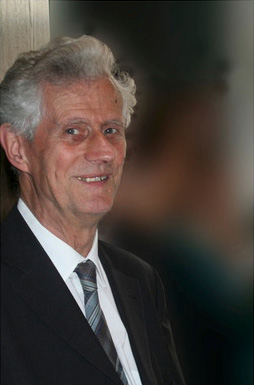
The CSMC dissertation award is named in honour of Professsor Dr Johan Peter Gumbert (1936–2016). He was Professor and Professor Emeritus of Western Palaeography and Codicology at Leiden University from 1979 to 2001, and an expert on Latin and Dutch manuscripts. As a frequent guest at the Universität Hamburg, Professor Gumbert was associated with the CSMC from its very beginning as well as with the COMSt-Network (Comparative Oriental Manuscript Studies).
The award includes a prize money of 5,000 Euro and a fellowship for a research stay at CSMC.
Guidelines for nominations
The successful dissertation contributes to any aspect of the study of manuscripts and other written artefacts from fields such as art history, history, codicology, epigraphy, material sciences, palaeography, or philology. Its research focus can be on any period or region. The dissertation must be written in English.
Nominations can be submitted by the first or second supervisor or by the doctoral students themselves. Members of CSMC or the University of Hamburg are excluded. Nominations must include:
- the doctoral dissertation thesis
- one review by the supervisorand final PhD certificate
- curriculum vitae
- a half-page statement describing in which respect the dissertation has established new grounds for the study of written artefacts beyond one discipline.
J.P. Gumbert Dissertation Award 2026
Details regarding the next round of nominations for the J.P. Gumbert Dissertation Award will be announced later in 2026.
Previous Winners
2025
Jake Benson (Leiden University): The Advent of Abrī: The First Wave of Paper Marbling in the Long 16th Century (ca. 1496–1616)
Jake wrote his dissertation on paper marbling, called abrī (clouding) in Persian, which emerged during an initial ‘first wave’ in the long sixteenth century.
Eugene Matanky (Tel Aviv University): Esoteric Labor: The Making of Cordoverean Kabbalah
Integrating the fields of history of knowledge and material philology, Eugene’s dissertation analyses early modern Hebrew manuscripts from the Safedian kabbalistic circle of Solomon Alqabeṣ and Moses Cordovero to illuminate the unrecorded processes involved in their generation and reception.
2024
Yitz Landes (Princeton University): The Transmission of the Mishnah and the Spread of Rabbinic Judaism, 200 CE–1200 CE
In his dissertation, Yitz looks at the history of the transmission, reception, and study of the Mishnah, the central text of the Rabbinic corpus, from its inception in third-century Galilee until the publication of Maimonides’ commentary to the Mishnah in 12th-century Egypt.
2023
Daria Kohler (Kondakova) (KU Leuven): ‘Publication’, papyri, and literary texts: process and presentation
Daria's thesis is a study of the concept of ‘literary publication’ and ‘publishing’ in the Greek and Roman world between the 4th century BCE and 2nd century CE, which combines a reinterpretation of the literary evidence with insights about the materiality of book production, as well as case studies and statistics from Greek and Latin papyri.
Elif Sezer (FU Berlin): A Manuscript Community in Ottoman Istanbul (18th-19th Centuries): Heroic Stories, Social Profiles, and Reading Space
Contributing to the fields of manuscript studies, the history of the book, as well as the Ottoman literary, social, and cultural history, Elif's study explores a reading community that formed around the manuscripts of popular heroic stories in Istanbul in the 18th and 19th centuries, based on first-hand manuscript notes.
2022
Mallory E. Matsumoto (Brown University): Sharing Script: Development and Transmission of Hieroglyphic Practices among Classic Maya Scribes
Based on epigraphic and palaeographic analysis, the author places classic Maya hieroglyphs in socio-political context and argues that variation in how scribes wrote reflects the decentralised trajectories through which they exchanged knowledge about the writing system and how to use it.
Madalina Toca (KU Leuven): Letters from Pelusium. Studies in the Reception, Formation, and Historicity of the Isidorian Epistolary Corpus
By the means of a comparative study of compiling practices of excerpting and rearranging the letters of the fifth century epistolary corpus attributed to Isidore of Pelusium, the author traces the emergence of distinct Isidorian reception profiles reflected in thematic collections across Greek, Latin, Syriac, and Slavonic manuscript traditions.
2021
Hui Sun (Universität Heidelberg): Funerary Lists from Early Chinese Shaft Tombs
Through a combination of codicological and philological data with archaeological and ethno-sociological theories, the author arrives at a new understanding of the usage of funerary lists from early Chinese shaft tombs (5th c. BCE-1st c. CE).
Jeremiah Coogan (University of Notre Dame): Eusebius the Evangelist: Rewriting the Fourfold Gospel in Late Antiquity
Analysing Eusebius of Caesarea’s fourth-century reconfiguration of the Gospels as a window into broader questions of technology and textuality in ancient and medieval Christianity, the author traces a neglected history of Gospel reading.