CSMC
CSMCCentre for the Study of Manuscript Cultures
Photo: UHH/Denstorf
1 April 2026
With five ‘Concepts and Methods Units’, UWA restructured itself at the beginning of its new funding phase. The ancient historian Kaja Harter-Uibopuu heads one of these groups, which focuses on the central UWA topic of ‘Material Choices’. Here she explains what she aims to achieve with this group.
In 2026, the Cluster of Excellence Understanding Written Artefacts (UWA) entered a new funding phase. What sounds like a bureaucratic formality has far-reaching implications: on this date, many of the research projects previously located in the cluster came to an end, and many new ones began. And while the core content of UWA has remained the same – we continue to research the material history of writing and examine written artefacts from all cultures and eras – it has since taken on a new structure: the Research Fields, which previously grouped individual research projects, no longer exist; Instead, so-called Project Groups (PGs) and Concepts and Methods Units (CMUs) have been formed. These are not, as before, collective pools to which the Individual Research Projects (IRPs) are clearly assigned. Instead, all three units – CMUs, PGs and IRPs – operate at different levels and complement each other.
What exactly do these changes mean for research at the cluster? What is the purpose of the new groups, what do they focus on, and how do they relate to each other? In this series of interviews, UWA researchers provide answers to these questions.
Kaja Harter-Uibopuu kicks things off: the ancient historian heads the CMU ‘Material Choices’; previously, she led the Research Field on ‘Inscribing Spaces’.
Let’s first clarify the terminology. How would you describe the relationship between Individual Research Projects (IRPs), Project Groups (PGs) and Concepts and Methods Units (CMUs)?
IRPs are the basis for us all: these are research projects in which we work alone or in pairs on particular written artefacts or a narrowly defined topic. PGs are groups of researchers working on specific artefact groups, regions, or questions. For example, ‘Writing in Colours’ is a very concrete and empirical study of the meaning of colours in written artefacts. Researchers will contribute examples from their individual projects, compare them, and hopefully gain new insights into the pragmatic and symbolic significance of writing with colours in specific cultural and historical contexts.
CMUs operate on a different level: in them, we want to develop theoretical concepts and methods that can help us with the more empirical questions in the IRPs and PGs. In terms of ‘Material Choices’, this means that we do not intend to find out why people in ancient Greece wrote on stone rather than wood, for example. Instead, we want to develop a method that will enable researchers interested in this specific case to answer this question.
Before we go into more detail about ‘material choices’, does that mean that PGs and CMUs exist side by side rather than in a hierarchy?
That’s right. PGs and CMUs are not levels that build on each other, but different forms of work. However, CMUs are more long-term: with PGs, we hope that they achieve their research results and fulfill their purpose in a few years, with new PGs evolving along the way. They are quite flexible units. CMUs are different; they are intended to accompany our entire UWA project and use the results they produce to underpin our work conceptually and methodologically.
In the previous phase, one of our Research Fields was entitled ‘Selecting Materials’. What is the connection between this field and the CMU ‘Material Choices’?
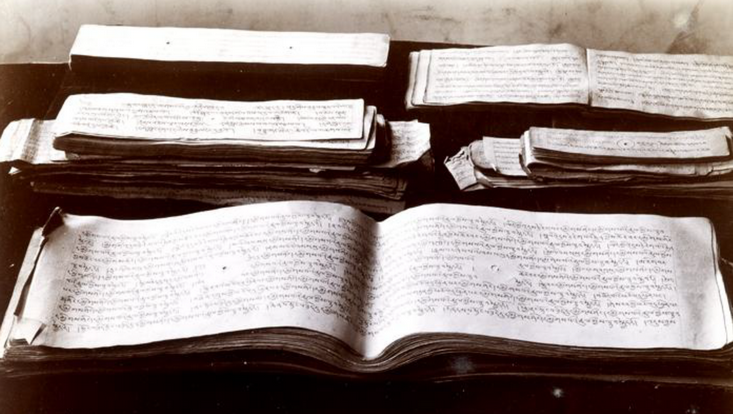
‘Selecting Materials’ was more empirically oriented and — thankfully — strongly influenced by the natural sciences. This is evident in the Occasional Paper that emerged from this Research Field: it provides a very valuable overview based on numerous examples but focuses less on the underlying theoretical questions.
‘Material Choices’ starts from a different point: we are not only interested in which materials or layout forms were used, but also why they were chosen. This shifts the focus more towards human actors, social practices, and cultural patterns. This theoretical-historical focus also reflects a broader development: in the new cluster, we are paying more attention to historical questions such as social dynamics, transmission channels, and modes of action. So, to answer your question: ‘Material Choices’ would not be possible without the work done previously in ‘Selecting Materials’.
In almost all societies, there are norms that shape how things are written
The modes of action that are the focus of your CMU concern the production of written artefacts. What are the key factors that determine what people write with, what they write on, and in what form?
There are several, of course. General availability and costs play an important role, but also the physical qualities. If I just want to quickly jot something down, like a to-do list, then I probably don’t care about the properties of the material. For something important, such as an invitation to a royal celebration, I might want special paper, elegant decorations, and so on. So, among other things, it depends on what I want to write about, how important the written artefact will be, and who will see it. These are very personal reasons for choosing a writing support.
In almost all societies, there are norms that shape how things are written, such as how official documents or religious texts are presented. These norms have varying degrees of influence: sometimes they are so pervasive that there is hardly any deviation for certain types of written artefacts within a given culture. This is particularly interesting because it highlights the strong influence of society in this area. And it becomes even more intriguing when we encounter outliers. Ultimately, every innovation can be traced back to a break with tradition.
You have now also mentioned the layout of written artefacts. ‘Material Choices’ thus refer not only to the material from which these artefacts are made, but also to their design?
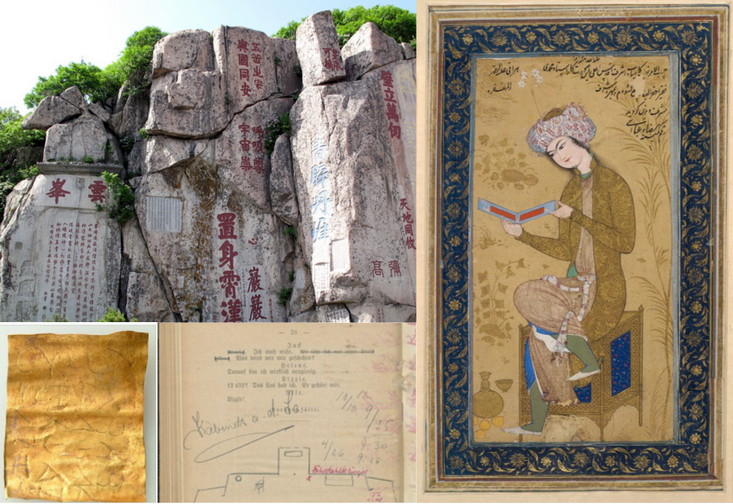
Yes, we use a broad understanding of our topic that takes into account not only the writing material but also the visual organisation, such as columns, font sizes, paragraphs, and images. These influence readability and status. A Bible intended for private study in a library will look different from one carried through the village by several men during the Corpus Christi procession; the latter must of course be larger, have a magnificent cover, and so on.
The fact that we always take the spatial context into account goes back to our earlier work in ‘Inscribing Spaces’: with inscriptions, it is obvious that the context in which they are placed is important, that is, who should read them and what impression they were intended to make. But with manuscripts, exactly the same questions can often be asked. So spatial context plays a role for all written artefacts.
What scope for action did scribes have, and how did they deal with it?
You said that you don’t want to address empirical questions, such as why a particular writing culture switched from parchment to paper at a certain point in time, or why a particular artefact deviates from the design norms of its historical context. What will the results of your group’s work look like, then?
My idea is that we will design a questionnaire, which will probably resemble a tree, that researchers can use to systematically decipher the materiality of their writing artefact, regardless of its culture or era. A tool that I can use to clarify, for example, how much tradition and how much initiative are involved in my written artefact, and what constraints imposed by affordability, religion, or social status are reflected in it. What scope for action did scribes have, and how did they deal with it? Ultimately, we will extract questions from the empirical studies underlying our efforts. For this endeavour the interdisciplinary approach and the different scholarly and scientific backgrounds of the participants of our CMU are vital.
At a later stage, we also want to apply this questionnaire to a specific group of written artefacts, namely legal documents, ranging from written norms and laws on the one end to private deeds and contracts on the other. Such written artefacts can be found in practically all writing cultures, which is why they are well suited for global, cross-epochal comparisons. Moreover, the interplay between individual freedom and administrative frameworks will allow us to concentrate on the reasons for material choices.
Finally, I would like to know how this CMU relates to the other five. Do all these groups work separately, or are there also cross-connections?
We work independently but still in close connection to each other, since there are definitely points of contact. In our case, these are most evident in ‘Phased Transmission’: our group deals with the production phase of written artefacts; ‘Phased Transmission’ takes over from the moment a written artefact is reused or repurposed. Sometimes, however, this boundary is difficult to draw: consider, for example, gravestones that are inscribed in such a way that the names of additional family members can be added later. When this happens, is it a case of continued use or reuse? Such borderline cases require exchange and cooperation with the other groups. Moreover, the use of a digital twin is also a deliberate material choice, and choices will have been influenced by crises. In other cases, we may not yet know exactly where such points of contact lie. Still, we expect a fruitful exchange of all CMUs, which will be reflected in our publications.