CSMC
CSMCCentre for the Study of Manuscript Cultures
Photo: UHH/Denstorf
10 December 2025
‘Pearls and corals’ – the meaning of the Manipravalam language’s name is as poetic as the language itself is important to the history of South India. Still, it has hardly been researched. Suganya Anandakichenin has received a prestigious ERC Consolidator Grant to gain a better understanding of it.

Suganya Anandakichenin, what is Manipravalam?
Manipravalam is a hybrid language, a blend of Tamil and Sanskrit, that emerged in the Tamil region of South India, in a way culminating during the medieval period between the 12th and 15th centuries, especially among the Sri Vaishnavas. It originated in a context where both Tamil and Sanskrit served different cultural and religious functions. Manipravalam brought these linguistic traditions together, often appearing in religious texts, poetic compositions, and even royal inscriptions.
One of its unique features is the way Sanskrit vocabulary and stylistic elements are woven into Tamil grammatical structures, creating a language that is neither wholly Tamil nor purely Sanskrit. This blending was particularly common in theological and literary works and reflected the region’s religious diversity. Importantly, Manipravalam was used by several religious communities, notably the Sri Vaishnavas, but also Shaivas and Jains. Each group adapted it to fit their particular needs.
What inspired you to dedicate yourself to this relatively unknown topic?
My academic background is in Indology, I did my PhD on devotional (bhakti) Tamil poetry. While preparing my dissertation for publication, I came across a large body of medieval commentaries from the Sri Vaishnava tradition, written in Manipravalam. What really drew me in was the linguistic challenge: while I could recognise almost every word in these texts, I struggled to make sense of the sentences themselves. The intertwining of two languages made the commentaries far more complex than anything I’d studied before.
This puzzle sparked my curiosity. Over the past decade, my fascination with the topic has only grown as I’ve continued to encounter new puzzles connected to this language. It challenged me intellectually, but also offered a unique opportunity: Despite its importance, Manipravalam has received relatively little scholarly attention, especially in Western academia.
Manipravalam served to connect communities and facilitate dialogue in a linguistically diverse region.
What’s the reason for the shortage of research that has been done on Manipravalam so far?
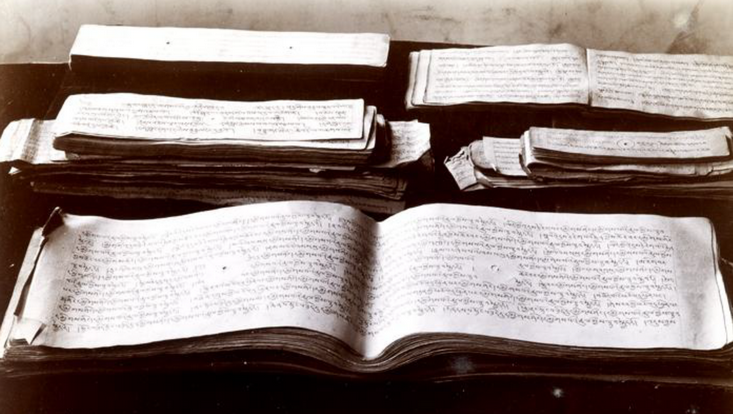
The primary reason is its degree of difficulty: to study Manipravalam, one must be proficient in both Tamil and Sanskrit, and possess a deep knowledge of the relevant religious contexts. Furthermore, much of the literature, especially non-Sri Vaishnava, has either not survived, remains in manuscript form, or has never been fully edited and translated.
Access to the living tradition is another challenge. Mastering Manipravalam often requires interaction with traditional scholars and oral communities who can provide interpretive context — something that is increasingly rare. Because of these hurdles, comprehensive scholarly translations and analyses are still scarce.
Coming back to Manipravalam itself, can you tell us more about how it was used, and by whom?
Several religious groups in the Tamil region made use of Manipravalam, each with distinctive approaches. The Sri Vaishnavas, for instance, used it in prose commentaries to interpret and transmit the deeper meanings of classic Tamil devotional poetry, often bringing in Sanskrit theological terms and concepts. Jains and Shaivas also made use of Manipravalam, occasionally even using it for composing poetry rather than prose, merely labelling their works as ‘Tamil’ even when they contained significant Sanskrit content.
The reasons for this hybridity partly reflect the competition and interaction among different sects vying for royal patronage and influence. Manipravalam allowed for sophisticated theological arguments while remaining accessible to Tamil-speaking audiences. It also served to connect communities and facilitate dialogue in a linguistically diverse region.

Is Manipravalam still used or taught today in any form?
While the classical, medieval form of Manipravalam isn’t used in everyday life, its legacy persists. Many Sanskrit words and constructions have been absorbed into modern Tamil, often unconsciously. Within the Sri Vaishnava tradition, Manipravalam remains the principal language for religious commentaries and instruction, especially for transmitting theological material. Of course, it has evolved over centuries, but the fundamental blending remains. Teaching and oral recitation in Manipravalam continue, mostly within specialised religious settings.
Now you are about to embark on a five-year research project devoted to this language. What are the main goals you will be pursuing?
Our project is multi-faceted. We’re working to collect and analyse Manipravalam texts across the Sri Vaishnava, Jain, and Shaiva traditions, including editing unpublished manuscripts and providing translations of a selection of texts that highlight both linguistic and theological features. We’re also building digital resources, such as searchable glossaries and electronic editions of the texts, which will facilitate future research.
A particularly interesting area of our study is how the usage of Manipravalam differs between traditions, and how shifts in theology or cultural context are reflected in linguistic choices. By combining philological methods with theological and historical analysis, we hope to gain a more nuanced understanding of cultural exchange in south India.
Given the expertise required, how do you approach building a research team for this specialised topic?
It certainly presents challenges! Mastering Manipravalam requires familiarity with both classical languages and their religious traditions, as well as the ability to work closely with living oral traditions. We’re lucky to have an international group of external collaborators, including experienced scholars from Hamburg and India, and specialists in Tamil, Sanskrit, and religious studies. Training young researchers, especially those who already have a grounding in Tamil and some exposure to Sanskrit, is a big priority. Collaboration with traditional teachers and knowledge holders is also essential, as their insights are often the key to unlocking the full meaning of the texts.