CSMC
CSMCCentre for the Study of Manuscript Cultures
Photo: UHH/Denstorf
2 December 2025

Photo: CSMC
A journey right into the heart of Mexico’s material writing culture: CSMC researchers Małgorzata Grzelec and Laura Gallardo Domínguez are back from a field trip during which they not only presented their recent work but also got to experience local papermaking and dye production traditions first-hand.
The application of synchrotron techniques yields great potential for the study of written heritage objects. Presentations at the inaugural Simposio de Ciencias del Patrimonio, a heritage science symposium held at the Universidad Nacional Autónoma de México (UNAM) in Mexico City, highlighted recent advances in this dynamic field. Małgorzata Grzelec and Laura Gallardo Domínguez presented synchrotron experiments that they conducted within their research projects on the ‘Measurements of Paper Components’ (RFA20) and ‘Multiscale Materials Characterisation as a Function of Processing Methods for Novel and Ancient Writing Surfaces’ (RFA18), respectively.
In her talk, ‘Analysing Historical Papers with Scanning Synchrotron X-ray Scattering Techniques’, Małgorzata showcased how X-ray scattering methods can reveal papermaking technologies, an approach she has been developing together with Agnieszka Helman-Ważny, Sylvio Haas, and Gangolf Ulbricht. Similarly, in ‘Análisis structural multiescala de manuscritos de hojas de palma usando rayos X de sincrotrón’ (‘Multiscale Structural Analysis of Palm-Leaf Manuscripts Using Synchrotron X-rays’), Laura discussed the use of these techniques to characterise plant materials employed as writing substrates in Southeast Asian palm-leaf manuscripts, a subject she explores in collaboration with Patrick Huber, Giovanni Ciotti, and Sylvio Haas.
Their fieldwork in Mexico brought them together with local scholars and scientists specialising in the history and technology of Mesoamerican papermaking, as well as historical dye and pigment production. Together with anthropologist Iván Pérez Téllez, the team visited several sites in Puebla and Hidalgo provinces, where the traditional craft of producing writing materials from amate fibres endures. Their main objective was to collect samples of indigenous tree species and handmade papers, investigating both those crafted by professional papermakers and by brujeros — ritual specialists who employ paper in ceremonial contexts such as Otomi paper cut-outs. The art of producing paper cut-outs is part of witchcraft practices focused on healing and cleansing, and sometimes curse-casting, which are shared by different indigenous communities in the region. Using certain plant species to produce amate in different colours is crucial for the correct symbolic representation of entities referred to during rituals. In this context, the trees used to produce amate are considered to have a spiritual and magical status.

Photo: CSMC
Laura Gallardo Dominguez, Malgorzata Grzelec, and Marie van der Meeren at the laboratories of the Instituto Nacional de Antropología e Historia.

Photo: CSMC
Fausto Santos collecting bark from the Jonote Colorado tree species. Photo: Ivan Perez Tellez
Photo: CSMC
Don Alfonso Garcia Tellez recounts the history of the first manuscripts he produced, recorded by Ivan Perez Tellez and Malgorzata Grzelec. Photo: Laura Gallardo Dominguez.

Photo: CSMC
Don Alfonso Garcia Tellez explains the meaning of an amate cut-out. Photo: Malgorzata Grzelec.

Photo: CSMC
Ritual paper cut-out by don Alfonso Garcia Tellez. Photo: Ivan Perez Tellez.

Photo: CSMC
One of the manuscripts the researchers obtained from don Alfonso Garcia Tellez. Photo: Malgorzata Grzelec.
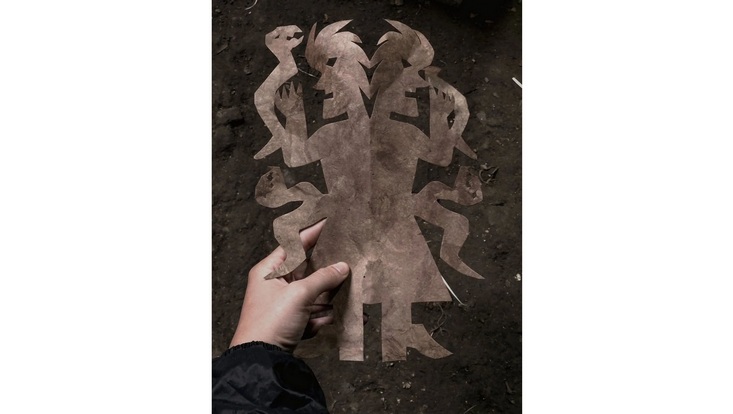
Photo: CSMC
Ritual paper cut-out by don Alfonso Garcia Tellez. Photo: Malgorzata Grzelec.
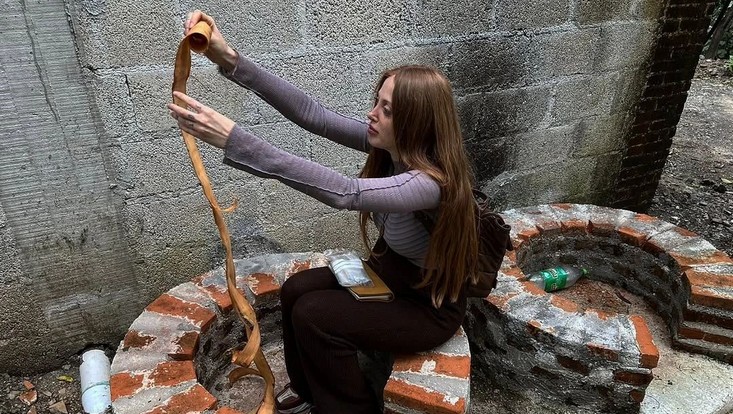
Photo: CSMC
Malgorzata Grzelec collects samples of bark from paper-making species in San Pablito. Photo: Laura Gallardo Dominguez.

Photo: CSMC
One of the paper cut-outs dressed in ritual attire on an altar in the household of don Alfonso Garcia Tellez. Photo: Laura Gallardo Dominguez.

Photo: CSMC
A selection of dye plants and additives in the workshop of Mariano Sosa Martinez, Teotitlan del Valle. Photo: Laura Gallardo Dominguez.
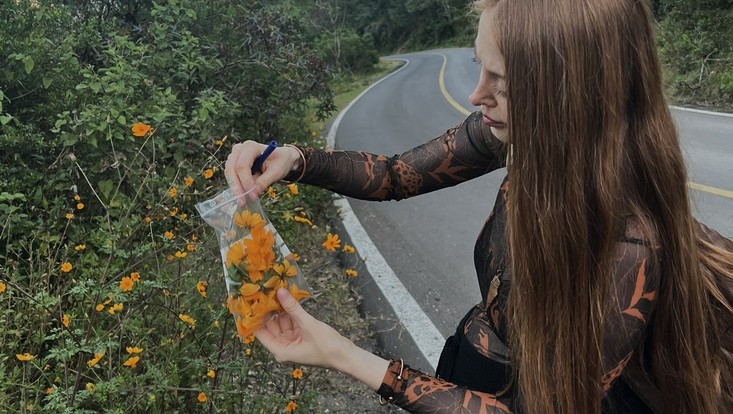
Photo: CSMC
Malgorzata Grzelec collecting flowers of the endemic xochipalli plant, used as a dye since pre-colonial times. Photo: Laura Gallardo Dominguez.

Photo: CSMC
Laura Gallardo Dominguez and Malgorzata Grzelec with the Sosa family at the Bii Dauu dye production workshop.
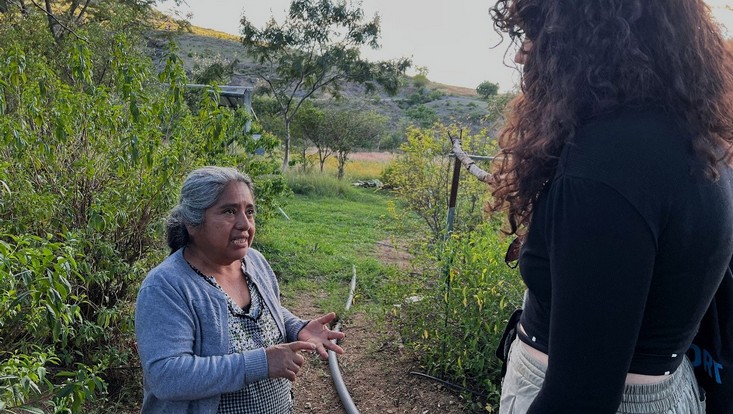
Photo: CSMC
Laura Gallardo Dominguez is learning about the cultivation and reintroduction of dye plants from the Bii Dauu community. Photo: Malgorzata Grzelec.

Photo: CSMC
Laura Gallardo Dominguez during maintenance work in the field cultivating opuntia cacti for cochineal production. Photo: Malgorzata Grzelec.

Photo: CSMC
Samples collected during fieldwork in Mexico mounted on beamline P62 in preparation for synchrotron measurements. Photo: Ivan Shevchuk.
One of these brujeros is don Alfonso Margarita García Téllez, a recognised maker of ritual manuscripts. Since the 1960s, he has created handmade books to communicate Otomi ritual knowledge to anthropologists — volumes now housed in collections ranging from the Metropolitan Museum of Art to the British Museum and the Bodleian Library. These manuscripts, often seen as a bridge between orality and writing, provide rare insight into the transmission of knowledge through ritual cutouts, information otherwise retained solely in spoken tradition. During their research, the CSMC team acquired several manuscripts from don Alfonso, one of which will be donated to the CSMC library.
The materials and processes documented during the fieldwork will be compared to other ethnographic paper samples, some generously provided by Marie van der Meeren, head conservator at the Instituto Nacional de Antropología e Historia, along with historical specimens from German institutions. This growing collection of plant components, processed fibres, and historical papers will support an evolving database mapping the species used in Mexican papermaking across both recent decades and earlier centuries. The unique cultural landscape of colonial Mexico, the influence of European papermaking, the effects of 20th-century deforestation due to bark overharvesting, and the subsequent introduction of new papermaking plant species have all contributed to shifts in local traditions. These complexities complicate attempts to reconstruct the historical development of Mexican papermaking. The plant samples collected in the field have undergone preliminary identification by UNAM botanist Alejandra Quintanar, and the materials have already been analysed using synchrotron techniques during experiments at DESY in November 2025. Going forward, the synchrotron methods refined in this project will deepen our understanding of Mesoamerican papermaking history.
Małgorzata and Laura, with the support of anthropologist Marta Turok, also collected dye plants, dye additives, and dyed fibres — primarily in Oaxaca province. Many of these species and materials are referenced in pre-colonial and colonial manuscripts, such as cochineal insects, the tree vine zacatlaxcalli, and various mosses and lichens. Thanks to the hospitality of, among others, the Zapotec Bii Dauu community of dyers in Teotitlán del Valle, the researchers documented dye production methods and visited gardens, jointly established by the community and botanists from Universidad Autónoma Chapingo, where native Mexican dye plants are cultivated.
Overall, the field trip yielded over 100 samples of plants, paper, and dyes. These will enrich a database underpinning both synchrotron experiments and other analytical techniques used in the CSMC Artefact Lab, thereby advancing the study of materials in written heritage.