CSMC
CSMCCentre for the Study of Manuscript Cultures
Photo: UHH/Denstorf
12 December 2025
In the historiography of the Silk Road, Central Asian peoples such as the Uyghurs have so far played only a minor role. Wrongly so, argues historian Márton Vér. In his ERC project, he challenges Eurocentric and Sinocentric perspectives and turns the history of the complex supra-network on its head.
Márton Vér, the notion of the ‘Silk Road’ is widely being used today, both in academic and public discourse. What do historians actually mean by it?
The Silk Road was the longest-lasting and most extensive Eurasian supra-network of interregional exchange. The term was popularised in the 19th century by the geographer Ferdinand von Richthofen, who was mapping potential economic opportunities in China. It was quickly adopted in both European and later Chinese political and cultural discourses. However, scholars have long pointed out the limitations of this notion: The image of the Silk Road as a single grand route stretching from China to the Mediterranean, united by the trade in silk and other luxury goods, is largely a myth. There was never just one Silk Road, nor was silk the most important commodity.
How did this myth become so firmly established?
Much of what is commonly assumed about the Silk Road comes from external narrative sources. By that I mean sources created far from the central regions of the Silk Road – often in Chinese, Middle Eastern, or European centres of power, thousands of kilometres away. These texts provide sweeping narratives that make them easily accessible, which is why they became a favoured foundation for historians. Problematically, however, these accounts distort how exchanges truly functioned on the ground.
For example, there is a prevalent story of how papermaking was supposedly transferred in a single dramatic event, according to which captured Chinese papermakers taught their Arab captors after the battle of Talas in 751. This is hardly plausible: A good deal of the famous Sogdian documents that were found at Mount Mugh in modern Tajikistan are dated to the first decades of the 8th century, and many of them were written on paper. Moreover, as Agnieszka Helman-Ważny has shown, the spread of papermaking along the Silk Road was accompanied by technological innovations, and local raw materials were used. Apparently, the spread of this highly important technology, which had an enormous effect on global history, happened more gradually and reached western Central Asia decades before the Battle of Talas. Still, stories like this one tend to be repeated even among historians.
Mongol rule in China produced changes of world‑historical importance, and the Uyghurs played a key role in this thanks to their linguistic abilities.
Does this make the notion of the Silk Road unsuitable for historical analysis?
No, but we need to shift our perspective. Instead of exclusively relying on external narrative sources, I suggest that we pay much closer attention to internal documentary sources: documents that were produced inside the communities that belonged to the Silk Road such as contracts, private letters, administrative documents, and similar everyday writings found in places like the Turfan region of modern Xinjiang. These sources are more difficult to assess: They are written in numerous languages, many of which hadn’t even been deciphered until the 20th century; and instead of giving us coherent narratives, they are fragmented and often deal with the mundane details of everyday transactions within small communities.
These internal sources, I argue, can serve as the foundation of a bottom-up history of the Silk Road. They are particularly suited to do micro-historical analyses, providing insights into the lives of individuals and small communities, as well as offering perspectives on the experiences of non-elites. This is the direction I want to take in ‘ReCent’, my ERC project on ‘Re-centring Central Asia: A Global Microhistory of the Silk Road between the 9th and 15th Centuries’.
One key group you focus on in this project is the Uyghur people. Why are they so important?
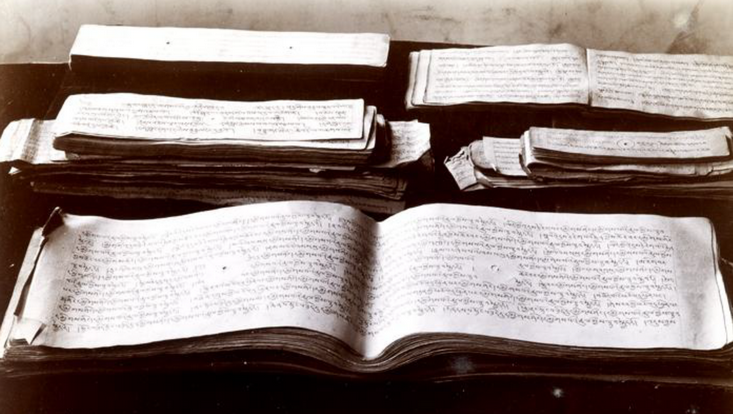
The Uyghurs occupy a unique place in the history of the Silk Road. They produced a substantial quantity of written material, much of which has survived thanks to the dry desert climate. Today, around 15,000 Uyghur fragments are in existence, including approximately 1,500 non-religious documents, which formed the focus of my previous work at the CSMC.
The Turfan region, located between the Taklamakan Desert and the eastern Tianshan Mountains in present-day Xinjiang Uyghur Autonomous Region in the PRC, was highly multilingual and multicultural. The Uyghurs were central facilitators of cross-cultural interactions in this area after the mid-9th century. After their ruler voluntarily submitted to Chinggis Khan in 1209, their influence expanded further, making them primary agents of knowledge transfer regarding the governance of sedentary people under Mongol rule. Through their influence on the Mongol Empire, their administrative traditions influenced early modern states from China to Eastern Europe. Nevertheless, their role, like that of other Central Asian peoples, has often been overlooked.

Could you give an example for the Uyghurs’ role as mediators?
One example that illustrates how ReCent will operate is the way the Uyghurs navigated the multilingual world of the Silk Road. The Turfan Collection in Berlin contains written artefacts in more than 20 languages and scripts, making it unique among pre-modern multilingual archives. While not all of these are connected to the Uyghurs, their documents provide insight into their interactions with various languages and scripts, including Sogdian, Tocharian, Tibetan, Mongolian, Sanskrit, and Chinese. During the Mongol Empire in the 13th and 14th centuries, their command of Chinese acquired particular global significance. Mongol rule in China produced changes of world‑historical importance, and the Uyghurs played a key role in this thanks to their linguistic abilities.
Historians have long recognised the Uyghurs’ remarkable proficiency in Chinese, yet they have paid little attention to how this linguistic competence was acquired. In recent decades, however, the work of several outstanding philologists has brought to light numerous Uyghur and Uyghur‑Chinese textual fragments that illuminate various facets of Uyghur engagement with the Chinese language. Despite these advances, we still lack a comprehensive, systematic historical analysis of these materials, including a reconstruction of the curriculum and an examination of the broader social and cultural contexts of language acquisition. By conducting such a micro-historical investigation, we can deepen our understanding of a pivotal moment in global history. This case illustrates how microhistory can shed light on macro‑historical developments; specifically, the emergence of highly multilingual, professionally skilled Uyghur administrators who helped govern the Mongol Yuan dynasty.
You now have five years to put your research ideas into reality. What are the main goals you would like to have achieved by the end of this period?
There are three main objectives. First, we want to uncover the real mechanisms of knowledge transfer as well as material and cultural exchange by studying documentary evidence from within Silk Road societies. Instead of simply knowing the ‘inputs and outputs’ of cultural contact, we want to highlight the many small, practical steps by which technologies and ideas moved.
We also hope to revise the standard chronologies and models for the Silk Road. For example, it is often assumed that these networks functioned only when large empires brought stability and collapsed when political fragmentation occurred. Our documents suggest that even in periods of division, local and regional connections often continued quite robustly. Moreover, various innovations took place during these politically fragmented periods that were later spread across Eurasia during periods of political unity.
Finally, we want to take a closer look at the Uyghur diaspora networks. From the 13th century onwards, these networks stretched from southern China to western Asia. No one has yet studied these networks as a whole in relation to their own documents, as well as Chinese, Arabic, and Persian sources.