
Writing in Colours
Project Group 2
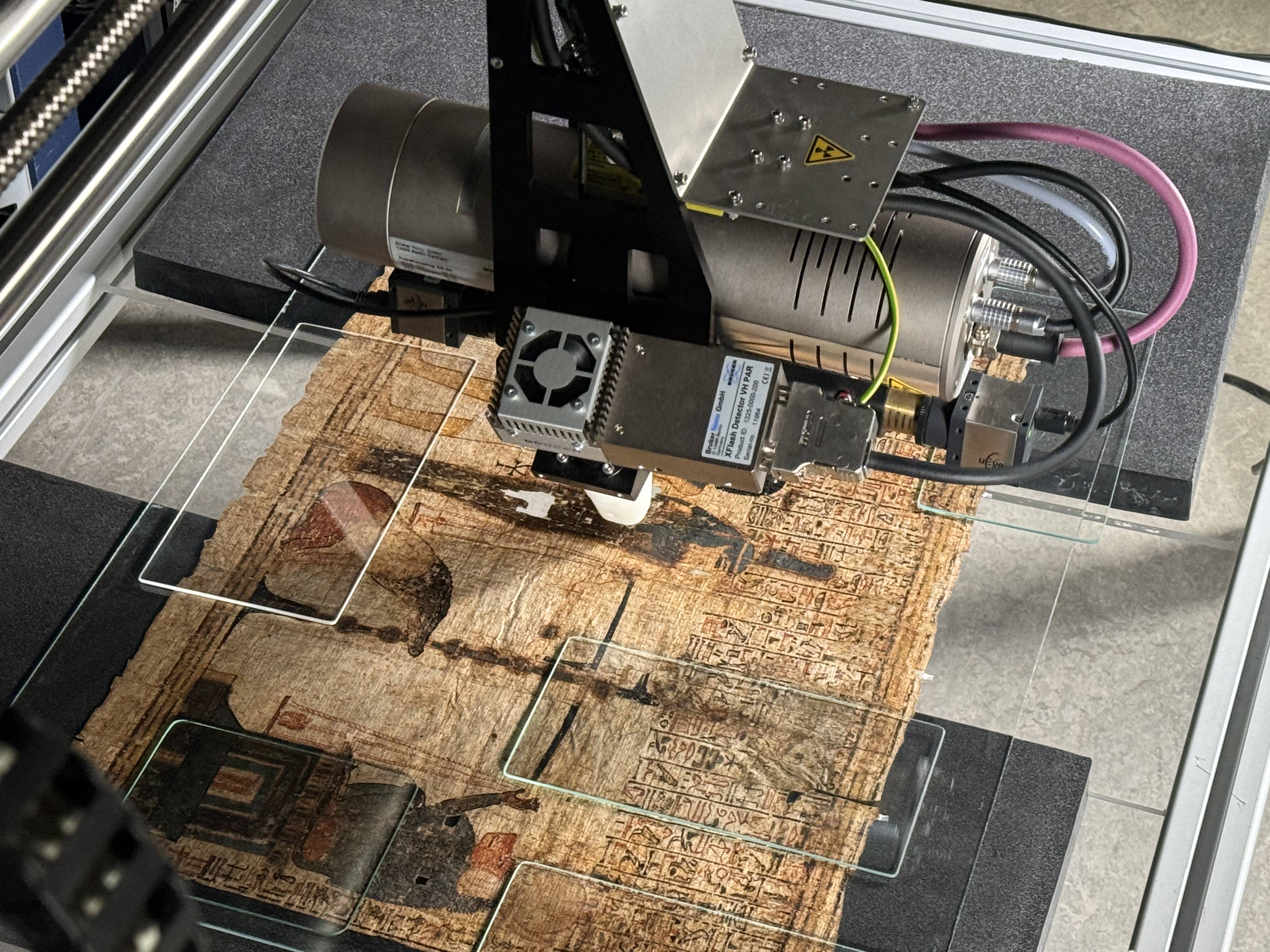
The Project Group Writing in Colours explores the significant role of colours in the production of written artefacts and their influence on how ancient societies perceived these sources /engaged or interacted with them. The group's primary focus lies on the ancient Egyptian, Greco-Roman, and Near Eastern cultures between the Bronze Age and the Early Middle Ages. The goal is to investigate how colours created visual and spatial hierarchies, emphasised concepts, and conveyed values across diverse cultural settings. The participation of specialists in Western Medieval studies, African studies, and Arabic studies opens further possibilities for systematic comparisons with other traditions, broadening the project's cross-cultural reach.
At the heart of the project lies a systematically compiled corpus of coloured written artefacts, representative of diverse spatial and social contexts, time periods, and manufacturing methods. The corpus encompasses manuscripts — including cuneiform tablets, scrolls, and codices — as well as epigraphic sources such as stelae, monumental inscriptions, tapestries and ephemeral writings. Through this material, the group examines the contextual choices behind the use of colour in diverse environments ranging from religious and public spaces to domestic settings, tracing how colours shaped the reception of written artefacts/sources and the environments in which they appeared.
The PG adopts a genuinely transdisciplinary approach, in which historical, philological, and material questions are addressed through an integrated set of methods drawn from both the humanities and the natural sciences. This combination allows the group to establish detailed material profiles — the chemical and physical fingerprints — of colouring agents and their supports, including rock, wood, papyrus, clay, textile, parchment, and composite materials. Collaborations with local, European, and extra-European institutions have been established to assemble a geographically and chronologically wide-ranging collection of samples, drawing on museum collections and ongoing archaeological fieldwork in Miletus (Turkey) and Oxyrhynchus (Egypt).
Experimental archaeology plays an essential role in the project's methodology. Ancient recipes for pigments and dyes are replicated and tested on various supports, shedding light on the pre- and post-production history of colours — from the trade of raw materials and selection practices to alteration processes over time. The results are compared with reference datasets using chemometric methods, including principal component analysis and machine learning, enabling the identification of shared technological approaches across different ancient societies and tracing knowledge transmission across space and time.
Alongside this material focus, the project examines how coloured written artefacts were perceived and interpreted by different audiences in distinct functional and spatial contexts. Historical visual studies, combined with close attention to archaeological contexts, inform this dimension of the research, which considers how specific colour choices communicated particular messages and helped to organise monumental and everyday spaces alike.
The dissemination of results targets both the international academic community and a broader audience. Key outputs include a public exhibition, accompanied by a scholarly catalogue presenting the methodological approach and a selection of case studies. A second major output is an open-access database, developed in cooperation with the UWA Data Linking Lab and the Centre for Sustainable Research Data Management, which brings together data on the contexts of discovery, material composition, production processes, and settings of use of coloured written artefacts. Incorporating a Geographic Information System (GIS), the database maps the origins of artefacts and their raw materials, and is designed to link with existing pigment and dye databases to serve the wider research community. Research data are stored in the Research Data Repository of the University of Hamburg and are freely accessible.