
Traces of Polycentric Archival Practices in the Ḥaram al-Sharīf Corpus
2023–2025
RFE17
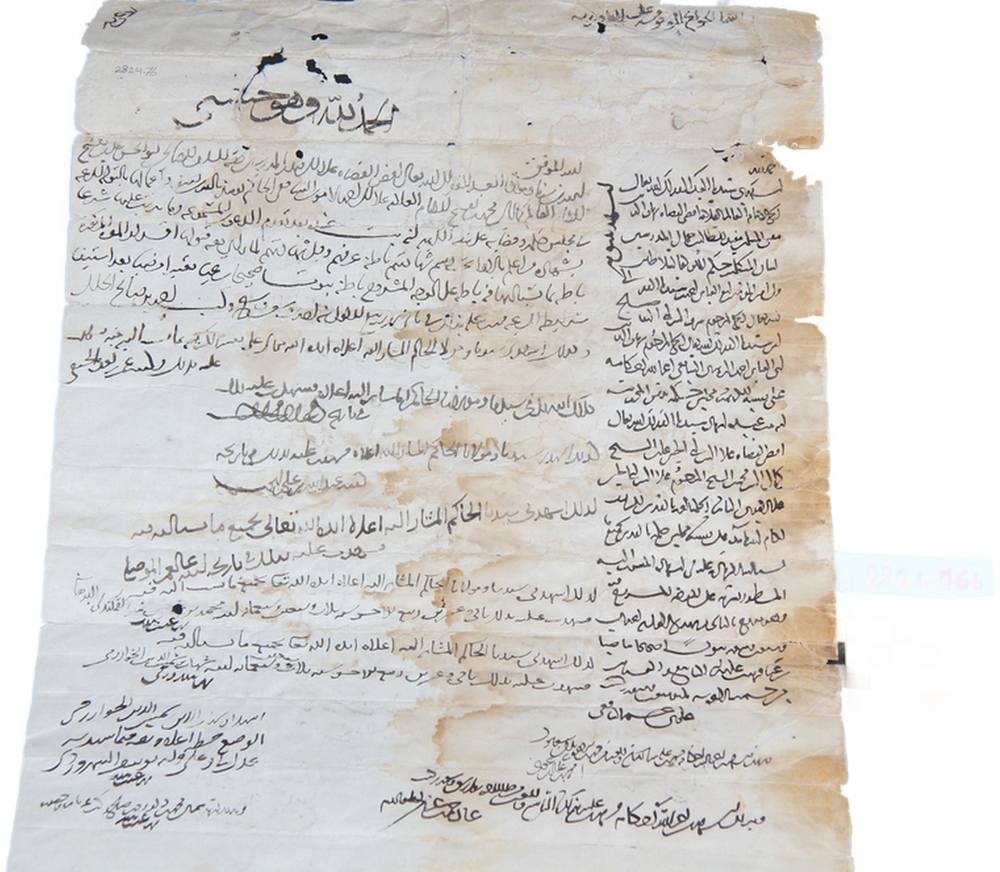
Project RFE17 investigated traces of archival practice in the Ḥaram al Sharīf corpus, a collection of almost one thousand handwritten documents, primarily Arabic-language records from late fourteenth-century Jerusalem, now preserved in the Islamic Museum. The documents, mostly legal and administrative, form one of the largest known collections of legal records from pre-Ottoman Jerusalem. Rather than the remnants of a single archive, the corpus consists of several subcorpora that once belonged to different archival sites across the city and were only later brought together. The project therefore seeks to understand how these records were originally archived, by whom, and for how long they were intended to be preserved.
At its core, the project explored three sequential questions and stages of research: (1) Building a database: which material and textual traces of archival practice can be identified and recorded across all Arabic documentary subcorpora of the Ḥaram corpus, and how these traces indicate whether a document was deliberately archived in fourteenth-century Jerusalem. (2) Hunting for clusters: which document clusters, understood as groups of documents that were once archived together, can be identified at the intersections of multiple material and textual traces of archival practice, and what logics of archiving these clusters allow us to reconstruct. (3) Contextualising shared patterns: what these clusters can reveal about the administrative and social processes that triggered or necessitated their preservation, and how strategic preservation across a wider network of archival sites and actors relates to local and transregional structures of administrative authority.
A key outcome of the first phase of research is the characterisation of archival notes. They summarised, classified, and enabled the retrieval of preserved records, functioning as visual signposts that remained visible even when documents were folded or bound. The archival notes can be grouped into several systems on the basis of their structure and wording, each with its own internal logic of classification. Their formulae show both continuity and innovation across the century, and their placement corresponded directly to the ways in which documents were physically handled for storage, whether folded into a booklet, positioned on the outside of a scroll, or assembled into a pierced and strung bundle. Identifying about 190 such notes allowed the project to define them as one of the most significant documentary traces of archival practice in the corpus.
Analysing both material and textual traces made it possible to determine whether a document had been deliberately archived, forming the basis for identifying clusters of documents that had once been stored together. Cluster building drew on several kinds of evidence, combined with the contents of the artefacts. Two strands were especially useful: a shared language of archival practice, visible in recurring combinations of material and textual traces, and the analysis of archival temporality, distinguishing short-, medium-, and long-term preservation horizons. Together with contextual and codicological observations, these approaches revealed the polycentric nature of archiving, with document preservation distributed across numerous actors and locations. The resulting clusters could be linked to a wide array of archival actors and sites, ranging from the personal archive of a formerly enslaved woman sewing together her marriage and divorce related records, to the household of the governor keeping track of taxes to be collected, and to the organisational archives of endowments in Jerusalem.
From there, broader patterns became visible. Studying by whom, how, and for how long documents were preserved made it possible to reconstruct the administrative and social processes that triggered archiving. Building on the polycentric landscape of archival sites and actors, the project mapped the main domains of archiving represented in the Ḥaram corpus: households, estate administrations, and endowment administrations, each with its own rhythm and material logic. This progression, from individual traces to clusters and then to broader domains of document preservation, helps illuminate how everyday governance in fourteenth-century Jerusalem and its surrounding villages was organised, as the archival practices documented in the corpus render the workings and shifting responsibilities of local authorities more clearly legible.
People
Project lead: Anna Steffen