CSMC
CSMCCentre for the Study of Manuscript Cultures
Photo: UHH/Denstorf
16 December 2025
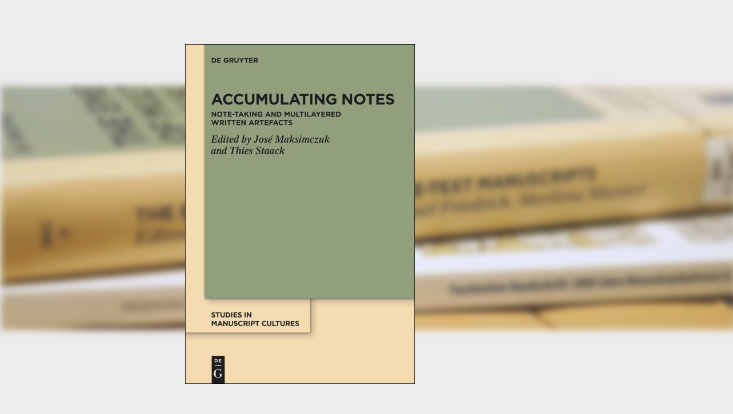
Photo: De Gruyter
Everyday writings, often following no fixed plan, are likely to account for the majority of all handwritten production in human history. The new volume of ‘Studies in Manuscript Cultures’ explores how the practice of taking notes shapes written artefacts and vice versa.
Notebooks were constant companions in Rainer Maria Rilke’s daily life. He guarded them like treasures and occasionally showed them to friends. The French writer André Gide later reported, with some astonishment, on such an exclusive glimpse he had been allowed into one of the famous poet’s notebooks. He claimed not to have seen a single correction in it. Instead, he saw complete poems, seemingly written down in perfect form on a bench in the Jardin du Luxembourg.
Anna Kinder and Sandra Richter recount this episode in their contribution to Accumulating Notes: Note-taking and Multilayered Written Artefacts, the latest volume in the series Studies in Manuscript Cultures. They also point out that the episode may reveal more about the public image Rilke sought to cultivate than about the actual appearance of many of his his notebooks. These notebooks were incorporated into the collection of the German Literature Archive around three years ago, in what was described at the time as one of the most important acquisitions of the post-war era. Research into this material, in which computer scientists from the CSMC are also involved, is still at an early stage. Yet one thing can already be said with certainty about Rilke’s notes: they were enormously complex and, not least visually, of a multilayered nature challenging for any reader. Poems written out neatly at the first attempt, like those Rilke showed Gide, are the great exception. Instead, one finds preliminary drafts of prose, poems, and letters, diary entries, everyday reminders, and drawings – written not only in different colours but also in different directions and languages, which sometimes alternate within a single sentence. Particularly striking are the dried plants Rilke placed between the pages, presumably to mark passages of special importance to him.
Rilke’s way of taking notes illustrates especially clearly the remarkable versatility and adaptability of this unregulated everyday writing practice. According to José Maksimczuk and Thies Staack, the two editors of the volume, the majority of all handwritten production can be traced back to this practice, both historically and even more so in the digital present. This is reason enough to place it at the centre of a comparative study drawing on examples from the Middle Ages to the 20th century and from a wide range of writing cultures. The contributors adopt a stratigraphic approach: the written artefacts analysed here are understood as ‘evolving entities’. Until now, this approach has mainly been applied to written artefacts that were conceived from the outset as developmental projects. In the new SMC volume, it is extended to artefacts whose creation followed no predefined plan or did not proceed in an orderly fashion. By focusing on the diverse forms of notes as material tools for visualising, organising, and transmitting knowledge, the volume sheds light on how note-taking and knowledge organisation practices shape written artefacts and, conversely, how these artefacts influence those practices.
The impetus for this volume was the conference ‘Accumulating Notes: Notebooks, Diaries and Related Examples of Everyday Writing as Multilayered Written Artefacts’, held on 1 and 2 December 2023 at the CSMC. It is the result of close collaboration between two research fields at the CSMC: ‘(Re-)Shaping Written Artefacts’ (Research Field D) and ‘Keeping Note(book)s’ (Research Field G). As always, it has been published by De Gruyter and, like most volumes in the series, can be downloaded free of charge from the publisher’s website.