CSMC
CSMCCentre for the Study of Manuscript Cultures
Photo: UHH/Denstorf
3 March 2026
Researchers from the Ajami Lab have continued their work on the Jos Museum manuscript collection deposited at the Kaduna Museum in Nigeria. This February, they established cataloguing and research procedures for identifying Ajami, and reviewed conservation principles relevant to the entire collection.
Following their initial fieldwork in Kaduna in November 2025, Dmitry Bondarev and Maria Luisa Russo from the Ajami Lab, together with their Nigerian colleagues, focused on two main tasks during the current trip.
The first was to establish a set of cataloguing and research procedures for identifying Ajami, that is African languages written in Arabic script. Ajami content appears in various visual configurations that interact differently with Arabic. Sometimes Ajami is used as a translation of Arabic, and sometimes it is used independently. Each configuration offers different research opportunities. For example, the independent use of Ajami is an important source for studying the development of regional didactic and devotional poetry, while Ajami translations provide insights into the linguistic history of African languages. It is therefore important to catalogue Ajami manuscripts according to their distinct types. However, categorising Ajami into types is not always straightforward. The discussions in Kaduna focused on complex cases within ‘miscellanea’ sets of manuscripts, which often contain a mixture of different Ajami types.
The second component of the work in Kaduna was to review principles of conservation and the management of manuscript in the collection. This work forms part of our broader engagement in cultural heritage preservation. Together with their colleagues in Nigeria, the Ajami Lab is now in the final stages of establishing a project for the preservation and digitisation of the entire Jos Museum collection.
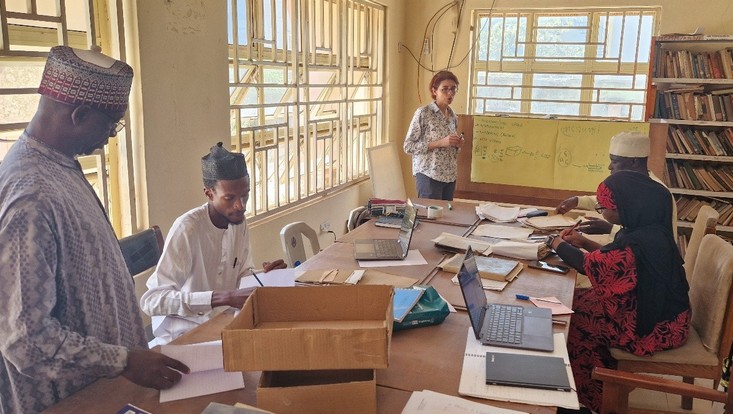
Photo: CSMC
Workshop on conservation procedures with Maria Luisa Russo.
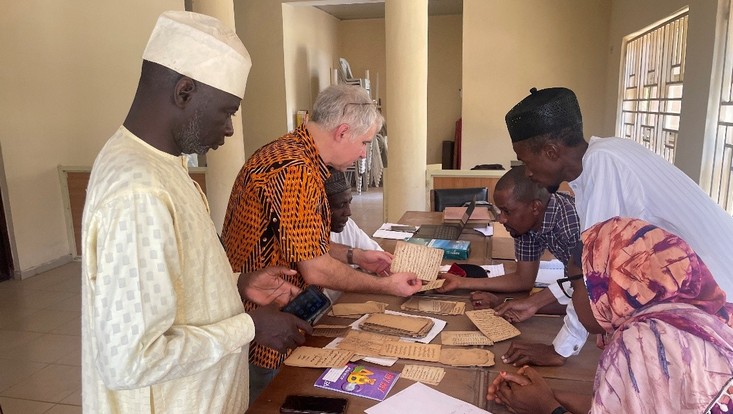
Photo: CSMC
Miscellanea manuscripts pose a challenge for the group of researchers.
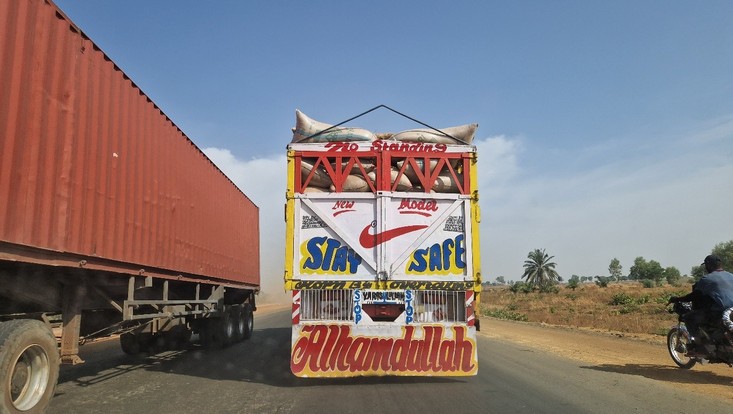
Photo: CSMC
On the road from Abuja to Kaduna.

Photo: CSMC
Dmitry Bondarev from the Ajami Lab and members of the Kaduna team discussing the typology of Ajami manuscripts.