CSMC
CSMCCentre for the Study of Manuscript Cultures
Photo: UHH/Denstorf
24 April 2026
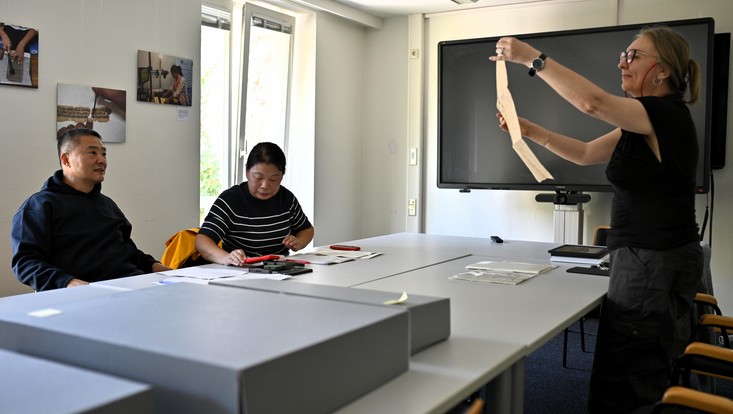
On 23 April, the CSMC once again took part in Germany’s Girls’ Day and Boys’ Day. The aim of the two action days is to give school students an insight into professions and fields of work they may not usually encounter in their everyday environment.

The programme offered at the CSMC revolved around exploring manuscripts, writing systems, inks, images, and the many methods used to study them.
The girls began by designing their own research projects. They learned how ideas evolve into structured projects, developing questions about writing and objects, and discussing methods, disciplines, and collaboration among experts. Next came a showcase of the CSMC’s collection: friendship albums and cookbooks from centuries past, religious manuscripts like the Quran, Chinese calligraphy, and Indonesian texts with secret knowledge. Participants handled these artefacts, leafed through them, and asked questions to grasp their enduring relevance.
Interdisciplinary work followed with informatics and art history. The group discovered the role of computer scientists at the CSMC, tested chatbots like ChatGPT and Perplexity to assess their strengths and limits, explored binary number storage, and compared AI outputs with an art historian to see how such tools aid research. The day culminated in Egyptology and archaeometry and a journey into ancient Egyptian papyrus craft. Participants ground pigments (black, red, yellow, white, Egyptian blue), mixed them with gum arabic and water into paints, mastered reed brush techniques, layered colours, and copied magical spells onto papyrus, complete with their names in hieroglyphs from sample manuscripts.
The boys first delved into academic libraries. They traced libraries’ history from antiquity and the Middle Ages to today and across continents, prompting hands-on exploration via a catalogue rally. They tackled questions like ‘Do we still need libraries?’ and examined librarians’ roles. This was followed by a session on informatics and art history in which participants learned about binary storage, CSMC projects on medieval manuscripts, and chatbot applications. In practice, they tested and compared AI responses to understand digital methods in scholarship.
In a section on theatre studies, the participants were introduced to some little-known key characters: the books that actors use to prepare their roles. In particular, they got to work with digital copies of an actor’s book from the Hamburg Thalia Theater collection that is currently being researched at the CSMC. Finally, in the session on Assyriology, they discovered cuneiform, humanity’s oldest script, used over 5,000 years ago in the Ancient Near East to impress myths, epics, rituals, letters, and contracts into wet clay. A chronology game built a timeline of key events and finds. Here, the boys became scribes themselves, crafting cuneiform inscriptions with styluses and clay, just as 4,000 years ago.
As in previous years, the day provided a lively introduction to the CSMC’s work and to the many questions that surround written artefacts from different periods and regions. The event also reflected the CSMC’s broader commitment to working with children and schools, bringing manuscript research closer to young people in an accessible and engaging way.