
Painting the Ancient World
Crystallochemical Characterisation of Pigments and Minerals in Ancient Written Artefacts
2022–2025
RFA19
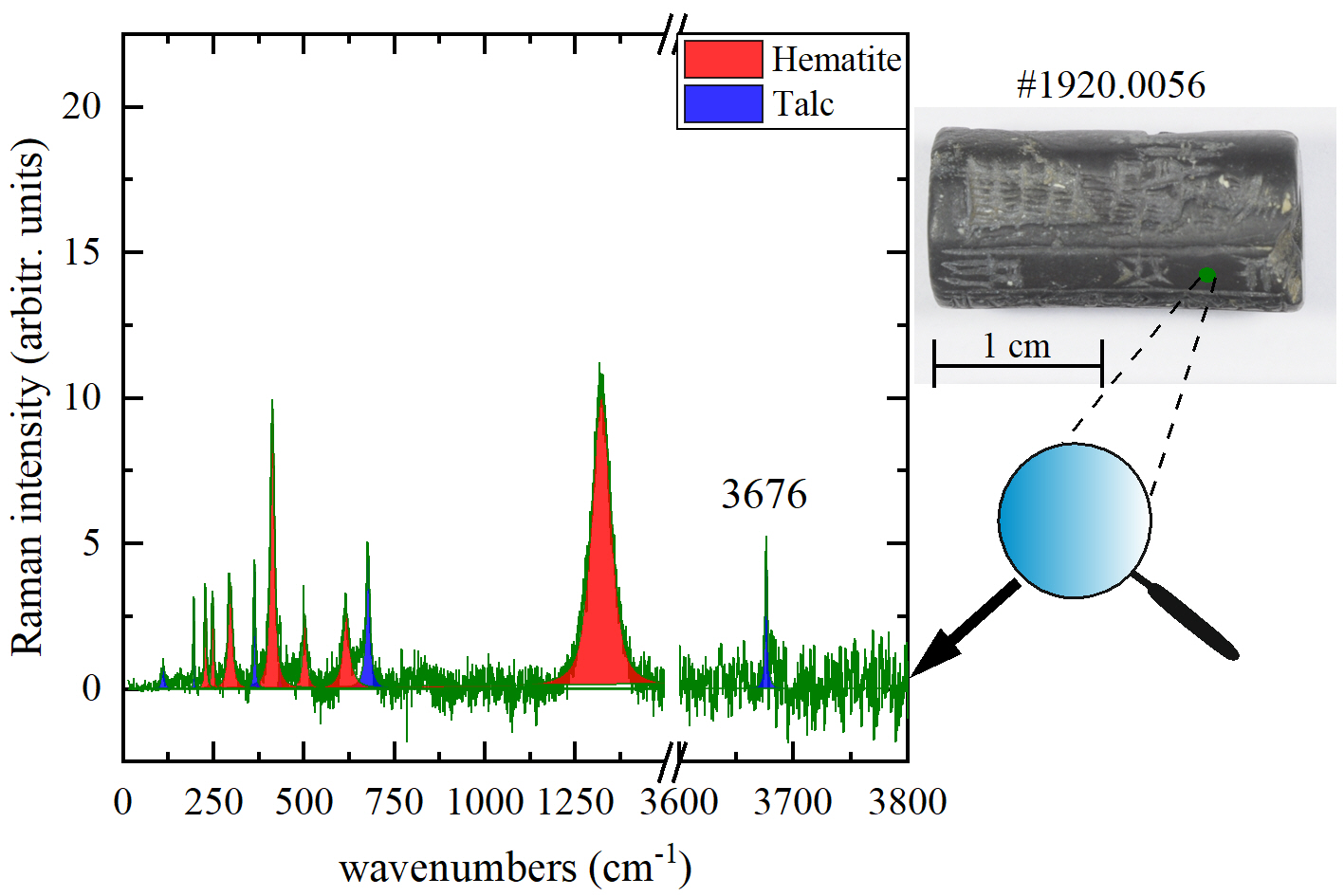
This research project has pursued a comprehensive and methodologically innovative approach to investigate the crystallochemical properties of mineral phases that constitute pigments and culturally significant artefacts. The primary objective has centred on employing non-destructive and non-invasive analytical techniques, focusing on Raman spectroscopy, to determine the chemical composition and structural characteristics of these mineral phases thereby preserving the integrity of invaluable cultural-heritage objects while extracting critical scientific information about their composition and production processes.
In particular, a series of 30 Mesopotamian cylinder seals, housed in the collection of Museum für Kunst und Gewerbe (MK&G, Hamburg, Germany), has been analysed by Raman spectroscopy and showed that the existing material characterization is mostly inconclusive and should be revised (Aspiotis et al., 2025). The resulting quantitative material profiles have demonstrated that combining classical art historical studies with Archaeology and Mineralogy of these remarkable artefacts which represent nearly three millennia of Mesopotamian material culture and artistic tradition and date between 3200 and 330 BCE, can promote provenance studies, reveal trade networks, and facilitate the identification of additional treatment during modern times. In addition, the non-destructive methodology employed in this research ensures that these irreplaceable objects remain unharmed while yielding this valuable information.
Further historically important artefacts, originating from the excavation site of the ancient city of Miletus (today’s Western Turkey) and representing the Hellenistic and Imperial period of Asia Minor have been systematically analysed by visible-near infrared reflectance (VIS-NIR) and diffuse reflectance Fourier-transform infrared spectroscopy (DRIFTS). This study had two primary goals; (i) to determine whether the pigment traces identified on the surface of Classical-Hellenistic marble statues and epigraphic stelae were also employed in the decoration of everyday objects, particularly the wall paintings found in St. Michael's Church (Miletus, Western Turkey), which span multiple historical periods; and second, to analyze the stratigraphic layers of the Byzantine-era fresco fragments from St. Michael's Church and characterize both their crystal structure and chemical composition. One particularly noteworthy discovery emerged from the detailed examination of a female marble statuette from the Classical-Hellenistic period, where spectroscopic analysis revealed that the red-coloured traces preserved on the neck and feet of the figure derive from distinctly different pigments, suggesting deliberate artistic choices or differential preservation patterns (Aspiotis et al.; submitted in Archäologischer Anzeiger).
The second major research component has included the comprehensive analysis of chlorite-group minerals belonging to the Museum of Nature Hamburg – Mineralogy collection. A series of chlorites was comprehensively studied by Raman scattering, electron-microprobe analysis, and, when necessary, Mössbauer spectroscopy, to correlate the Raman-spectral parameters with the mineral chemical composition (Aspiotis et al., in preparation). The applied methodological approach followed the previously established strategy for studying layered silicates, which commonly exist in various rock-based writing supports, including biotite (Aspiotis et al., 2022; EJM, 34, 573-590, https://doi.org/10.5194/ejm-34-573-2022), serpentine-group minerals, and talc (Aspiotis et al., 2023; JRS, 54, 1502-1516, https://doi.org/10.1002/jrs.6601). The achieved results, which are currently being summarized in a paper, are very promising to be further used in material profiling of Late-antiquity inscribed gemstones, ancient Babylonian cylinder seals, and clay tablets, where chlorite is a key mineral constituent.
Additionally, complementary Raman spectroscopic material analyses have been conducted on palm-leaf manuscripts from South and South-East Asia held in the CSMC collection, undertaken within the Palm Leaf Manuscript Profiling Initiative (PLMPI), successfully differentiating various carbon-based inks and determining the crystallinity grade and particle-size diameter of carbonaceous materials (poster contribution to RAA2023 conference). Material profiling studies of selected Egyptian and Egyptianizing scarabs and scaraboids from the MK&G collection by using Raman spectroscopy, X-ray fluorescence spectroscopy, and computed tomography scanning assisted to the determination of the mineral-phase composition, firing conditions, glazed surface chemistry and structure, as well as internal structural characteristics of these objects (Aspiotis et al.; to be submitted).
Ultimately, this research project recognizes that comprehensive knowledge of the chemical composition and structural characteristics of mineral groups present in cultural-heritage objects and pigment materials can significantly advance provenance studies and illuminate distinctive characteristics of ancient societies, their technological capabilities, and aesthetic preferences. These mineralogical and crystallochemical insights constitute essential factors for understanding coloured inscriptions, their rock-based writing supports, and the manufacturing origins and conservation histories of coloured artefacts.
People
Project lead: Stylianos Aspiotis