
Digital Lunch Seminar Series
Summer Semester 2026
UHH/Esfandiari
Convenor: Markus Fischer
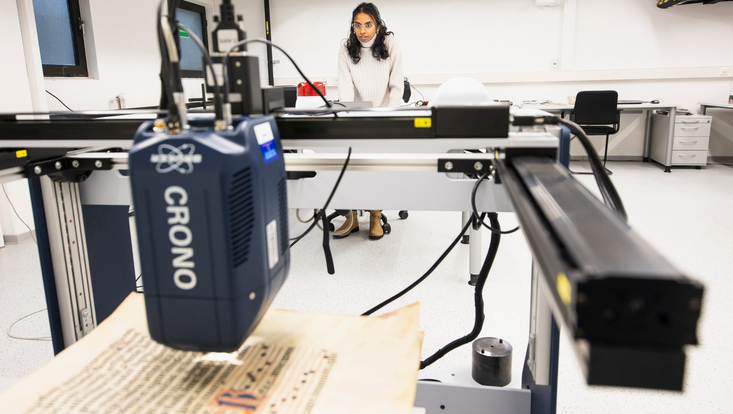
Bringing together the humanities, natural sciences, and computer science in the study of written artefacts is integral to the research programme of the CSMC. The Digital Lunch Seminar Series exemplifies how this crossdisciplinary collaboration works in practice, featuring compact one-hour online sessions, jointly presented by at least two researchers from complementary fields, such as philologists and material scientists, who have teamed up to address a specific research question on manuscripts or other written artefacts, like wood profiling, ink analysis, degradation prevention, or digital modelling. The lectures are open to everyone.
Schedule: Mondays, 12:00 pm – 1:00 pm
Overview
| Date | Titel | Speakers |
| 1 June 2026 | Evolution of Writing Systems: How the Material Choice and Phenomenology of Handwriting Shaped Southeast Asian Scripts |
Małgorzata Grzelec, Laura Gallardo, and Elisa Barney Smith Chair: Dewa Ayu Carma Citrawati |
| 15 June 2026 | Milk, Brain, Blood: Proteinaceous Substances of Animal Origin Used in Tibetan Manuscript Production. A Case Study of Khams Brygyd Volumes from the Oslo University Library Collection |
Agnieszka Helman-Ważny and Małgorzata Grzelec Chair: Laura Gallardo |
| 29 June 2026 | Computational Visual Cataloguing: A Case Study of Rilke’s Notebooks |
Sandra Richter and Hussein Mohammed Chair: José Maksimczuk |
| 6 July 2026 | Japanese Paper Clothing |
Eike Grossmann and Agnieszka Helman-Ważny Chair: Thies Staack |
Abstracts and Registration
Evolution of Writing Systems: How the Material Choice and Phenomenology of Handwriting Shaped Southeast Asian Scripts
- Date: on01.06.2026from12:00 PMuntil1:00 PM
Date
Event is over
Małgorzata Grzelec, Laura Gallardo, and Elisa Barney Smith
The graphical forms of handwriting are thought to develop under the influence of multiple factors, including the tools and materials used in their production. Certain Southeast Asian writing systems are believed to have evolved into more ‘rounded’ forms as a result of being incised on palm leaves, which were historically used in the region as a writing substrate. It is commonly argued that the morphology of the leaf surface facilitates inscribing of curved rather than straight lines, and that rounded incisions are less likely to compromise the mechanical integrity of the leaf.
The talk will summarize the current state of the interdisciplinary project aimed at testing these two hypotheses. We started by mathematically characterizing the shape of characters across different writing systems to evaluate whether palm-leaf scripts exhibit higher degrees of curvature. Simultaneously, in order to connect script geometry to the material support, confocal laser microscopy was performed at DESY to characterize the three-dimensional features of the incisions in selected manuscript folios, which revealed the relationship of line orientation and curvature to the depth of incisions. To further comprehend how the material support determines the features of the script, the engineers from DESY developed a mechanical setup to monitor writing forces needed to incise various shapes in the palm leaf substrate. Samples produced with this device will subsequently undergo mechanical testing and measurements at the synchrotron, to understand the impact of incision type on mechanical properties of the material. Results of the investigation are interpreted in cooperation with scholars researching South East Asian manuscript cultures and tied to the historical and geographical distribution of writing systems in the region.
Małgorzata Grzelec is a research associate at the Centre for the Study of Manuscript Cultures, where she is realizing her doctoral thesis in archaeometry within the project RFA20: Measurements of Paper Components, which focuses on characterization of historical papers with synchrotron radiation. She specializes in development of analytical methods for investigation of organic materials, such as fibers, paper, dyes or leather. Her primary focus is the materiality of written heritage of indigenous and ethnic minority groups.
Laura Gallardo is a research associate in the project RFA18 and writes her doctoral thesis at the Institute of Material and X-ray Physics from Hamburg Technical University (TUHH). Her work focuses on the application of synchrotron X-ray methods and complementary techniques to understand the materiality of palm leaf manuscripts, linking their physical properties to their manufacture and history.
Elisa Barney Smith is a professor at Luleå Technical University (LTU) since 2022. Before that, she spent 22 years on the faculty at Boise State University. Her research focuses on image processing and machine learning. She has applied her knowledge to solve problems in many fields such as document analysis, materials science, biomedical engineering, and groundwater remediation.
Milk, Brain, Blood: Proteinaceous Substances of Animal Origin Used in Tibetan Manuscript Production
- Date: on15.06.2026from12:00 PMuntil1:00 PM
Date
Event is over
Agnieszka Helman-Ważny and Małgorzata Grzelec
The process of religious manuscripts production in Tibet concerns various raw materials of local origin used in their production, primarily fibers from plants, such as Daphne and/or Stellera spp., alongside unique sizing and binding agents like animal glue, milk and wheat starch, or various tupes of ink based on carbon, gold, or even blood, reflecting regional availability and cultural practices for creating distinctive, high-quality deluxe manuscripts. Animal parts have been enumerated as one such important source of materials. This talk will present an overview of various animal-derived substances and recipes used in manuscript production; among others the use of animal glue as a binder, addition of bovine brain tissue to writing layers, instances of paper sizing with milk casein or alleged addition of animal blood to writing ink. The recent investigation of material composition of Khams Brygyd volumes from the Oslo University Library collection, will serve as a case study, and the various analytical methods essential to identify this type of challenging materials will be discussed.
Małgorzata Grzelec is a research associate at the Centre for the Study of Manuscript Cultures, where she is realizing her doctoral thesis in archaeometry within the project RFA20: Measurements of Paper Components, which focuses on characterization of historical papers with synchrotron radiation. She specializes in development of analytical methods for investigation of organic materials, such as fibers, paper, dyes or leather. Her primary focus is the materiality of written heritage of indigenous and ethnic minority groups.
Agnieszka Helman-Ważny (Ph.D. 2007) is a member of the Cluster of Excellence 'Understanding Written Artefacts' at the Centre for the Study of Manuscript Cultures at the University of Hamburg, and Professor of Book Studies at the University of Warsaw. Her publications include monographs and articles on the history of books and paper in Central Asia and the Himalayas, material culture of Tibet, codicology of Silk Road manuscripts and the history of Asian book collections, including The Archaeology of Tibetan Books (Brill, 2014), The Mustang Archives: Analysis of handwritten documents via the study of papermaking traditions in Nepal (Brepols, 2021, co-authored with Charles Ramble), and the latest volume of the ‘Studies in Manuscript Cultures’ book series providing the complete history of Tibetan Zhangzhung Nyengyü tsakali cards, unique ritual artefacts that remain little known outside specialist circles.
Computational Visual Cataloguing: A Case Study of Rilke’s Notebooks
- Date: on29.06.2026from12:00 PMuntil1:00 PM
Date
Event is over
Sandra Richter and Hussein Mohammed
This talk presents a case study on Rainer Maria Rilke’s notebooks. In this work, page-level and word-level attributes, such as orientation, colour and writing implement, are detected and linked to specific locations. This process yields “computational visual catalogues” that enable corpus-wide querying and materially attentive analysis. The approach demonstrates that even the text itself contains salient visual information beyond transcription, and that layout, spatial relations and features of the writing support can be modelled at scale. Brief reference will be made to an accompanying interactive explorer that overlays predictions on images to ensure transparency of inference, while the emphasis remains on the underlying scientific methods. Overall, computer vision is positioned as a means to analyse visual structure in manuscript images, not merely a conduit to textual surrogates. As such, the preparation of edited texts can be informed by page-anchored evidence detected automatically, including layout, spatial relations, script variation and material features, that standard transcription does not capture.
Sandra Richter has been Reader in German at King's College London in 2006, Professor of German at King's College London in 2006 and 2007, professor of Modern German Literature at the University of Stuttgart from 2008 to 2025, director of the German Literature Archive in Marbach since 2019 and, since October 2025, professor of German literature at the University of Hamburg. Visiting professorships have taken her to London, Cambridge, Paris, Philadelphia and Beijing. Her publications include Eine Weltgeschichte der deutschsprachigen Literatur (2017) and the biography Rainer Maria Rilke oder Das offene Leben (2025) as well as, in collaboration with co-authors, Rilke zeichnet (2025) and Rilke als Gärtner (2025).
Hussein Mohammed is the head of the Visual Manuscript Analysis (VMA) Lab at the Centre for the Study of Manuscript Cultures (CSMC), Universität Hamburg. Since 2019, he has been a Principal Investigator within the Cluster of Excellence “Understanding Written Artefacts” at CSMC. His research covers computer vision approaches to manuscript studies, including handwriting style analysis, visual navigation and computational restoration. In UWA II, he will be Principal Investigator for several projects, focusing on the visual navigation of digitised manuscripts.
Japanese Paper Clothing
- Date: on06.07.2026from12:00 PMuntil1:00 PM
Date
Event is over
Eike Grossmann and Agnieszka Helman-Ważny
Japanese washi—a paper celebrated for its unmatched strength, durability, and versatility—transcends its conventional role as a writing surface. Far more than writing surface, washi has been ingeniously adapted into sliding doors (shōji), umbrellas, lampshades, toys, and even clothing, blending aesthetic elegance with remarkable functionality.
In our talk, we turn the spotlight on washi’s most unexpected application: the crafting of garments. While paper may seem an unlikely material for clothing, Japanese artisans have perfected techniques to transform it into wearable art—lightweight yet resilient, insulating against cold, and even water-repellent. But the story doesn’t end there. These paper garments often evolve into written artifacts, layered with ritual symbolism, history, and multiple meanings—some of which we’ll explore through visual examples. We will discuss how washi bridges traditional craftsmanship, innovative technology, and cultural expression, proving that paper can be far more than meets the eye when explored by scientific methods.
Eike Grossmann is professor of Japanese Cultural History and Theatre at Universität Hamburg. Her research areas include Japanese traditional theatre and folk performing arts, material culture and the study of perceptions of the body. She is co-editor of the two-volume Companion to Nō and Kyōgen Theatre (Brill, 2024), and is currently working on the nō manuscripts of Shimotsuma Shōshin (1551–1616) and a cultural history of paper clothing in Japan.
Agnieszka Helman-Ważny (Ph.D. 2007) is a professor of archaeometry and book studies specializing in the history of books, paper, and manuscript cultures across Central Asia, the Himalayas, and the Silk Road. Her work bridges natural sciences and humanities, focusing on codicology, material analysis, and the archaeology of written artifacts. Author of The Archaeology of Tibetan Books (2014) and The Mustang Archives (2021), she investigates Tibetan, Nepalese, and Southeast Asian papermaking traditions, particularly among ethnic minorities in borderland regions. Since 2010, she has been affiliated with the CSMC (Hamburg), exploring 1st-millennium manuscripts and Himalayan archival documents.