• Zur Metanavigation
  • Zur Hauptnavigation
  • Zur Suche
  • Zum Inhalt
  • Zur Subnavigation
  • Zum Seitenfuß
  • University of Hamburg
  • For journalists
  • Staff Service Portal0
  • STiNE
https://www.kus.uni-hamburg.de/aktuelles.json?recentnews=true
  • Institutions and target groups
    • Einrichtungen
      • Faculties

        • Faculty of Law
        • Faculty of Business, Economics and Social Sciences
        • Faculty of Medicine
        • Faculty of Education
        • Faculty of Humanities
        • Faculty of Mathematics, Informatics and Natural Sciences
        • Faculty of Psychology and Human Movement Science
        • University of Hamburg Business School
      • Services

        • Study Information Net STiNE
        • Surfmail
        • Exchange
        • Staff Service Portal
        • Learning Platforms
        • Katalogplus – Catalogue of Hamburg Libraries
        • SharePoint
      • Student facilities and services

        • Campus Center
        • Career Center
        • PIASTA
        • AStA (student council)
        • University Sports
        • University Music
        • Family Office
        • University Language Center
        • General Languages
        • Office of Affairs for Students with Disabilities or Chronic Diseases
        • Departmental libraries
        • Healthy Campus
      • Further facilities and services

        • The Cluster of Excellence CLICCS
        • The Cluster of Excellence CUI
        • The Cluster of Excellence Quantum Universe
        • The Cluster of Excellence Understanding Written Artefacts
        • Hamburg Research Academy
        • Pier Plus
        • Hamburg Center for University Teaching and Learning (HUL)
        • Hub for Crossdisciplinary Learning (HCL)
        • CEN
        • Museums and collections
        • University Archives (in German)
        • Regional Computing Center (RRZ)
        • University Administration
        • Knowledge Exchange Agency
        • The Unikontor Shop (in German)
    • Target groups

      • Prospective students
      • Students
      • International prospective students
      • Young researchers
      • Researchers
      • Instructors
      • Staff
      • Prospective continuing education students
      • Alumni
      • Journalists
      • Refugees (in German only)
    Close
  • /sitemap.json
University of Hamburg - to research, to teach, to educate and form, to homepage

CSMC

CSMCCentre for the Study of Manuscript Cultures
  • About
    • People
    • News
    • Ethics
    • Equity & Diversity
    • Sustainability
    • Logbook: The CSMC Blog
    • Contact & Newsletter
    • Vacant Positions
    • Intranet
  • Research
    • Concepts & Methods Units
    • Project Groups
    • Individual Research Projects
    • Working Groups
    • Affiliated Projects
    • Fellowships
    • Research Events
    • UWA I (2019–2025)
    • SFB (2012–2020)
  • Core Units
    • Laboratories
    • Graduate School
    • Cultural Heritage
    • Library
  • Collaboration
    • with Research Partners
    • with Archives, Libraries, and Museums
    • with Artists
    • with Companies
    • with Schools
    • within the HALM and PIER Networks
  • Publications
    • manuscript cultures
    • Studies in Manuscript Cultures
    • Occasional Papers
    • Software
    • Research Data and Information Systems
    • Written Artefact Profiling Guide
    • Artefact of the Month
    • Mesopotamian Bulletins
    • Videos
    • More Publications

Photo: CSMC

  1. UHH
  2. CSMC
  3. Publications
  4. Software
  5. Handwriting Analysis Tool (HAT)

Handwriting Analysis Tool (HAT)
Download HAT from UHH RDR

Source Code in GitHub

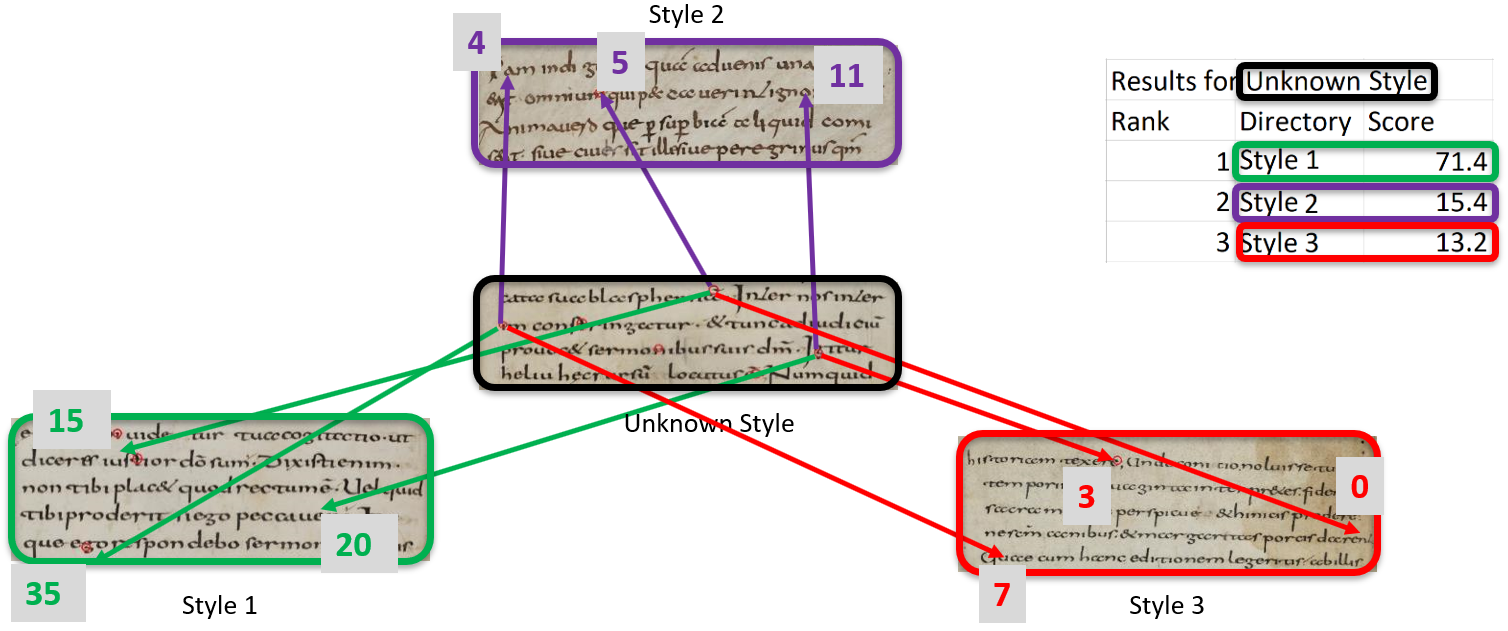
HAT is a software tool that can be used to analyse handwriting styles. Multiple and different handwriting styles can be analysed concurrently and sorted according to their similarity to a questioned or unknown style. A similarity score can be calculated for each predefined style to create a relative comparison between them with respect to an unknown style. The handwriting styles (scribes) do not need to be known, only discriminative labels must be used for each different style (hand).

In order to download HAT to your computer, please follow these steps:

  1. Download the ".zip" file, then extract it to a folder in your local computer.
  2. You can run the HAT application by double-clicking the executable file "HAT3p5" in your extracted folder. It might require some administrative privileges depending on your system settings.
  3. A command window will start, then the HAT will run in your default internet browser. Although it uses your internet browser, it is an offline application running on your local computer, you do not need internet connection.
  4. When you finish using HAT, you can simply close the command window.

Relevant Publications:

  • Mohammed, H., Helman-Wazny, A. . Understanding the Zhangzhung Nyengyu tsakali Collection using Computational Pattern Analysis. In CHAI workshop at 45th German Conference on Artificial Intelligence. 2022.
  • Ciotti, G., & Franceschini, M. (2024). Experimenting with Digital Palaeography: The First Application of the Handwriting Software Tool (HAT 3.5) to Indian Scripts. TRACCE. ITINERARI DI RICERCA/AREA UMANISTICA E DELLA FORMAZIONE, 159-192.
  • El-Khatib, A. (2023). Editing MSS Leiden Or. 14.545 b–c: The Oldest Qurʾān Fragments in Leiden University Library. Journal of Islamic Manuscripts, 14(2-4), 235-278.
  • Blezer, H. (2023). Towards a Definition of Local Orthographies of Bon Manuscripts: A Pilot Study. In A. Helman-Ważny, & C. Ramble (Eds.), Bon and Naxi Manuscripts (Vol. 28, pp. 1-21). (Studies in Manuscript Cultures; Vol. 28). De Gruyter. https://doi.org/10.1515/9783110776478-002.
  • Marco Heiles, Johannes Hartliebs Leben und Werk vor 1441. Zugleich ein Beitrag zur Schreiberidentifizierung, in: Zeitschrift für deutsches Alterum und deutsche Literatur 150 (2021), S. 337–379, https://doi.org/10.3813/zfda-2021-0012.
  • Pattern Analysis Software Tools (PAST) for Written Artefacts, Springer Nature,Document Analysis Systems 2022.
  • A Comparison of Arabic Handwriting-Style Analysis Using Conventional and Computational Methods, manuscript cultures, 2020.
  • Writer Identification for Historical Manuscripts: Analysis and Optimisation of a Classifier as an Easy-to-Use Tool for Scholars from the Humanities, ICFHR, 2018.
  • Normalised local näive bayes nearest-neighbour classifier for offline writer identification, Springer Nature, ICDAR, 2017.

License:
HAT is licensed under the Creative Commons Attibution Non Commercial No Derivatives 4.0 International.

Video Tutorial

  • Publications

  • manuscript cultures
  • Studies in Manuscript Cultures
  • Occasional Papers
  • Software
    • Handwriting Analysis Tool (HAT)
      • Visual-Pattern Detector (VPD)
      • ScriptSight
      • Line Detection Tool (LDT)
      • Visual Similarity Annotation Tool (V-SAT)
      • X-ray Fluorescence Data Analysis Tool (XRF-DAT)
      • Text-Lines Counter (TLC)
      • Artefact-Features Analysis Tool (AFAT)
    • Research Data and Information Systems
    • Written Artefact Profiling Guide
    • Artefact of the Month
    • Mesopotamian Bulletins
    • Videos
    • More Publications

    Last update: 19 January 2026

    • Feedback
    • Legal notice
    • Privacy statement
    • Accessibility
    • Site map

    University of Hamburg

    Innovating and Cooperating for a Sustainable Future in a Digital Age

    • Follow us on Instagram.
    • Follow us on Facebook.
    • Connect with us on LinkedIn.
    • Follow us on Mastodon.
    • Follow us on Bluesky.
    • Subscribe to our channel on YouTube.
      • Studies
      • Prospective students
      • Continuing education
      • Research
      • Teaching at UHH
      • Doctoral studies
      • Job opportunities
      • Knowledge exchange
      • University
      • Excellence
      • Faculties
      • Alumni
      • Contact
      • Campus Navigator
      • UHHApp
      • Emergencies, safety and security
      • Antidiscrimination
    Go to family-friendly higher education institution audit
    Go to internationalisation re-audit
    Go to the Sustainability Audit page
    Go to Diversity Audit
    Go to System accreditation

    © 2026 University of Hamburg. All rights reserved