CSMC
CSMCCentre for the Study of Manuscript Cultures
Photo: UHH/Denstorf
12 March 2026
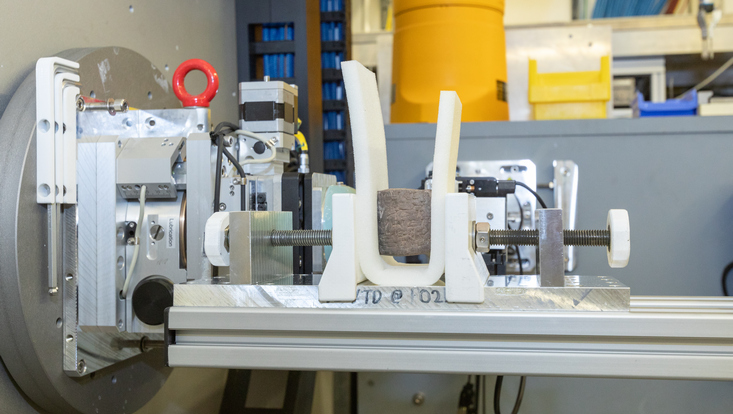
Photo: Marta Mayer/DESY
Can synchrotron X-rays shed light on the material biographies of cuneiform tablets? In a recent study, CSMC and DESY researchers analysed artefacts from two local collections in a non-destructive way. The paper is available open access.
Cuneiform-inscribed clay tablets from ancient Mesopotamia serve as primary sources for understanding the history of the Near East. These objects were predominantly crafted from illitic clays sourced from Tigris-Euphrates alluvial sediments. While administrative documents were typically sun-dried, other items, such as foundation cones, often underwent thermal treatment to ensure long-term durability. The material history of these artefacts is further complicated by the 20th-century practice, employed by many museums, to fire the ancient tablets in an attempt to make the material more robust. Moreover, the precise provenance of many of these objects is unknown because the archaeological context of their discovery cannot be reconstructed. For these reasons, there is a significant need for non-destructive analytical approaches to determine their origins and production methods.
A recent study by Riccardo Cameli Manzo, Zsombor J. Földi, Szilvia Jáka-Sövegjártó, and Martin Etter, published in npj Heritage Science, addresses this need by applying synchrotron X-ray powder diffraction (XRPD) at the PETRA III beamline at DESY. This research analysed 36 artefacts from the Museum für Kunst und Gewerbe (MK&G) and the Hamburg State and University Library (SUB). Unlike previous methods that required invasive sampling or were limited to surface-level analysis, this transmission-mode approach penetrates whole objects between 10 and 40 mm thick. This allows for a comprehensive and non-destructive mapping of mineral compositions. The results confirmed that the illitic clays align with Euphrates River sediments and revealed distinct thermal signatures in clay cones, documenting subtle alteration patterns acquired during their time in burial environments.
As the largest non-invasive mineralogical survey of cuneiform artefacts to date, the study establishes a quantitative baseline that links material composition to both production and taphonomic processes. It demonstrates how mineralogy can be used to trace raw material sources to specific clay deposits and reconstruct ancient manufacturing choices, such as the distinction between sun-drying and kiln-firing. While prior studies offered chemical overviews through X-ray fluorescence or invasive diffraction techniques, this work positions synchrotron XRPD as a highly effective standard for analysing intact objects. Expanding this dataset to include hundreds of artefacts may enable the clustering of data to refine provenance studies and distinguish between distinct local manufacturing traditions.