CSMC
CSMCCentre for the Study of Manuscript Cultures
Photo: UHH/Denstorf
4 February 2026

Photo: IGdJ/CSMC
The estates of German-Jewish intellectuals held at the National Library of Israel bear wit-ness to the migration of people and archives in a turbulent era. In a new online exhibition, developed jointly by CSMC and IGdJ, visitors can follow some of these intricate paths.
On 23 August 1942, Max Grunwald wrote a letter to Martin Buber asking for help in publishing his Jewish Cultural History. Four years earlier, the German invasion had prevented the publication of his work in Austria and Grunwald had fled from Vienna to Jerusalem. But he did not give up: instead, Grunewald tried to use his extensive network to get his work published in Palestine – an endeavour which, as the letter to Buber shows, he was still persistently pursuing in August 1942, but which had not yet been brought to a successful conclusion. As far as we know, that was the end of the matter: there is no evidence that the cosmopolitan scholar, who was rabbi at the Neue Dammthor Synagogue in Hamburg from 1895 to 1903, ever published this book.
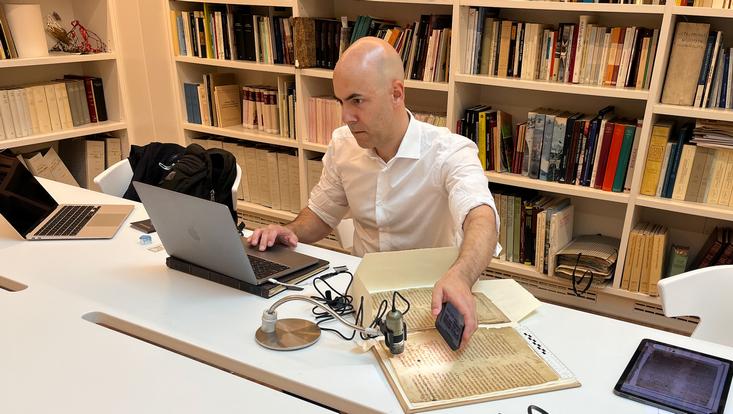
That you are being told about this very episode, which is documented in the recently published online exhibition ‘Between Hamburg and Jerusalem: Archival Excursions’, is a matter of chance. One of the exhibition’s distinctive features is that it can be explored in various ways. One option is to follow it conventionally from beginning to end: in six chapters, Sebastian Schirrmeister from the CSMC and Anna Menny from the Institute for the History of the German Jews (IGdJ) trace the material remains of German-Jewish history across various estates and collections at the National Library of Israel (NLI) in Jerusalem and in other archives. Between 2021 and 2022, the CSMC and the NLI digitised a total of 24 such archives, recording around 750,000 individual pages. The new online exhibition draws on this material, addressing, among other things, the connections between Hamburg and Jerusalem, the controversial awarding of the Hanseatic Goethe Prize to Martin Buber in 1953, and the contested commemoration of Heinrich Heine during the National Socialist era and the years that followed.
At the same time, however, the exhibition also allows visitors to plunge into the material at random: by clicking a designated button, chance determines in which chapter and at which point within it a visitor begins their tour. In the test run carried out for this brief report, this happened to be the episode concerning Max Grunwald’s unsuccessful efforts to publish his book. From there it takes only a few digital steps to discover that Grunwald’s correspondence runs like a red thread through the estates of German-Jewish figures held at the NLI. Martin Buber, in turn, as one learns in the chapter on ‘Bringing things together and thinking ahead: places, people, themes’, was among those protagonists of the exhibition who, owing to their prominent role in the German-Jewish intellectual milieu, were contacted particularly frequently by letter.
Playing with chance is programmatic in the context of this exhibition: our view of the past is shaped by what happens to be preserved and rediscovered, and although archives in particular, with their systematic approach, may give the impression that chance is a factor that should be eliminated or at least minimised in historical research, it is nevertheless an essential part of finding, researching, and connecting. ‘This exhibition navigates this field of tension,’ it says at the outset, ‘by attempting, on the one hand, to make the element of chance transparent and, on the other hand, to highlight relationships and networks between Hamburg and Jerusalem by means of individual material testimonies.’
The online exhibition constitutes a collaboration between the IGdJ with the research project ‘A Fresh Look. Visualising Digitised German-Jewish Archives’ at the CSMC. It is freely accessible on the website of the Key Documents of German-Jewish History published by the IGdJ.