
CSMC
CSMCCentre for the Study of Manuscript Cultures
Photo: UHH/Denstorf
11 December 2025
We are deeply saddened by the death of our colleague, Professor Dr Bruno Reudenbach (1952–2025). Bruno Reudenbach was one of the longest-standing members of the CSMC, having shaped and supported it since its very beginnings with great expertise, commitment, and passion.
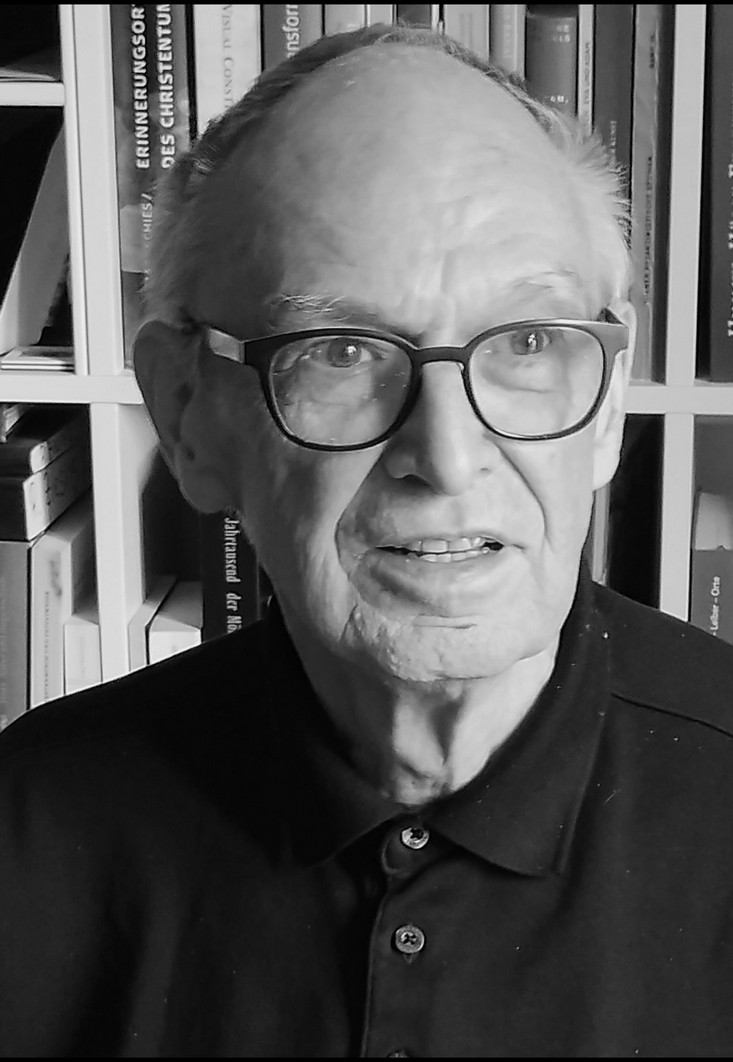
The first expert for European manuscript cultures to join what was then a small group of specialists in Asian and African manuscripts (Forschergruppe ‘Manuscript Cultures in Asia and Africa’), he was instrumental in establishing both the Sonderforschungsbereich ‘Manuscript Cultures in Asia, Africa, and Europe’ and its successor, the Cluster of Excellence ‘Understanding Written Artefacts’. At the Sonderforschungsbereich, he was principal investigator of two research projects, spokesperson of the research field ‘Visual Organisation’, and, for many years, a member of the steering committee. He continued to support the CSMC as a senior professor, a position that he held until very recently.
Bruno Reudenbach was an art historian of international renown. Having studied in Cologne and Freiburg i. Br. and held a post-doctoral position in Münster, he was appointed professor of medieval art history at the University of Hamburg in 1986. He is best known for his expertise in medieval art, for instance his seminal work on relics and reliquaries and on Jerusalem as a holy site, but also his research on the interpretation of the Middle Ages and medieval art and architecture in Nazi Germany. Publications like the volume on Carolingian and Ottonian art in the monumental Geschichte der Bildenden Kunst in Deutschland series, which he co-edited, and his slimmer volume on medieval art 800–1200, which he authored for the popular Beck Wissen series, have reached broad and diverse audiences of experts and the wider public; in these he replaced older canonical narratives of style and influence with new approaches that situated medieval artefacts within their cultural context.
It was Bruno Reudenbach’s outstanding expertise in medieval manuscripts, however, that first brought him together with the colleagues who would establish the CSMC. His centering of the formal, visual, and material qualities of individual artefacts as the point of departure for a careful exploration of their historical context and cultural meaning perfectly fitted, and deeply informed, the CSMC’s methodology. Bruno Reudenbach explored the potential that this approach had for fostering cross-disciplinary research on many levels: in the collaborative research environment of the project group ‘Visual Organisation’; in cross-disciplinary collaborations such as the workshop and subsequent volume on the Eusebian Canons in Gospel manuscripts from European and African traditions; and in his own research on medieval European manuscripts such as his brilliant study of the 10th-century ‘marriage charter’ of the Byzantine princess and Ottonian empress Theophanu as a complex and deliberate fusion of Byzantine and Ottonian manuscript cultures, diplomacy, and conceptions and expressions of rulership.
It was not only his outstanding expertise as a manuscript scholar, however, that has made such a lasting impact on the CSMC. Bruno Reudenbach had an extraordinary ability to foster an atmosphere of collaboration and a sense of community that was shaped by mutual respect and support, as well as by his immense intellectual curiosity.
We remember Bruno Reudenbach with deep gratitude: as an inspiring teacher and colleague, as a generous mentor and friend. Our thoughts are with his family.

