CSMC
CSMCCentre for the Study of Manuscript Cultures
Photo: UHH/Denstorf
26 May 2026

Photo: Andreas Schropp
With the mobile CT scanner ENCI, researchers can look inside sealed cuneiform tablets without opening them. An open-access article in ‘npj Heritage Science’ now provides the first in-depth account of the device and the results it yielded during its first meas-urement campaigns.
Ennum-Aššur was a busy man. In the first half of the nineteenth century BCE, the merchant travelled to various cities in central Anatolia to conduct business. And things were not quiet back at home during his absence either. A colleague to whom he had lent silver had so far failed to repay the debt. So Ennum-Aššur instructed his wife, Anna-anna, to recover the silver for him. Without success, as she reported to her husband in a letter: the debtor refused to hand over the silver and stated that he would only give it to her husband personally after his return.
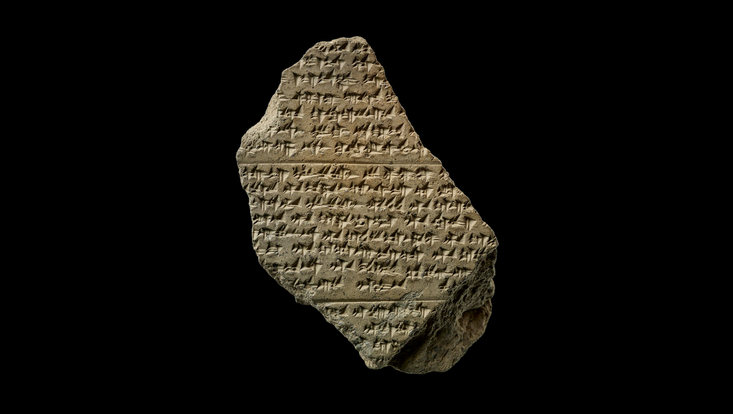
Anna-anna’s letter was found during an excavation at Kültepe (Kanesh) and has been stored for many years in the Museum of Anatolian Civilisations in Ankara, Türkiye. Yet since the day it was written around 4,000 years ago, no one had read it – including Ennum-Aššur, its intended recipient. To this day, the letter remains inside a clay envelope which, apart from the names of the sender and the addressee, contains no information about its contents. In ancient Mesopotamia, letters and contracts were sealed in this way to protect them from prying eyes and damage during the often long transport routes. Anna-anna’s letter probably never reached her husband.
That we know its contents today is thanks to ENCI, which is short for ‘Extracting non-destructively cuneiform inscriptions’. ENCI is the first mobile CT scanner for cultural heritage objects. A recent open-access article in npj Heritage Science now offers the first scientific presentation of the device and the results obtained with it during its first two deployments, at the Louvre Museum and in Ankara.
ENCI was developed by an interdisciplinary team headed by Cécile Michel (Assyriology), Christian Schroer (X-ray physics), and Stephan Olbrich (computer science). Assyriologists provide the historical and philological knowledge needed to identify the objects and interpret the texts in their administrative, social, and cultural context. X-ray physicists design the imaging principle that makes it possible to look inside dense clay non-destructively, and they ensure that the data are recorded under the required safety standards. Computer scientists then turn the raw tomographic data into usable reconstructions: they develop the algorithms for calibration, image processing, surface extraction, visualisation, and the virtual ‘unwrapping’ of tablets and envelopes.
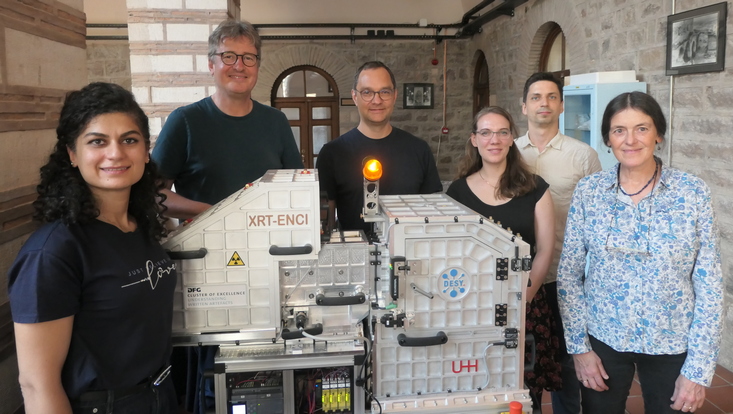
ENCI was developed for use directly in museums and archives, where large heritage collections are kept and where many of the most sensitive objects cannot easily be moved. This mobility is crucial: instead of transporting unique artefacts to a laboratory, ENCI can be assembled on site and used in the immediate vicinity of the collection. The new article demonstrates the scanner’s performance on a series of cuneiform tablets and envelopes, including the successful recovery of the letter written by Anna-anna to her husband.
The research value of ENCI reaches far beyond the decipherment of hidden letters, as became clear during the first field campaigns with the instrument. The CT scans reveal not only writing, but also the internal structure of the clay, inclusions such as seeds, and traces of manufacturing techniques. This means that the device can help answer questions about how tablets and envelopes were made, what raw materials were used, and how ancient scribes worked.
Another important result is that ENCI is not limited to cuneiform tablets. ‘ENCI can be operated in a wide range of experimental parameters, allowing tomographic images of a large variety of objects that fit into the scanner and are not too absorbing’, the authors write. These objects include not only other clay artefacts, but also manuscripts and composite objects from different periods and cultures.