CSMC
CSMCCentre for the Study of Manuscript Cultures
Photo: UHH/Denstorf
8 May 2026
The invention of the printing press by Johannes Gutenberg is often described as the end of the age of handwriting. Ondřej Škrabal, however, argues that the distinction between the handwritten and the printed is far less clear-cut. To this day, the two remain dynamically intertwined.

The Met Collection
Ondřej Škrabal, the name of your Concepts and Methods Unit is ‘Imprinted Handwriting’. Isn’t that a contradiction in terms? Isn’t a document either handwritten or printed?
At first glance, it may seem that way. But our argument is that handwriting and printing are not separate worlds: they are historically connected practices that need to be studied together. This idea reflects a broader shift at the CSMC. Researchers here initially focused on manuscripts in the traditional sense: mainly paper, parchment, and papyrus objects. But soon it became clear that similar practices also appear in inscriptions, seals, cast objects, and other media. That broader view led to the concept of the ‘written artefact’. From there, it became obvious that mechanically reproduced writing also belongs in the same discussion.
The key distinction is between handwriting in the sense of shaping the graphemes gradually on the writing surface, usually by linear movement; and imprinting entire graphemes, words, or text onto the surface from another artefact. That difference matters, but our group’s point is that these practices are intertwined: printing grows out of earlier writing practices and remains dependent on them. And once established, it also influences the way people write by hand.
Before we discuss this interplay, what exactly is the difference between ‘imprinting’ and ‘printing’? Why not simply use the latter term?
‘Printing’ often makes people think first of books, movable type, and the European story of the press. We want to use a wider term that also includes seals, coins, castings, rubbings, woodblocks, lithographic stones, and other forms of reproduction by pressure or impression.
We believe that the notion of ‘imprinted handwriting’, much like that of the ‘written artefact’, can be very helpful in establishing a common vocabulary for a range of phenomena that have often been considered in isolation. It allows us to examine 15th-century European type printing and Mesopotamian seals from the 3rd millennium BCE together.
In that sense, we are more of a concept unit than a methods unit. What we want to do is test whether this broader concept holds explanatory value and can open up new perspectives when very different practices are placed side by side.

The Cleveland Museum of Art
This has a much broader scope than the invention of printing as it is usually understood in Europe: Gutenberg's press in the 15th century.
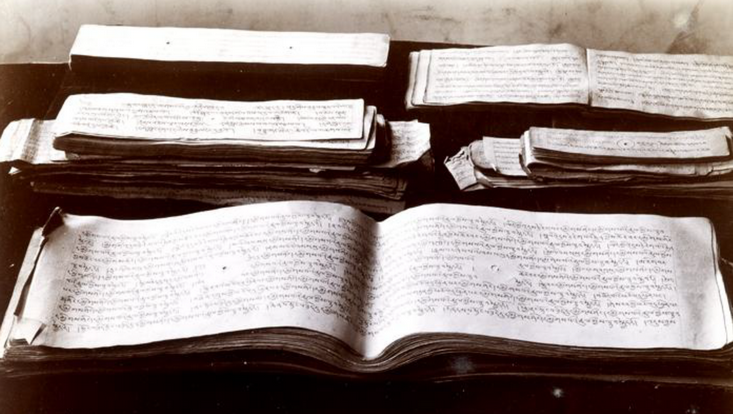
In fact, one of our goals is to provincialise Gutenberg’s invention by examining how imprinting developed in other parts of the world, especially where different scripts, materials, and social settings produced different technological solutions. East Asia is especially important here. There, woodblock printing emerged in Buddhist contexts, first for sutras and devotional material, and later for broader scholarly and literary uses. Even before that, East Asian cultures had developed rubbing techniques from stone inscriptions, which already allowed for faithful reproduction of texts and calligraphy.
In Europe as well, experiments with mechanical reproduction of text were already under way in the century before Gutenberg. What was truly new about his invention was not printing as such, but the way he produced movable type. That process was much faster and more efficient than anything that had gone before. In East Asia, for instance, movable type had in use already since the 11th century, but the material employed was wood, clay, or bronze, which rendered the production extremely labour-intensive. Lead movable type was introduced to China only at the beginning of the 19th century, only to be surpassed by lithographic printing shortly afterwards. At the same time, Gutenberg’s invention was especially well suited to the Latin alphabet, and far less suitable for other writing systems, such as Arabic or Chinese and their derivatives. For this reason, Gutenberg’s printing press did not, for a long time, have the global influence that is frequently attributed to it today, particularly in Germany and Europe.

Ningxia Institute of Cultural Relics and Archaeology
Would you say that the development of printing techniques in different cultures follows a broadly linear process: first handwriting, then imprinting in order to produce written materials more quickly and in greater quantity?
Not quite. People had already been using impressions in textile decoration, ceramics, and other forms of design before writing existed. In that sense, imprinting is older than writing itself. What changes later is that people who are capable of writing begin to use this already familiar technology. Interestingly, the earliest examples are often seals and similar tools of authentication. Their purpose is usually not to produce larger quantities of written artefacts. That is why the impact on a society’s knowledge economy can remain limited at first. The real effects become much greater once imprinting is applied to texts that can circulate widely and carry knowledge.
Gutenberg, too, could not have achieved such an impact had paper not, in parallel, become established in Europe as a writing support in place of the expensive parchment on which he was still printing. It was only through this material shift that printed documents could truly accelerate the circulation of knowledge.
How did printed texts, once they appeared, change the spread of information in a society?
The large social impact of print came not only from major books. In fact, it was often driven by shorter pamphlets, single sheets, news items, and other rapidly circulated texts. These printed artefacts helped create new publics and new forms of information exchange. The Reformation is a good example of this dynamic. Print made it possible to circulate provocative, vernacular, often polemical material quickly and widely. That marked the emergence of an early news industry, something that had not existed before.
It also introduced a new way of dealing with information. Much like today, readers often did not know the exact source of what they were reading. Print therefore changed not only how information moved, but also how people related to it.

The Board of Trustees of the Science Museum
You argue that imprinting practices, once they have become widespread, also affect handwriting. How does that happen?
Printed forms often borrow from existing handwriting or epigraphic styles. At the same time, once printed forms become widespread, they have an influence on what people consider standard, legible, or even beautiful handwriting. Antiqua is a good example. This typeface, originally developed for print in Renaissance Italy, eventually helped reshape handwriting instruction. Today, children increasingly learn forms of writing that reflect printed letter shapes rather than older cursive traditions.
Printing also helps preserve and spread calligraphic styles. Reproductions such as rubbings, woodcuts, and later lithographs made it possible for many more people to study and imitate famous hands. So it is mistaken to assume that printing simply replaces handwriting. In many cases, it transforms it.
You now have seven years to test and develop the concept of ‘imprinted handwriting’. That sounds like a lot of time but given the scope of the topic, it is not that much. What do you aim to achieve in this time?
Our immediate aim is a conceptual article in an interdisciplinary peer-reviewed venue. But the larger ambition is longer-term: we want to establish ‘imprinting’ as a useful umbrella term in the international study of manuscript and print cultures and revisit associated terminologies. The point is to give scholars a shared language for discussing related phenomena that have often been treated separately. In the first step, we plan to test the concept through case studies, because those are needed to refine it and make it usable across different historical and geographical settings. In the long run, success would mean that researchers in different fields can use this language to talk to one another more easily and more precisely. That, ultimately, is what we are trying to build.