
Materiality and Textual Transmission
Project Group 10
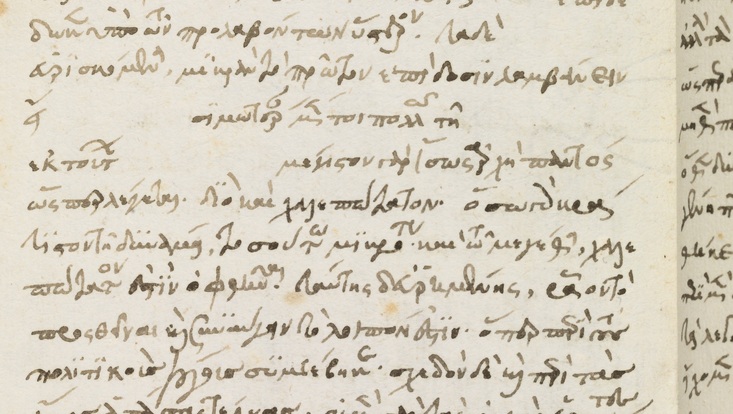
Project Group 10 investigates the impact of material features on the history of transmission of contents, merging text-focused approaches with material analysis to enhance philological studies.
A large amount of the extant written artefacts transmit content copied from another, older written artefact. Discovering links between such ‘copies’ and ‘models’ is of paramount relevance to reconstruct written artefacts’ biographies and grasp the dynamics behind their individual production process. Project Group 10 is convinced that the investigation of material features provides key information for connecting witnesses of individual texts, thus enriching a traditionally text-critical approach. Putting the study of written artefact’s materiality in close conversation with philology, Project Group 10 explores this topic. It focuses on the analysis of ‘triggers’, that is material features of written artefacts and their visual organisation that prompt changes in the content during its transmission process in derivative written artefacts. An obvious example of a ‘trigger’ is a missing folio in a codex that explains the textual gap found in a derivative codex; or a specific visual organisation of the paracontent: if a marginal explanatory note in an older written artefact matches the content and the position of a textual addition in the core content of a younger written artefact, it can be inferred that the marginal note of the former protruded into the core text of the latter. ‘Triggers’ can be present in any form of written artefact and content. In the 18th century, the Swedish Count Fredrik Gyllenborg produced a drawing of his family’s coat of arms on paper and sent the drawing to China, ordering a porcelain service to be made and decorated with his family crest. During the trip, water accidentally spilled on the drawing, blurring portions of it. The Chinese artisans faithfully copied the image, including the water stain, rendering this as a cloud accompanying the coat of arms.
Expanding on well-established precedents in European philological research (e.g. conceptualisations put forward by Giorgio Pasquali, Sebastiano Timpanaro, and Michael D. Reeve), the Project Group explores further angles of ‘triggers’ through the investigation of the phenomenon also in African and Asian manuscript cultures (Armenian, Arabic, Assyrian, Chinese, Ethiopic, Georgian, Japanese, Tamil). In addition, Project Group 10 investigates ‘triggers’ in types of contents other than text, namely musical notation, drawings, diagrams, and forms of written artefacts other than the codex, including palm-leaf manuscripts, scrolls, clay tablets, reliefs and inscriptions.
Thanks to its cross-disciplinary approach, the Project Group’s research activity will lead to a broader understanding of ‘triggers’, including an appropriate definition and coherent terminology and categorisation, to develop a global framework for the identification of this phenomenon.