
Turning Rock into Pixels
The Jewish Cemetery Altona
Project Group 1
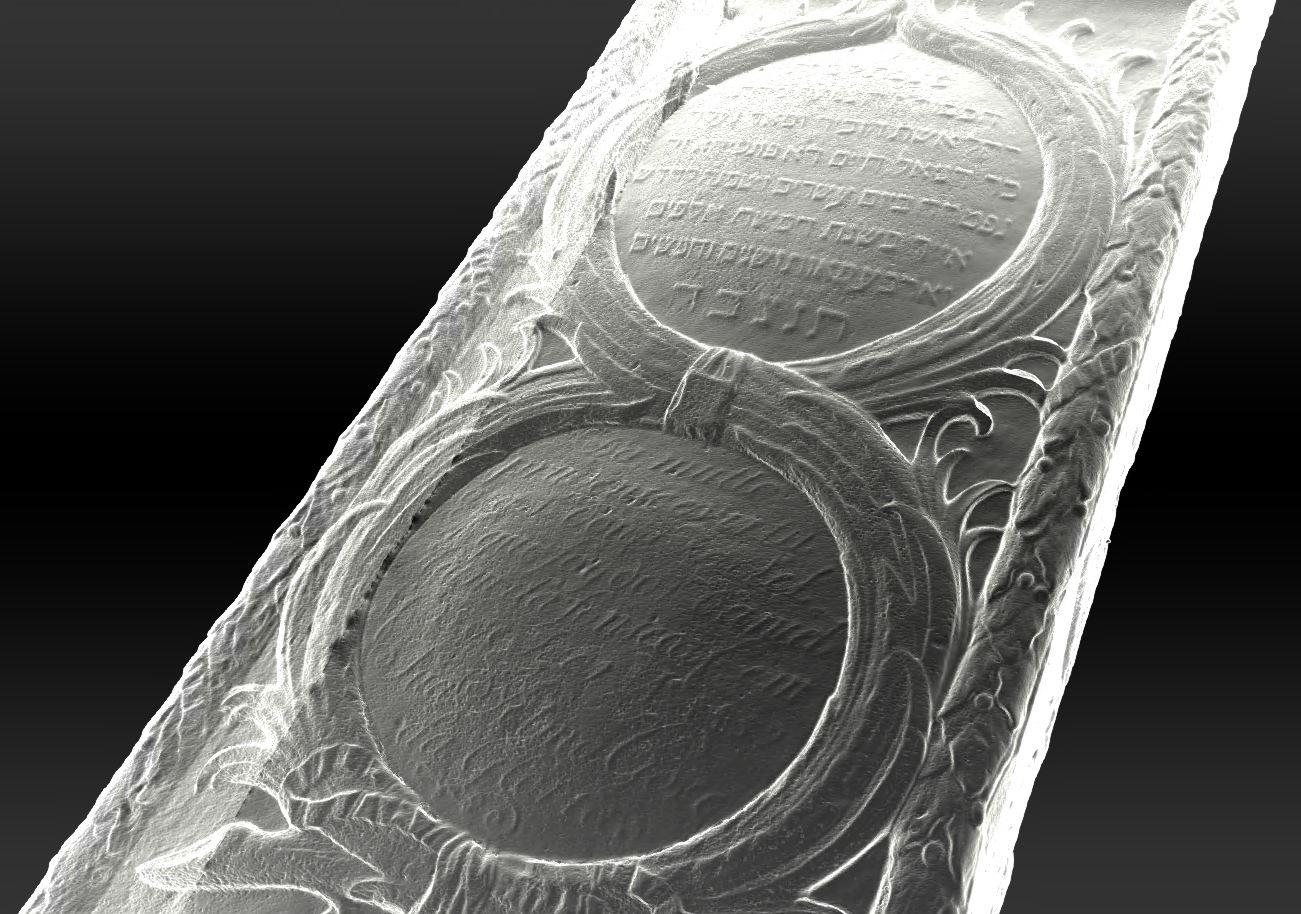
The Jewish cemetery at Königstraße in Hamburg-Altona is an exceptional monument of early modern Jewish culture in Europe. With approximately 7,000 inscribed tombstones spread across two hectares, the site bears witness to the rich diversity of Sephardic and Ashkenazi communities and the various spiritual currents they embodied, including Sabbateanism, the Haskalah movement, and Orthodoxy. The tombstones carry multilingual and multigraphic inscriptions in Hebrew, Portuguese, and German, alongside a wide range of iconographic features — making the cemetery one of the most complex written heritage sites of its kind. The central research question guiding ‘Turning Rock Into Pixels’ is: How can we ethically study large-scale sites with complex written heritage that are exposed to environmental degradation? To address this core question, the group combines the collective ‘Understanding Written Artefacts (UWA)’ expertise in immersive 3D environments, material analysis, and the Humanities. Three interconnected research approaches form the core of the project’s activities.
The first and overarching approach is the development of the Altona Cemetery Virtual Research Environment (ACVRE). Building on UWA’s prior experimentation with 3D virtual environments, including work on the Lucklum church and the theatre of Miletus, the ACVRE is conceived as a digital research infrastructure that integrates tombstone visualizations with multiple layers of scholarly data: transcriptions of inscriptions, typologies of iconographic features, biographical and bibliographical records, photographs, and results from material analysis. The environment is designed to support both close and distant reading approaches, facilitating the investigation of historical developments and enabling potential reconstructions of deteriorated content. To ensure its long-term sustainability, the project collaborates with UHH’s Centre for Sustainable Research Data Management. A proof-of-concept prototype covering three representative sample areas of the cemetery was completed in 2023–2024, demonstrating the viability and potential of this approach.
During the first year of the project, the PG team is actively developing this virtual research environment and establishing the large-scale digitisation and visualization processes required for the cemetery as a whole. In parallel, we are working as a team in sourcing and evaluating archival records, which will be incorporated together with already existing research data into ACVRE.
The second approach to the formulated central research question concerns material analysis of selected rock-based tombstones, focusing on both weathering-related changes and provenance studies. Drawing on UWA’s expertise in mineralogical analysis and applying methods such as Raman spectroscopy, Fourier-transform infrared (FTIR) spectroscopy, and X-ray fluorescence (XRF), the research builds on preliminary work conducted on tombstones at Hamburg’s Ohlsdorf cemetery. This earlier work demonstrated that material differences between inscribed and non-inscribed areas of marble-based written artefacts occur, which can be quantified by the ratio of weathering-related products and the major mineral phase in pristine marble. Consequently, deteriorated inscriptional content can, at least in part, be recovered through in-depth analysis of weathering processes. Provenance studies of the rock-based writing support, in particular when marble has been used, provide an additional dimension, offering insight into the transregional economy and the material choices of Altona's different Jewish communities. These activities are conducted in close collaboration with other project groups working on material provenancing within the wider UWA cluster.
The last aspect of this interdisciplinary collaboration focuses on research into family ties and social networks within Altona’s Jewish communities. Digital tools enable a quantitative and statistical distant reading of the funerary inscriptions, uncovering topical and stylistic interconnections between literary and visual motifs such as floral ornaments. This work is carried out in cooperation with UWA’s newly founded Computer Science Lab, which combines pattern recognition via computer vision with large-scale data approaches. Overall, throughout all activities, ethical considerations remain central. Questions regarding the application of Jewish religious law to digital twins of cemeteries are being assessed in close collaboration with external stakeholders, particularly the Jewish Community Hamburg. By establishing a community-driven vetting process for the protocols governing the creation of an enhanced digital twin of a religious space, ‘Turning Rock Into Pixels’ serves as a key example of the cluster's broader commitment to ethical self-reflection.