
CSMC
CSMCCentre for the Study of Manuscript Cultures
Photo: Karsten Helmholz
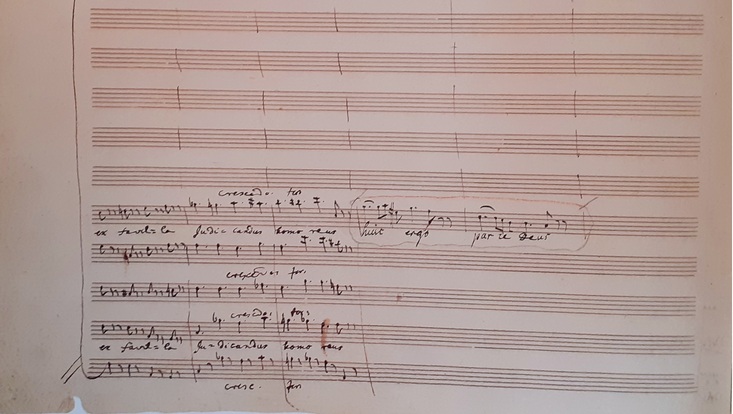
Photo: Creative Commons Attribution-Share Alike 4.0
Before the Romantic aesthetic of the fragment emerged, no composer left behind more fragments than W. A. Mozart.
The Neue Mozart Ausgabe (NMA) devoted an entire volume of facsimiles to his fragments, though this volume excludes some of the most extensive one: the operas the operas Zaide (K. 344), L’oca del Cairo (K. 422), and Lo sposo deluso (K. 430), the Mass in C minor (K. 427), the concerto movement for basset horn and orchestra (K. 584b), and the Requiem (K. 626). However, the NMA only considers materially independent units as fragments, and excludes incomplete and abandoned drafts of movements contained within manuscripts of completed compositions. Therefore, an unfinished and discarded draft of a movement that has been removed from the score is considered a ‘fragment’, whereas if it remained in the score, it would be called a ‘draft’. The recent edition of the ‘Köchel catalogue’ overcomes this distinction in that, regardless of their physical nature, all manuscripts that cannot be classified by their musical content as referring to another composition or a movement of such a composition are considered ‘fragments’. This applies even if they form part of the genesis of a completed work from which they were replaced by other material.
The term ‘fragment’ can refer to both incomplete manuscripts and incomplete compositions. An autograph manuscript score of a composition that was formerly complete but is now incomplete, for which no complete score exists, is a fragment in both material and musical terms. In material terms, however, an autograph manuscript score of an unfinished composition is not a fragment. However, in musical terms, it is. This material definition of ‘fragment’ is the starting point of this project, which will deliver the first comprehensive study of Mozart's incomplete compositions and discarded first thoughts. Furthermore, the common distinction between fragments, drafts and versions will be refined. Beyond formerly complete compositions that are now incomplete, the following working definitions apply: unfinished compositions; temporary unfinished compositions that were later completed; discarded incomplete drafts; revised incomplete drafts; and completed but discarded first versions.
By comparing sketches and fragments in terms of the latter’s independence from the former, it will be proven whether Mozart can truly be pictured as meticulously working through the ideal stages of a work’s genesis by means of sparingly used paper, or whether he can also be imagined engaging in a joyful profligacy of paper and ideas. Although it is already known that Mozart sometimes left his drafts for years before completing them — for example, the symphonies K. 129 and 181, and the piano concertos K. 449, 488, 503, 537 and 595 — ink analysis carried out with the Mobile Lab will provide new insights into the stages of the compositional processes behind some of the greatest classical music masterpieces.
Project Lead: