
CSMC
CSMCCentre for the Study of Manuscript Cultures
Photo: Karsten Helmholz
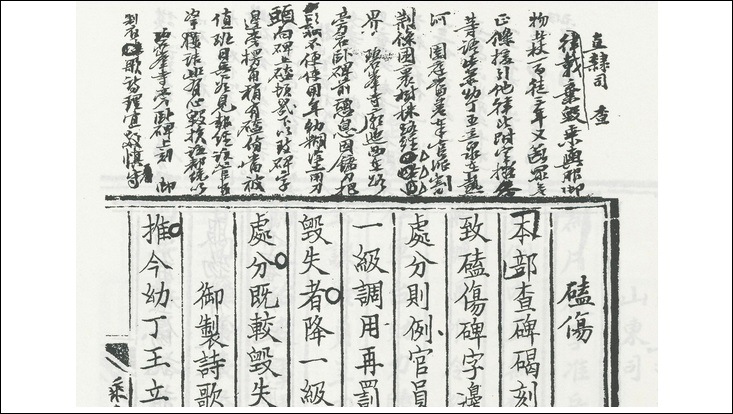
Photo: Fenghuang chubanshe
The nineteenth century was a period of major crisis for the Qing Empire (1644–1911). Internal turmoil, combined with growing external pressure from foreign powers, led to significant social, political, and institutional changes.
In these turbulent times, the ruling dynasty was attempting to adapt its criminal law to the rapidly changing realities; however, legislation often lagged behind, posing challenges for judicial officials. In fact, doubtful cases were submitted from all over the empire to the Ministry of Justice at the court in Beijing. Its decisions contained the most up-to-date information on how to handle current legal problems. Some of these decided cases were circulated and collected by judicial officials to look for guidance on how to deal with situations not (yet) covered by codified law.
This project is concerned with a particularly extensive collection of cases compiled by the high-ranking judicial official and renowned legal scholar Shen Jiaben 沈家本 (1840–1913). Shen gathered almost 3,500 case records in the 1880s and 1890s, while working on various posts at the Ministry of Justice and in prefectures around the capital. Originally meant to be published in print under the title Conspectus of Judicial Cases – Third Instalment (Xing’an huilan sanbian 刑案匯覽三編), the project was abandoned in the early twentieth century, and the 126 booklets that constitute the case collection eventually ended up in the National Library of China.
The project approaches the case collection as a testimony to scholarly practices of knowledge organisation in premodern China. How did Shen compile, structure and update his collection? The booklets exhibit a range of material features that can help to answer these questions. For example, although Shen apparently copied most of the cases himself, several other hands were at work in the collection, pointing to a collaborative project. Furthermore, the cases were copied on paper from different stationery suppliers, as indicated by differences in the design of the pre-printed frames and gridlines, as well as the colour of the ink. Lastly, most of the collection is handwritten, but Shen also removed individual folios from printed circulars and bound them together with the hand-copied records.
By investigating these and other material aspects together with the content of the case collection and supplementary sources such as Shen’s diaries, the project sheds light on the compilation process of Shen’s collection and helps to uncover his scholarly practices. How did he organise his case collection, and how did he keep it organised over more than a decade of constant growth, and with a view to heterogeneous writing supports? What were his criteria for the inclusion of cases, and to what extent did he modify them for compilation? Who were Shen’s collaborators, and how exactly do we have to imagine the division of labour?
Due to the size of the collection, consisting of more than 20,000 pages, the project harnesses the potential of AI and computer vision, for example, to categorise the collection according to writing support and scribal hand, by drawing on the expertise of the CSMC’s ‘Visual Manuscript Analysis Lab’. These approaches will also contribute to and benefit from the work of the Project Group ‘Navigating Multigraphic Written Artefacts’.
By studying the genesis and development of Shen Jiaben’s case collection, the project aims to identify and analyse specific practices of knowledge organisation in the legal domain. Ultimately, the goal is to determine how officials and scholars in late imperial China used written artefacts to compile and maintain ‘pre-modern databases’ for practical purposes, thereby clarifying broader patterns of information management in this period.
Project Lead: