
The Origins and Development of the English Queen’s Household and Wardrobe
2023–2025
RFD18
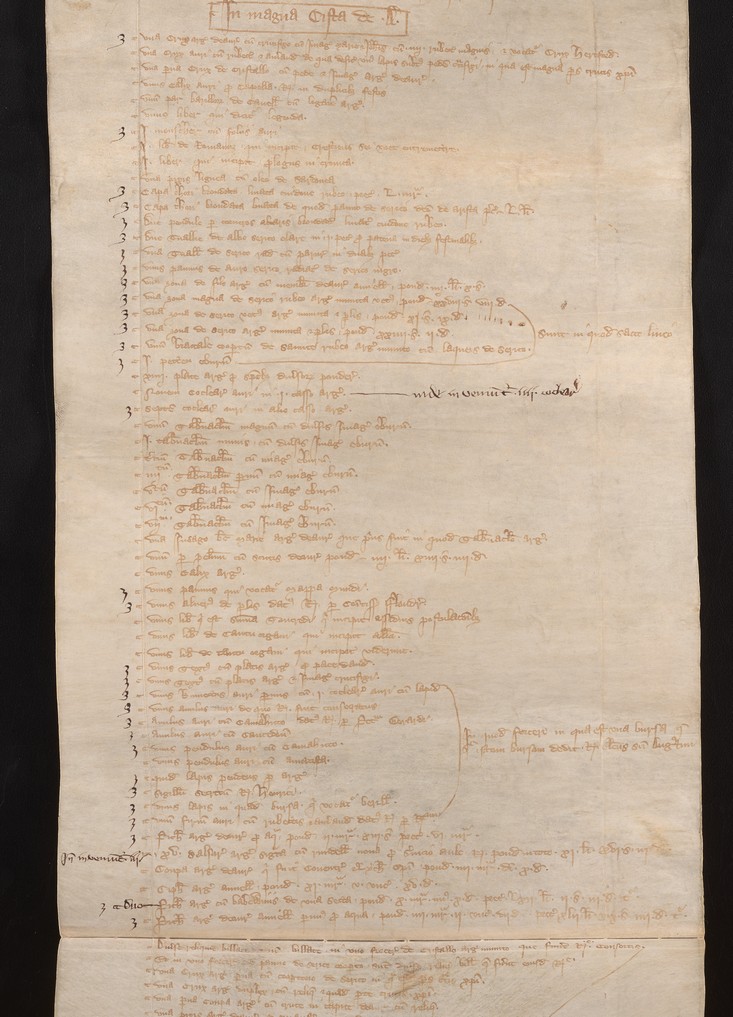
Research into the records of medieval English royal government has been a cornerstone of Anglophone historical scholarship for centuries. Nevertheless, approaching these records with new methodologies and research questions continues to yield fresh insights into the functioning of English royal administration in the Middle Ages. Rather than focussing on the contents of these government records, examining the documents as artefacts in themselves by investigating the materials they were written upon, the shapes of the documents, and the hands that wrote them can shed new light on the administrative and record-keeping practices of medieval English royal government.
The project has applied this material-focussed approach to some curiously understudied royal records: the earliest surviving household and wardrobe accounts of the English queens. These documents survive from the thirteenth century onwards, following the creation of a separate wardrobe for Eleanor of Provence, the queen of Henry III (r. 1216–1272). One of the main aims of the project was to understand the administrative practices of the queens’ households and wardrobes. Were these queenly departments administratively independent, producing their own accounts and records of the queens’ activities or were the queens’ households and wardrobes subject to the oversight and management of the king’s own administration? Studying the extant records from queen Eleanor of Provence and the two queens of Edward I (r. 1272–1307), Eleanor of Castile and Margaret of France, this project has charted how procedures in royal record-keeping and administration developed over the course of the thirteenth century. While the queens’ officials produced their own accounts of their activities, there was far greater oversight from the king’s own wardrobe during the reign of Edward I as it took increasing prominence as the main financial office of royal government.
In order to be able to better understand the processes and choices in the production of accounts within the queens’ administration has involved the in-depth examination of the size, shape and material substrate of the surviving written artefacts, in conjunction with the layout of the content, the hands that wrote them and how they were subsequently used, namely as part of the audit of royal finances. As such, this project has frequently participated in discussions within Research Field D ((Re-)Shaping Written Artefacts), as well as Research Fields C (Creating Originals) and K (Selecting Materials). The project contributed towards the publication of Occasional Paper Nos 9 and 10 stemming from Research Fields D and K respectively: Multilayered Written Artefacts: Definition, Typology, Formatting (http://doi.org/10.25592/uhhfdm.14336); Towards the Investigation of Material Choices in Written Artefacts: Methodological Reflections (https://doi.org/10.25592/uhhfdm.17049).
One of the main outputs of this project has been the production of an in-depth handbook on the thirteenth-century English royal household and wardrobe and their records: Abigail S. Armstrong, Approaching Records of the Household and Wardrobe: The Royal Accounts of Thirteenth-Century England (https://www.routledge.com/Approaching-Records-of-the-Household-and-Wardrobe-The-Royal-Accounts-of-Thirteenth-Century-England/Armstrong/p/book/9781032267555). This book outlines the functions, organisation and development of the household and wardrobe in the thirteenth century, along with the activities and accounts of the various officials and departments charged with their undertaking. It also includes two case studies offering close readings of a household diet account of Margaret of France and a wardrobe jewel account of Eleanor of Provence to demonstrate how these records can be used to elucidate the actions and agency of medieval English queens.
The findings of this project have also been presented at multiple conferences across Europe with publications subsequently in preparation. A chapter on the processes of the audit of the queens’ household and wardrobe accounts and the changes in procedures from the reign of Henry III to Edward I will be included within Thirteenth Century England XX: Proceedings of the Lincoln Conference, 2025 (Woodbridge: Boydell Press, In Preparation).
People
Project lead: Abigail Armstrong