• Zur Metanavigation
  • Zur Hauptnavigation
  • Zur Suche
  • Zum Inhalt
  • Zur Subnavigation
  • Zum Seitenfuß
  • University of Hamburg
  • For journalists
  • Staff Service Portal0
  • STiNE
https://www.kus.uni-hamburg.de/aktuelles.json?recentnews=true
  • Institutions and target groups
    • Einrichtungen
      • Faculties

        • Faculty of Law
        • Faculty of Business, Economics and Social Sciences
        • Faculty of Medicine
        • Faculty of Education
        • Faculty of Humanities
        • Faculty of Mathematics, Informatics and Natural Sciences
        • Faculty of Psychology and Human Movement Science
        • University of Hamburg Business School
      • Services

        • Study Information Net STiNE
        • Surfmail
        • Exchange
        • Staff Service Portal
        • Learning Platforms
        • Katalogplus – Catalogue of Hamburg Libraries
        • SharePoint
      • Student facilities and services

        • Campus Center
        • Career Center
        • PIASTA
        • AStA (student council)
        • University Sports
        • University Music
        • Family Office
        • University Language Center
        • General Languages
        • Office of Affairs for Students with Disabilities or Chronic Diseases
        • Departmental libraries
        • Healthy Campus
      • Further facilities and services

        • The Cluster of Excellence CLICCS
        • The Cluster of Excellence CUI
        • The Cluster of Excellence Quantum Universe
        • The Cluster of Excellence Understanding Written Artefacts
        • Hamburg Research Academy
        • Pier Plus
        • Hamburg Center for University Teaching and Learning (HUL)
        • Hub for Crossdisciplinary Learning (HCL)
        • CEN
        • Museums and collections
        • University Archives (in German)
        • Regional Computing Center (RRZ)
        • University Administration
        • Knowledge Exchange Agency
        • The Unikontor Shop (in German)
    • Target groups

      • Prospective students
      • Students
      • International prospective students
      • Young researchers
      • Researchers
      • Instructors
      • Staff
      • Prospective continuing education students
      • Alumni
      • Journalists
      • Refugees (in German only)
    Close
  • /sitemap.json
University of Hamburg - to research, to teach, to educate and form, to homepage

CSMC

CSMCCentre for the Study of Manuscript Cultures
  • About
    • People
    • News
    • Ethics
    • Equity & Diversity
    • Sustainability
    • Logbook: The CSMC Blog
    • Contact & Newsletter
    • Vacant Positions
    • Intranet
  • Research
    • Concepts & Methods Units
    • Project Groups
    • Individual Research Projects
    • Working Groups
    • Affiliated Projects
    • Fellowships
    • Research Events
    • UWA I (2019–2025)
    • SFB (2012–2020)
  • Core Units
    • Laboratories
    • Graduate School
    • Cultural Heritage
    • Library
  • Collaboration
    • with Research Partners
    • with Archives, Libraries, and Museums
    • with Artists
    • with Companies
    • with Schools
    • within the HALM and PIER Networks
  • Publications
    • manuscript cultures
    • Studies in Manuscript Cultures
    • Occasional Papers
    • Software
    • Research Data and Information Systems
    • Written Artefact Profiling Guide
    • Artefact of the Month
    • Mesopotamian Bulletins
    • Videos
    • More Publications

Photo: CSMC

  1. UHH
  2. CSMC
  3. Registration
  4. Digital Lunch Seminar Series

Digital Lunch Seminar Series

Winter 2022/2023
UHH/Esfandiari

Convenor: Markus Fischer

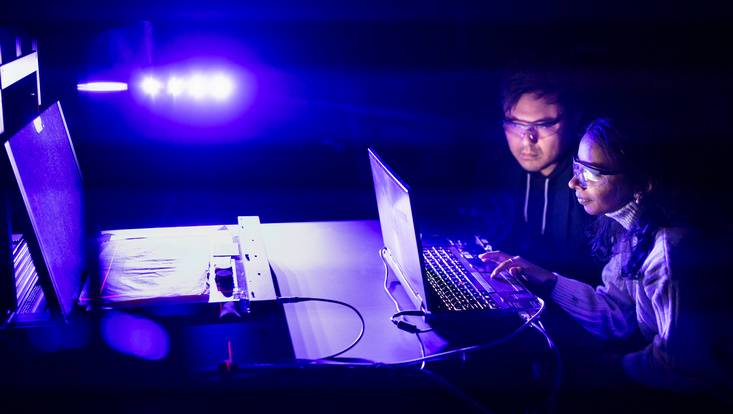
The Digital Lunch Seminar Series is back: in easily digestible bites, two scientists from CSMC deliver a one-hour presentation of a joint research topic. What’s special about this format is that the pairs are made up of disciplines that usually rarely collaborate. The talks thus exemplify how scientists from over 40 disciplines from the humanities, natural sciences, and computer sciences at CSMC work together on the holistic study of written artefacts.

The start of the second season is on 7 November when Marina Creydt and Stephan Seifert explain how the chemical analysis of proteins and metabolites provides information about the biological identity of and natural or anthropogenic influences on ancient written artefacts. Three weeks later, on 28 November, José Pablo Maksimczuk and Olivier Bonnerot discuss what we can learn from the analyses of inks used for a 15th-century manuscript of the Organon, Aristotle’s treatises on logic. On 12 December, Kaja Harter-Uibopuu and Boriana Mihailova present inscribed gems from the collection of the Museum für Kunst und Gewerbe, Hamburg, to highlight the potential of the holistic study of rock-based written artefacts. Finally, on 23 January, Agnieszka Helman-Wazny and Hussein Adnan Mohammed employ numerous Tibetan written artefacts to show how visual pattern analysis can help us to better understand when, were, and by whom they were produced.

Schedule: Mondays, 12:00 pm – 1:00 pm

Download the programme of the Digital Lunch Seminar Series 2022/2023 here:

  • Programme (PDF)
Date Titel Speakers
7 November Proteins & Metabolites – Mass Spectrometry-Based Analysis of Ancient Manuscripts

Marina Creydt and Stephan Seifert

Chair: Claudia Colini

28 November Notebooks – Identifying Disiecta Membra on the Basis of Palaeography, Codicology, and Textual Criticism 

José Pablo Maksimczuk and Olivier Bonnerot 

Chair: Hanna Wimmer

12 December Inorganic Non-Metallic Supports

Kaja Harter-Uibopuu and Boriana Mihailova

Chair: Ondřej Škrabal

23 January Digitalisation – Visual-Pattern Analysis in Digitised Written Artefacts 

Agnieszka Helman-Wazny and Hussein Adnan Mohammed

Chair: Szilvia Jáka-Sövegjártó  

Abstracts and Contributors

Proteins & Metabolites – Mass Spectrometry-Based Analysis of Ancient Manuscripts

Monday, 7 November 2022, 12:00 pm – 1:00 pm

The chemical analysis of proteins and metabolites provides information about the biological identity of a written artefact as well as about natural or anthropogenic external influences. In this way, knowledge can be gained about the origin or history of the underlying plant material. Furthermore, meta-analyses provide additional information about the object’s prehistory. The data are collected with high-resolution mass spectrometers. In order to comprehensively exploit the complex data generated by spectrometric techniques, several bioinformatic approaches are applied. First, multivariate methods are utilised for the classification of the mass spectra of analysed samples. These methods are divided into unsupervised approaches, which are applied without further information, and supervised approaches using samples with known class memberships by which classification models are trained. Furthermore, mass spectrometric signals are identified that are significantly different between the groups of analysed samples. For this, statistical and novel machine learning methods are applied. The identified signals can be compared to databases to assign them to proteins and metabolites, respectively.


Marina Creydt studied food chemistry at the Hamburg School of Food Science (HSFS, Universität Hamburg), where she wrote her thesis on food profiling using high-resolution mass spectrometry. She heads the working groups on mass spectrometry and the ‘Metabolomics’ at the HSFS. Since April 2021 she has been the Principal Investigator of the research project ‘Mass Spectrometric Proteome Analysis of Written Artefacts’ in the Cluster of Excellence ‘Understanding Written Artefacts’. Marina Creydt’s main areas of work are: development of mass spectrometric strategies for food authentication (food profiling) and authentication of artefacts (artefact profiling) with metabolomics and proteomics approaches.

Stephan Seifert has been working as a junior professor for Chemometrics of Complex Material Systems at the HSFS and in the Cluster of Excellence ‘Understanding Written Artefacts’ since March 2020. His research is located at the interface between method development/validation of chemometric and bioinformatics methods and their practical applications on spectrometric, spectroscopic, and sequence data in various research areas. Professor Seifert studied chemistry at Humboldt-Universität zu Berlin and received his PhD in the research group ‘Nanoscale Optical Spectroscopy’ on the classification and characterisation of pollen. From 2016 to 2020, he was a postdoctoral researcher at the Institute of Medical Informatics and Statistics at Christian-Albrechts-Universität zu Kiel, developing and validating machine learning approaches for the study of chronic inflammatory skin diseases such as neurodermatitis and psoriasis.

Notebooks – Identifying Disiecta Membra on the Basis of Palaeography, Codicology, and Textual Criticism

Monday, 28 November 2022, 12:00 pm – 1:00 pm

Aristotle’s collection of treatises on logic, commonly known as the Organon, has been passed down to us in around 150 Greek manuscripts from the 9th to the 15th century. Several Organon manuscripts preserve the entire collection. Others transmit only a part of it. In some cases, the scribes deliberately copied a specific portion of the collection. On another occasions, codices display marks of physical damage, unmistakably indicating that their incomplete content is due to material losses. Most of the detached folios and quires that came down to us from broken manuscripts of the Organon were never recovered and could be lost forever. Occasionally, however, they survive as disiecta membra in one or several unrelated volumes. Our paper probes an Organon manuscript copied around 1442 by the scholar and churchman Theodore Agallianos, whose fragments are preserved in codices from Leipzig, Paris, and Vatican City. The proposed study will be undertaken from an interdisciplinary perspective, including Manuscript Studies, Palaeography, Philology, Textual Criticism, History, and Ink Analysis. In the last two decades, the combination of UV-vis-NIR reflectography and X-ray fluorescence (XRF) spectroscopy has become the standard way to characterise and differentiate inks. Its application to the study of inks from Vat. gr. 1777, Par. 1919, and Rep. I 68a exemplifies well how such analysis complements the observations made by scholars, and the need for close collaboration between the different disciplines to fully understand the history of a manuscript.


Olivier Bonnerot studied Chemistry at the École Nationale Supérieure de Chimie de Paris (MSc in Analytical Chemistry, and MEng. in Chemistry). He then did a PhD in Mediterranean Archaeology at the University of Cyprus on the study of materials from wall mosaics before joining the Bundesanstalt für Materialforschung und -prüfung (BAM) to analyse inks as part of the collaboration between the BAM and CSMC. Since June 2022, he is the Principal Investigator of the project ‘From Carbon to Iron: Evolution of Greek inks from Hellenistic times to Late Antiquity’ at the Cluster of Excellence ‘Understanding Written Artefacts’.

José Maksimczuk studied Classics and Literature at the Catholic University of Buenos Aires. Between 2014 and 2018, he did a PhD in Greek Studies at the Catholic University of Leuven (Belgium). He joined the Cluster as a Research Associate on the project ‘Polygenetic manuscripts of Aristotle’. Since October 2022, he is the Principal Investigator of this project (together with Christian Brockmann). He is also the spokesperson of the Research Field on ‘Notebooks’.

Inorganic Non-Metallic Supports

Monday, 12 December 2022, 12:00 pm – 1:00 pm

The diversity of written artefacts in terms of material support is huge and it includes clay tablets, stones, metal, ivory, parchment, palm leaves, paper, et cetera. Among these, mineral- or rock-based supports have usually been considered as ‘forever-lasting’ messengers and therefore have played a critical role as a means of public communication and storage of knowledge.

Different types of natural inorganic non-metallic support will be discussed from the point of view of their use by different agents as well as of their mineral-phase composition and analytical materials-science methods for fingerprinting them. A showcase of inscribed gems from the collection of the Museum für Kunst und Gewerbe, Hamburg, to holistically study rock-based written artefacts will be presented.


Kaja Harter-Uibopuu studied Ancient History and the History of Ancient Law at the University of Graz, where she received her PhD in 1996. After working as a senior scientist at the Austrian Academy of Sciences in Vienna, she came to the Universität Hamburg as a Professor for Ancient History in 2015. Her research interests include Greek and Roman Epigraphy, Ancient Greek Law, as well as Funerary Customs in Greco-Roman Asia Minor.

Boriana Mihailova graduated in physics from Sofia University in 1989 and received her PhD degree from the Bulgarian Academy of Sciences in 1997. Since 2005, she has been Professor of Crystallography at the Universität Hamburg. Her main research interests are solid-state spectroscopy, phase transitions, ferroelectrics, complex hydrous silicates, disordered silicates, biomaterials, and novel methods for non-destructive mineral characterisation.

Visual-Pattern Analysis in Digitised Written Artefacts

Monday, 23 January 2023, 12:00 pm – 1:00 pm

Automatic visual-pattern analysis has become increasingly important for scholars in the humanities as the number of digitised manuscripts has grown exponentially. Even clearly defined tasks such as image categorisation or finding specific visual elements have become very difficult, time consuming, and even impossible in some cases. On the other hand, rapid advancements in machine learning and computer vision provide an unprecedented opportunity to automate the analysis of visual-patterns in digitised written artefacts. This automation not only saves time and effort but can also provide answers which otherwise might be beyond reach of manual approaches. Thus, we can learn more about the structure of writing supports, for example to identify technologies and sometimes even the papermaking sieve-mates; to find the same patterns in large sets of images or textual peculiarities from the large number of digitised books; to identify similar iconographies, styles, as well as scribes’ and artists’ hands; or to find particular documents which are written by the same person (or not). In this lecture, we will present a number of Tibetan written artefacts, such as the selected legal documents from the Mustang Archives and a set of ‘Initiation Cards’ used in numerous Tibetan rituals. Beyond the stories of their provenance, we will also reveal some excerpts from scribes, artists, and contemporary people.


Agnieszka Helman-Ważny is presently employed by the Federal Institute for Materials Research and Testing, Division 4.5 (Analysis of Artefacts and Cultural Assets) in Berlin. She is also a Principal Investigator at the Cluster of Excellence ‘Understanding Written Artefacts’ and Professor of Social Sciences in the Department of Book and Media History at the University of Warsaw. Her publications include monographs and articles on the history of the regional production and usage of paper and books in Asia, including The Archaeology of Tibetan Books (Brill, 2014), and The Mustang Archives: Analysis of handwritten documents via the study of papermaking traditions in Nepal (Brepols, 2021, co-authored with Charles Ramble).

Hussein Mohammed received his MA degree in informatics engineering from the University of the Algarve and continued his work on shape detection and recognition as a Research Associate at the computer vision lab at the same university. In October 2015, he came to Universität Hamburg to continue his research in the field of computational document analysis. In March 2019, he received his doctoral degree in computer science for his work in computational analysis of handwriting styles. Since July 2019, he is a Principal Investigator at the Cluster of Excellence ‘Understanding Written Artefacts’. His main research interests are pattern recognition, machine learning, and computer vision.

  • .

Last update: 5 March 2024

  • Feedback
  • Legal notice
  • Privacy statement
  • Accessibility
  • Site map

University of Hamburg

Innovating and Cooperating for a Sustainable Future in a Digital Age

  • Follow us on Instagram.
  • Follow us on Facebook.
  • Connect with us on LinkedIn.
  • Follow us on Mastodon.
  • Follow us on Bluesky.
  • Subscribe to our channel on YouTube.
    • Studies
    • Prospective students
    • Continuing education
    • Research
    • Teaching at UHH
    • Doctoral studies
    • Job opportunities
    • Knowledge exchange
    • University
    • Excellence
    • Faculties
    • Alumni
    • Contact
    • Campus Navigator
    • UHHApp
    • Emergencies, safety and security
    • Antidiscrimination
Go to family-friendly higher education institution audit
Go to internationalisation re-audit
Go to the Sustainability Audit page
Go to Diversity Audit
Go to System accreditation

© 2026 University of Hamburg. All rights reserved