• Zur Metanavigation
  • Zur Hauptnavigation
  • Zur Suche
  • Zum Inhalt
  • Zur Subnavigation
  • Zum Seitenfuß
  • University of Hamburg
  • For journalists
  • Staff Service Portal0
  • STiNE
https://www.kus.uni-hamburg.de/aktuelles.json?recentnews=true
  • Institutions and target groups
    • Einrichtungen
      • Faculties

        • Faculty of Law
        • Faculty of Business, Economics and Social Sciences
        • Faculty of Medicine
        • Faculty of Education
        • Faculty of Humanities
        • Faculty of Mathematics, Informatics and Natural Sciences
        • Faculty of Psychology and Human Movement Science
        • University of Hamburg Business School
      • Services

        • Study Information Net STiNE
        • Surfmail
        • Exchange
        • Staff Service Portal
        • Learning Platforms
        • Katalogplus – Catalogue of Hamburg Libraries
        • SharePoint
      • Student facilities and services

        • Campus Center
        • Career Center
        • PIASTA
        • AStA (student council)
        • University Sports
        • University Music
        • Family Office
        • University Language Center
        • General Languages
        • Office of Affairs for Students with Disabilities or Chronic Diseases
        • Departmental libraries
        • Healthy Campus
      • Further facilities and services

        • The Cluster of Excellence CLICCS
        • The Cluster of Excellence CUI
        • The Cluster of Excellence Quantum Universe
        • The Cluster of Excellence Understanding Written Artefacts
        • Hamburg Research Academy
        • Pier Plus
        • Hamburg Center for University Teaching and Learning (HUL)
        • Hub for Crossdisciplinary Learning (HCL)
        • CEN
        • Museums and collections
        • University Archives (in German)
        • Regional Computing Center (RRZ)
        • University Administration
        • Knowledge Exchange Agency
        • The Unikontor Shop (in German)
    • Target groups

      • Prospective students
      • Students
      • International prospective students
      • Young researchers
      • Researchers
      • Instructors
      • Staff
      • Prospective continuing education students
      • Alumni
      • Journalists
      • Refugees (in German only)
    Close
  • /sitemap.json
University of Hamburg - to research, to teach, to educate and form, to homepage

CSMC

CSMCCentre for the Study of Manuscript Cultures
  • About
    • People
    • News
    • Ethics
    • Equity & Diversity
    • Sustainability
    • Logbook: The CSMC Blog
    • Contact & Newsletter
    • Vacant Positions
    • Intranet
  • Research
    • Concepts & Methods Units
    • Project Groups
    • Individual Research Projects
    • Working Groups
    • Affiliated Projects
    • Fellowships
    • Research Events
    • UWA I (2019–2025)
    • SFB (2012–2020)
  • Core Units
    • Laboratories
    • Graduate School
    • Cultural Heritage
    • Library
  • Collaboration
    • with Research Partners
    • with Archives, Libraries, and Museums
    • with Artists
    • with Companies
    • with Schools
    • within the HALM and PIER Networks
  • Publications
    • manuscript cultures
    • Studies in Manuscript Cultures
    • Occasional Papers
    • Software
    • Research Data and Information Systems
    • Written Artefact Profiling Guide
    • Artefact of the Month
    • Mesopotamian Bulletins
    • Videos
    • More Publications

Photo: CSMC

  1. UHH
  2. CSMC
  3. UWA 2019–2025
  4. Research Fields
  5. Research Field K: Selecting Materials
  6. From carbon to iron: Evolution of Greek inks from Hellenistic times to Late Antiquity

From carbon to iron

Evolution of Greek Inks from Hellenistic Times to Late Antiquity
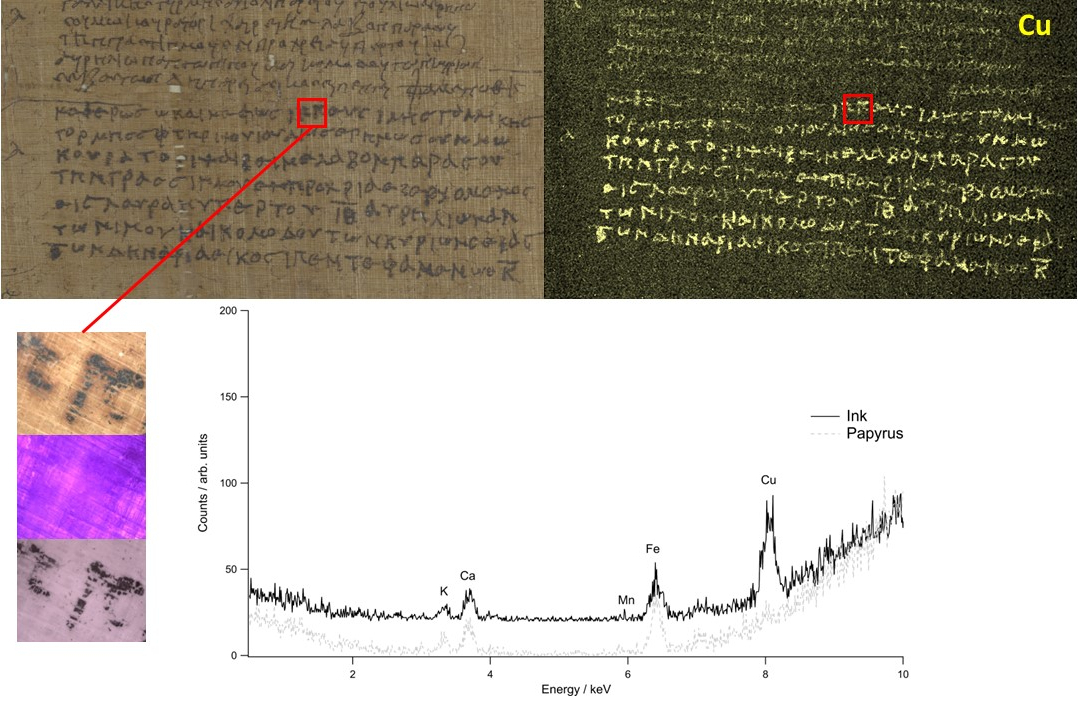
Top: Photo (left) and distribution of copper right) of the bottom right column of Papyrus Graec. 184.I. from Staats- und Universitätsbibliothek Hamburg (SUB). Bottom: visible, ultraviolet and near-infrared pictures of a letter (left, from top to bottom), with corresponding XRF spectra of ink and papyrus support (right).

The RFK02 project investigated the material composition of inks used on Greek papyri from Hellenistic times through Late Antiquity (approximately 300 BCE to 600 CE), examining how ancient writing materials evolved over time and what material analysis can reveal about scribal practices, cultural exchanges, and technological developments in the ancient Mediterranean world. By combining traditional philological and papyrological approaches with archaeometric methods, this research provided new insights into the production and use of writing materials in antiquity.

The project focused on securely dated administrative documents, with a focus on multilingual and multicultural texts, primarily from major papyrus collections including the Staats- und Universitätsbibliothek Hamburg, the Institut de Papyrologie de la Sorbonne (Paris), the papyrus collection of the Österreichische Nationalbibliothek (Vienna), the Rijksmuseum van Oudheden (Leiden) and the Cambridge University Library. Using non-invasive analytical techniques such as X-ray fluorescence (XRF) mapping, infrared reflectography (IRR) and Raman spectrometry, the project characterized ink compositions and traced their development across different periods and regions. Over the course of the project, 73 securely dated papyri were analysed, revealing that most ancient Greek inks were, as suspected, pure carbon-based, though more than a third contained at least traces of metal (iron, copper or lead), already from early Hellenistic time. These results were contextualised by the extensive study of Antique and Byzantine written sources on recipes. These findings contribute to our understanding of regional variations and chronological developments in ink production technologies. The project has also strived to improve analytical methods to investigate inks, especially on papyrus.

The project was deeply integrated into the cluster's collaborative research environment through participation in study days, digital lunch seminars, and cross-field collaborations with many individual projects of the cluster (RFA06, RFA07, RFA19, RFB14, RFD07, RFE08, RFE16, PLMPI, FNT07, RFK01, RFK07, RFK08, FNT07). These collaborations provided opportunities to improve material analysis methods, by adapting them to a range of different materials (pigments and dyes, paper, palm leaves, glazed objects). Analysis of the composition of inks from other historical periods and cultures, such as early Islamic or late Byzantine inks also provided invaluable contributions to our understanding of the history of inks. Numerous collaborations with external institutions such as the Staats- und Universitätsbibliothek Hamburg (https://www.csmc.uni-hamburg.de/about/blog/2023-07-05-written-treasures-of-hamburg.html, https://www.csmc.uni-hamburg.de/artefact-lab/artefact-lab/mobile/provenance-dating/receipt-book.html), the Staatsarchiv Hamburg (https://www.csmc.uni-hamburg.de/about/blog/2025-05-22-red-city-book.html), the Rylands library (Manchester, UK), the Museum für Kunst und Gewerbe (Hamburg), the Graz University Library (https://www.csmc.uni-hamburg.de/about/blog/2024-09-09-mummy-book.html), the Marciana library (Venice), the Diocesan Museum of Pelplin (Poland), and the Rijksmuseum van Oudheden in Leiden (Netherlands) (https://www.csmc.uni-hamburg.de/artefact-lab/artefact-lab/mobile/hazards/book-of-the-dead.html), led to many publications, participations in workshops, and presentations at conferences.

Finally, the project was actively engaged in public outreach and teaching. Contributions were made to the cluster's knowledge transfer initiatives through the Artefact Profiling Guide (https://www.csmc.uni-hamburg.de/profiling-guide.html). Regular participation in the cluster's "Girls and Boys' Day" with laboratory demonstrations (https://www.csmc.uni-hamburg.de/about/blog/2023-05-02-girls-boys-day.html, https://www.csmc.uni-hamburg.de/about/blog/2024-05-03-girls-boys-day.html, https://www.csmc.uni-hamburg.de/news/2025-04-10-girls-day-boys-day.html), participation in the UHH Großes Campusfest (https://www.uni-hamburg.de/newsroom/campus/2023/0531-campusfest.html), and various interventions in secondary schools introduced manuscripts cultures and ink analysis to a young audience. A broader audience was also reached through contributions to the exhibition "Hamburgs Schriftschätze: Neue Fragen an alte Manuskripte" at Hamburg State Library, with two exhibition catalogue entries (https://www.csmc.uni-hamburg.de/hamburgs-schriftschaetze/english/roman-army.html and https://www.csmc.uni-hamburg.de/hamburgs-schriftschaetze/english/epikrisis.html), and through an Artefact of the Month (https://www.csmc.uni-hamburg.de/publications/aom/028-en.html).

Interview for the CSMC blog: https://www.csmc.uni-hamburg.de/about/blog/2022-08-05-olivier-bonnerot.html

More Information

Publications

Publications directly related to the project:

  • O. Bonnerot, L. Mascia, “Scribes and Writing Practices in Egypt’s Ala Veterana Gallica: A Preliminary Study of Inks from a Military Roll”, 2023 Proceedings of the IMEKO TC-4 International Conference on Metrology for Archaeology and Cultural Heritage. Rome (Italie), October 19-21 2023, 845-850.
  • L. Berkes, G. Nehring, O. Bonnerot, M. Krutzsch, I. Rabin, T. S. Richter, “Mixed inks in two Coptic documents from the Hermopolite region”, Pylon 3, 2023.
  • O. Bonnerot, E. Chronopoulou, M. Krutzsch, I. Rabin, “Instrumental analysis of the inks from the magical papyrus P.Berol. inv. 5026 (PGM II / GEMF 30)”, Zeitschrift für Papyrologie und Epigraphik 224, 2022, 267-273.
  • O. Bonnerot, L. Mascia, “Retiring in Red: Unveiling the Story of a Veteran Roman Soldier through Scarlet Letters”. In L. Mascia, K. Becker (eds): Artefact of the Month No. 28, CSMC, Hamburg. https://www.csmc.uni-hamburg.de/publications/aom/028-en.html
  • L. Mascia, O. Bonnerot, “A Soldier Retires - An Excerpt from the Epikrisis Acts of the Prefect Vibius Maximus”. In K. Harter-Uibopuu, K. Janz-Wenig (eds): Hamburgs Schriftschätze: Neue Fragen an alte Manuskripte (Written Treasures of Hamburg: New Questions to Old Manuscripts), 2023, 58-61.
  • L. Mascia, O. Bonnerot, “Multiculturalism in the Roman Army - A Receipt Book from the ala veterana Gallica”. In K. Harter-Uibopuu, K. Janz-Wenig (eds): Hamburgs Schriftschätze: Neue Fragen an alte Manuskripte (Written Treasures of Hamburg: New Questions to Old Manuscripts), 2023, 54-57.
     

Publications stemming from cooperation with other projects:

  • G. Nehring, O. Bonnerot, S. Bosch, C. Colini, K. A. Huskin, G. Marotta, I. Shevchuk, “How to Non-Invasively Analyse Black Writing Inks?”, Analytical Methods Committee Technical Briefs (in press).
  • K. Grigoriadou, O. Bonnerot, C. Colini, “Investigating the inks of Cod. Philol. 88 (State and University Library Hamburg) through UV-VIS-NIR reflectography and μ-XRF imaging”, in D. Deckers, L. Orlandi, J. Maksimczuk (eds.), Mesótēs. At the Intersection of Textuality and Materiality, Papers on Textual Criticism, Manuscript Studies, and Scholarly Practices. Presented to Christian Brockmann on his 65th Birthday. Transmissions series, De Gruyter, 2025.
  • S. Bosch, O. Bonnerot, S. Sathiyamani, “Multi-Instrumental Analysis of Pigments and Dyes”, in A. Helman-Wazny: A Story of One Object: Crossdisciplinary study of Zhangzhung Nyengyu tsakali collection, De Gruyter, 2025.
  • C. Colini, J. Maksimczuk, M. Heiles, A. S. Armstrong, S. Aspiotis, C. Berthold, O. Bonnerot, M. Creydt, A. Fedeli, K. Grigoriadou, S. Jaengsawang, M. Kohs, G. Marotta, L. Mascia, J. Nassan Agha, S.-C. Raschmann, C. Reck, C. Ruzzier, S. Sathiyamani, “Towards the Investigation of Material Choices in Written Artefacts: Methodological Reflections”, Working papers: Vol. 10 (Occasional Papers; Volume 10), https://doi.org/10.25592/uhhfdm.17049
  • C. Brockmann, J. Maksimczuk, O. Bonnerot, K. Grigoriadou, “Sylvester Syropoulos’ Wandering Notes: Displaced into a Foreign Context (From Vat. Reg. gr. 116 to Ambr. D 54 sup.)”, The Vatican Library Review 4/1, 2025.
  • S. Sathiyamani, S. Ngiam, O. Bonnerot, S. Jaengsawang, P. Panarut, A. Helman-Ważny, C. Colini, “Material Characterisation of 19–20th century manuscripts from Northern Thailand”, Restaurator. International Journal for the Preservation of Library and Archival Material 45 (2-3), 2024, 117-140.
  • C. Brockmann, O. Bonnerot, J. Maksimczuk, “A Scribe and His Inks: An Interdisciplinary Approach to Byzantine Inks in the Manuscripts Coislin 330 and Vat. gr. 244”, in G. De Gregorio, G. Prinzing, R. Tocci (eds), Festschrift in honor of Erich Lamberz, 2024.
  • O. Bonnerot, “4.2. Material analysis of the pigments”, in S. Demichelis (author), Il Libro dei Morti di Baki (P. Torino Cat. 1827/1 + Cat. 1811 + P. IFAO 289-2890), Museo Egizio / Franco Cosimo Panini Editore: Modena (Italy), 2021, 131-132.
  • N. Nehring, O. Bonnerot, N. Gordon, I. Rabin, “Writing and Correcting a Torah Scroll in Germany of the Thirteenth and Fourteenth Centuries”, COMSt Bulletin 7, 2021, 123-127.

Future publications:

  • O. Bonnerot, G. Nehring, C. Colini, S. Sathiyamani, “Innovations and Limitations in Ink Analysis on Papyrus”, in M. Blanco, INK-Quiry. Text and materiality of historical inks from Greco-Roman Antiquity to Arab Middle Ages, Nuncius series. Studies and Sources in the Material and Visual History of Science, Brill (under review)
  • S. Haas, S. Bosch, O. Bonnerot, S. Sathiyamani, A. Helman-Wazny "In-depth study of an Ancient 15th Century Tibetan Zhangzhung Nyengyu Tsakali Collection yield to the discovery of a new Tibet-Indigo pigment" (under review)
  • O. Bonnerot, L. Mascia, G. Nehring, “Zenon’s ink legacy: the oldest papyrus with an iron-containing ink at the Hamburg Library” (in writing)
  • L. Mascia, O. Bonnerot, S. Aspiotis, S. Ehteram, "Egyptianising and Egyptian Scarabs and Scaraboids from the Museum für Kunst und Gewerbe (Hamburg, Germany)" (in writing)
  • G. Nehring, S. Bosch, O. Bonnerot, A. Aspiotis, “A deep dive into the inks of Gutenberg’s bible” (in writing)

Presentations and Posters

Presentations and posters at conferences directly related to the project:

  • O. Bonnerot, L. Mascia, “"Burn these things, make ink and write": ink recipes from Greco-Egyptian and Coptic magical papyri”, Congrès International de l’Histoire de l’Art, Lyon (France), 06/2024.
  • G. Nehring, O. Bonnerot, S. Bosch, I. Rabin, “Black Writing Inks in Ancient and Early Medieval Papyri: Questions, Research and Future Investigations”, Seventh Papyrus Curatorial and Conservation Meeting, Leiden (Pays Bas), 06/2024.
  • S. Sathiyamani, O. Bonnerot, C. Colini, “Material analysis of papyri from the chancellery of Qurra b. Sharik”, 6th International Conference on Innovation in Art Research and Technology, Oslo (Norway), 06/2024.
  • O. Bonnerot, G. Nehring, “Ink-sights into Hellenistic and Roman Egypt: a journey from Carbon to Iron-gall inks”, 4th International Congress of Archaeological Sciences in the Eastern Mediterranean and the Middle East, Nicosia (Cyprus), 05/2024.
  • O. Bonnerot, “Priests, Officials, and Scribes: “Ink-Contacts” in the Multilingual and Multicultural Panorama of Greco-Roman and Late Antique Egypt”, Ink-Quiry Inks- between text and materiality, Madrid (Spain), 12/2023.
  • O. Bonnerot, L. Mascia, “Scribes and Writing Practices in Egypt’s Ala Veterana Gallica: A Preliminary Study of Inks from a Military Roll”, Metroarcheo, Rome (Italy), 10/2023.
  • I. Rabin, G. Nehring, M. Krutzsch, O. Bonnerot, O. Hahn, “Berlin P.13275 – conservation and material analysis”, XXXth International Congress of Papyrology, Paris (France), 07/2022.

Presentations and posters stemming from cooperation with other projects:

  • G. Nehring, O. Bonnerot, K. A. Huskin, E. Jacobi, S. Soliman, “Unveiling the Original Colours of the Book of the Dead of Qenna”, 31st International Congress of Papyrology, Cologne (Germany), 07/2025.
  • S. Aspiotis, O. Bonnerot, S. Ehteram, L. Mascia, “Non-invasive material analysis of Egyptian Shabtis by XRF, Raman spectroscopy and CT Scanning”, Young Researchers in Archaeometry 2024, Nicosia (Cyprus), 10/2024.
  • S. Aspiotis, O. Bonnerot, L. Mascia, “Material analysis of Egyptian scarabs by XRF and Raman spectroscopy”, European Mineralogical Conference 2024, Dublin (Ireland), 08/2024.
  • G. Nehring, O. Bonnerot, S. Bosch, C. Colini, A. Fedeli, K. Grigoriadou, O. Hahn, A Helman-Wazny, K. A. Huskin, S. Sathiyamani, I. Shevchuk, K. Janz-Wenig, I. Rabin, “The CSMC Mobile Lab for the Study of Written Artefacts”, Textus et Pictura, Torún (Poland), 04/2024.
  • S. Aspiotis, C. Berns, O. Bonnerot, S. Bosch, C. Colini, L. Mascia, B. Burgaya Martínez, “Material analysis of coloured figurines, statues, inscriptions and architectural elements: case studies from Oxyrhynchus and Miletus and future perspectives”, Colours revealed: Polychrome monuments in the Roman provinces detection, interpretation, visualization, Hainburg (Austria), 03/2024.
  • J. Maksimczuk, O. Bonnerot, “Ink analysis with the combination of UV-vis-NIR reflectography and XRF”, Archäologie der Handschrift, Freiburg im Breisgau (Germany), 10/2023.
  • S. Sathiyamani, S. Aspiotis, C. Colini, G. Ciotti, O. Bonnerot, “Raman spectroscopy as a tool for analysing carbon inks from ancient palm-leaf manuscripts”, International Conference on the Application of Raman Spectroscopy in Art and Archaeology, Athens (Greece), 09/2023.
  • J. Maksimczuk, O. Bonnerot, “An interdisciplinary analysis of the Greek manuscript Vat. Reg. gr. 116 (Manuscript Studies, Textual Criticism, Ink Analysis)”, Studying Written Artefacts: Challenges and Perspectives, Hamburg (Germany), 09/2023.
  • S. Sathiyamani, O. Bonnerot, P. Panarut, S. Jaengsawang, C. Colini, “Material Characterization of 19th century manuscripts from Northern Thailand”, Technart 2023, Lisbon (Portugal), 05/2023.
  • G. Nehring, O. Bonnerot, N. Gordon, I. Rabin, “Same but different – XRF study of inks from a medieval Torah scroll”, Der 34. Deutsche Orientalistentag, Berlin (Germany), 09/2022.
  • O. Bonnerot, J. Maksimczuk, “Material analysis of inks from Byzantine manuscripts”, 24th International Congress of Byzantine Studies, Venice and Padua (Italy), 08/2022.

Project Overview

Project lead: Olivier Bonnerot

Status: completed (2022–2025)

Project affiliation: Cluster of Excellence Understanding Written Artefacts (UWA I)

Research Field: Selecting Materials (RFK)

Project number: RFK02

  • UWA 2019–2025

Last update: 28 October 2026

  • Feedback
  • Legal notice
  • Privacy statement
  • Accessibility
  • Site map

University of Hamburg

Innovating and Cooperating for a Sustainable Future in a Digital Age

  • Follow us on Instagram.
  • Follow us on Facebook.
  • Connect with us on LinkedIn.
  • Follow us on Mastodon.
  • Follow us on Bluesky.
  • Subscribe to our channel on YouTube.
    • Studies
    • Prospective students
    • Continuing education
    • Research
    • Teaching at UHH
    • Doctoral studies
    • Job opportunities
    • Knowledge exchange
    • University
    • Excellence
    • Faculties
    • Alumni
    • Contact
    • Campus Navigator
    • UHHApp
    • Emergencies, safety and security
    • Antidiscrimination
Go to family-friendly higher education institution audit
Go to internationalisation re-audit
Go to the Sustainability Audit page
Go to Diversity Audit
Go to System accreditation

© 2026 University of Hamburg. All rights reserved