• Zur Metanavigation
  • Zur Hauptnavigation
  • Zur Suche
  • Zum Inhalt
  • Zur Subnavigation
  • Zum Seitenfuß
  • University of Hamburg
  • For journalists
  • Staff Service Portal0
  • STiNE
https://www.kus.uni-hamburg.de/aktuelles.json?recentnews=true
  • Institutions and target groups
    • Einrichtungen
      • Faculties

        • Faculty of Law
        • Faculty of Business, Economics and Social Sciences
        • Faculty of Medicine
        • Faculty of Education
        • Faculty of Humanities
        • Faculty of Mathematics, Informatics and Natural Sciences
        • Faculty of Psychology and Human Movement Science
        • University of Hamburg Business School
      • Services

        • Study Information Net STiNE
        • Surfmail
        • Exchange
        • Staff Service Portal
        • Learning Platforms
        • Katalogplus – Catalogue of Hamburg Libraries
        • SharePoint
      • Student facilities and services

        • Campus Center
        • Career Center
        • PIASTA
        • AStA (student council)
        • University Sports
        • University Music
        • Family Office
        • University Language Center
        • General Languages
        • Office of Affairs for Students with Disabilities or Chronic Diseases
        • Departmental libraries
        • Healthy Campus
      • Further facilities and services

        • The Cluster of Excellence CLICCS
        • The Cluster of Excellence CUI
        • The Cluster of Excellence Quantum Universe
        • The Cluster of Excellence Understanding Written Artefacts
        • Hamburg Research Academy
        • Pier Plus
        • Hamburg Center for University Teaching and Learning (HUL)
        • Hub for Crossdisciplinary Learning (HCL)
        • CEN
        • Museums and collections
        • University Archives (in German)
        • Regional Computing Center (RRZ)
        • University Administration
        • Knowledge Exchange Agency
        • The Unikontor Shop (in German)
    • Target groups

      • Prospective students
      • Students
      • International prospective students
      • Young researchers
      • Researchers
      • Instructors
      • Staff
      • Prospective continuing education students
      • Alumni
      • Journalists
      • Refugees (in German only)
    Close
  • /sitemap.json
University of Hamburg - to research, to teach, to educate and form, to homepage

CSMC

CSMCCentre for the Study of Manuscript Cultures
  • About
    • People
    • News
    • Ethics
    • Equity & Diversity
    • Sustainability
    • Logbook: The CSMC Blog
    • Contact & Newsletter
    • Vacant Positions
    • Intranet
  • Research
    • Concepts & Methods Units
    • Project Groups
    • Individual Research Projects
    • Working Groups
    • Affiliated Projects
    • Fellowships
    • Research Events
    • UWA I (2019–2025)
    • SFB (2012–2020)
  • Core Units
    • Laboratories
    • Graduate School
    • Cultural Heritage
    • Library
  • Collaboration
    • with Research Partners
    • with Archives, Libraries, and Museums
    • with Artists
    • with Companies
    • with Schools
    • within the HALM and PIER Networks
  • Publications
    • manuscript cultures
    • Studies in Manuscript Cultures
    • Occasional Papers
    • Software
    • Research Data and Information Systems
    • Written Artefact Profiling Guide
    • Artefact of the Month
    • Mesopotamian Bulletins
    • Videos
    • More Publications

Photo: CSMC

  1. UHH
  2. CSMC
  3. UWA 2019–2025
  4. Research Fields
  5. Research Field D: (Re-)Shaping Written Artefacts
  6. Multilayered Manuscripts in the Transmission of Aristotle’s Organon

Multilayered Manuscripts in the Transmission of Aristotle’s Organon
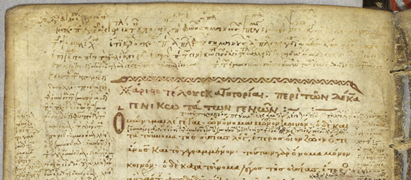

Paris, BnF, Coislin 330 © BnF

The Organon, namely the collection of Aristotle’s six treatises on logic, scientific reasoning, and theory of argumentation, was passed down to us in circa 150 Greek manuscripts written between the 9th and the 16th century. Most Organon manuscripts are complex objects reflecting a long, open textual and material transmission. They are prime examples of multilayered artefacts, for, in addition to a core and paracontent written during the first production process, they contain a web of layers of disparate qualities and origins, resulting from different users’ engagement with the manuscripts over centuries. Such layers consist in, for instance, emendations to the core or paracontent (by conjecture or collation), exegetical notes explaining the rather difficult core text (mainly more or less reworked quotations from independent late-antique or Byzantine commentaries), added folios containing core or paracontent that had been lost after the first production process. Focusing on well-chosen case studies, this project explores the practices employed by the scribes, scholars, and laymen who introduced additional layers to historically, codicologically, and philologically relevant Organon manuscripts. This investigation reveals the origins, goals, and individual fates of the analysed layers as well as their relationship with the first production unit of the manuscripts that contain them. Furthermore, it allows us to evaluate the constituent principles of layers in Organon manuscripts and compare their implementation in this context to those found in different manuscript cultures investigated at the Cluster. In addition to conceptualising general and specific features of multilayeredness in Organon manuscripts, a further goal of this project is to shed light on some parts of the Greek manuscript tradition of the Organon, especially for the First and Second Analytics, whose story remains mostly untold. Thus, our project aims to establish a partial stemma codicum of the Analytics, based on textual, material, and cultural analyses of the manuscripts of interest and the families and groups to which their core and paracontent (as well as their different layers) are related.

The manuscript and text phenomena that are of interest to us are, among others, ‘contamination’, ‘physical evidence’, ‘composite manuscripts’, ‘disiecta membra’, ‘palimpsests’, and ‘paracontent’. Our approach is multidisciplinary and involves Philology, Textual Criticism, Manuscript Studies, Codicology, Palaeography, History, and the Natural Sciences (mainly ink analysis and MSI analysis).

Philosophy by Hand


People

Project lead: Christian Brockmann, José Maksimczuk

Project Overview

Project lead: Christian Brockmann, José Maksimczuk

Status: completed (2019–2025)

Project affiliation: Cluster of Excellence Understanding Written Artefacts (UWA I)

Research Field: (Re-)Shaping Written Artefacts (RFD)

Project number: RFD07

  • UWA 2019–2025

Last update: 28 October 2026

  • Feedback
  • Legal notice
  • Privacy statement
  • Accessibility
  • Site map

University of Hamburg

Innovating and Cooperating for a Sustainable Future in a Digital Age

  • Follow us on Instagram.
  • Follow us on Facebook.
  • Connect with us on LinkedIn.
  • Follow us on Mastodon.
  • Follow us on Bluesky.
  • Subscribe to our channel on YouTube.
    • Studies
    • Prospective students
    • Continuing education
    • Research
    • Teaching at UHH
    • Doctoral studies
    • Job opportunities
    • Knowledge exchange
    • University
    • Excellence
    • Faculties
    • Alumni
    • Contact
    • Campus Navigator
    • UHHApp
    • Emergencies, safety and security
    • Antidiscrimination
Go to family-friendly higher education institution audit
Go to internationalisation re-audit
Go to the Sustainability Audit page
Go to Diversity Audit
Go to System accreditation

© 2026 University of Hamburg. All rights reserved