CSMC
CSMCCentre for the Study of Manuscript Cultures
Photo: UHH/Denstorf
5 October 2026
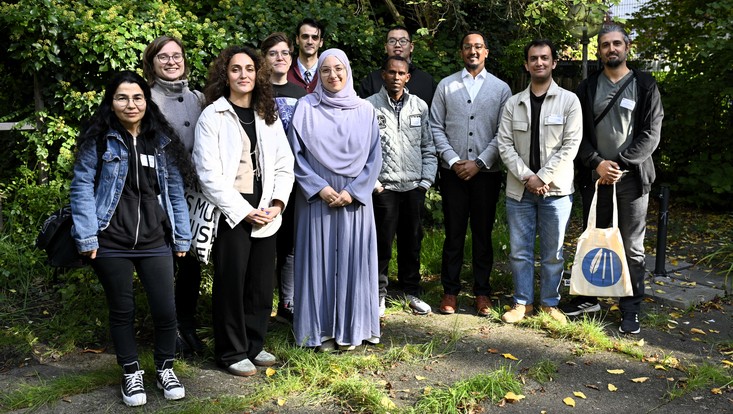
Photo: CSMC
It is a day we at the CSMC have been awaiting for two years: at the start of the 2026/2027 winter semester, we welcome a group of new MA students to our centre. Due to the transition from a one-year to a two-year programme, it is the first intake since autumn 2024.
A number of changes have been made to the newly launched MA programme in Manuscript Cultures: for instance, the new curriculum integrates modules on ‘Cultural Heritage and Ethics in Manuscript Research’, which places questions of ownership, provenance, access, and responsibility at the centre of critical reflection, and modules from the computer sciences, including courses on information systems and natural language processing as well as on computer-assisted analysis of manuscript visuals.
In other respects, things have remained the same compared to previous years: just like its precursors, the new cohort brings together a considerable diversity of young graduates from various countries of origin and with very different academic backgrounds. What unites them all is an interest in handwritten documents and in researching them using a variety of methods from the humanities, natural sciences, and computer science.
On 5 October, the group met for the first time. On the premises of the CSMC, they received an introduction to the programme by Hanna Wimmer (Head of the MA programme) and Merryl Rebello (coordinator of the Graduate School), met some of the CSMC’s PhD researchers, and got a first overview of the different modules.
The MA ‘Manuscript Cultures’ provides a comprehensive and research-oriented introduction to the study of handwritten artefacts in a global perspective, with particular emphasis on Asia, Africa, and Europe. It covers a wide variety of manuscript traditions and materials, ranging from religious and literary manuscripts to scientific, administrative, and artistic documents. Students learn to analyse manuscripts as carriers of text, image, notation, and other forms of graphic information, and at the same time as material objects embedded in specific historical and social contexts. In its explicit combination of cultural, philological, analytical, and methodological perspectives on manuscripts, the programme offers a uniquely comprehensive education in the cross-disciplinary engagement with manuscripts from all epochs and regions of the world.