• Zur Metanavigation
  • Zur Hauptnavigation
  • Zur Suche
  • Zum Inhalt
  • Zur Subnavigation
  • Zum Seitenfuß
  • University of Hamburg
  • For journalists
  • Staff Service Portal0
  • STiNE
https://www.kus.uni-hamburg.de/aktuelles.json?recentnews=true
  • Institutions and target groups
    • Einrichtungen
      • Faculties

        • Faculty of Law
        • Faculty of Business, Economics and Social Sciences
        • Faculty of Medicine
        • Faculty of Education
        • Faculty of Humanities
        • Faculty of Mathematics, Informatics and Natural Sciences
        • Faculty of Psychology and Human Movement Science
        • University of Hamburg Business School
      • Services

        • Study Information Net STiNE
        • Surfmail
        • Exchange
        • Staff Service Portal
        • Learning Platforms
        • Katalogplus – Catalogue of Hamburg Libraries
        • SharePoint
      • Student facilities and services

        • Campus Center
        • Career Center
        • PIASTA
        • AStA (student council)
        • University Sports
        • University Music
        • Family Office
        • University Language Center
        • General Languages
        • Office of Affairs for Students with Disabilities or Chronic Diseases
        • Departmental libraries
        • Healthy Campus
      • Further facilities and services

        • The Cluster of Excellence CLICCS
        • The Cluster of Excellence CUI
        • The Cluster of Excellence Quantum Universe
        • The Cluster of Excellence Understanding Written Artefacts
        • Hamburg Research Academy
        • Pier Plus
        • Hamburg Center for University Teaching and Learning (HUL)
        • Hub for Crossdisciplinary Learning (HCL)
        • CEN
        • Museums and collections
        • University Archives (in German)
        • Regional Computing Center (RRZ)
        • University Administration
        • Knowledge Exchange Agency
        • The Unikontor Shop (in German)
    • Target groups

      • Prospective students
      • Students
      • International prospective students
      • Young researchers
      • Researchers
      • Instructors
      • Staff
      • Prospective continuing education students
      • Alumni
      • Journalists
      • Refugees (in German only)
    Close
  • /sitemap.json
University of Hamburg - to research, to teach, to educate and form, to homepage

CSMC

CSMCCentre for the Study of Manuscript Cultures
  • About
    • People
    • News
    • Ethics
    • Equity & Diversity
    • Sustainability
    • Logbook: The CSMC Blog
    • Contact & Newsletter
    • Vacant Positions
    • Intranet
  • Research
    • Concepts & Methods Units
    • Project Groups
    • Individual Research Projects
    • Working Groups
    • Affiliated Projects
    • Fellowships
    • Research Events
    • UWA I (2019–2025)
    • SFB (2012–2020)
  • Core Units
    • Laboratories
    • Graduate School
    • Cultural Heritage
    • Library
  • Collaboration
    • with Research Partners
    • with Archives, Libraries, and Museums
    • with Artists
    • with Companies
    • with Schools
    • within the HALM and PIER Networks
  • Publications
    • manuscript cultures
    • Studies in Manuscript Cultures
    • Occasional Papers
    • Software
    • Research Data and Information Systems
    • Written Artefact Profiling Guide
    • Artefact of the Month
    • Mesopotamian Bulletins
    • Videos
    • More Publications

Photo: CSMC

  1. UHH
  2. CSMC
  3. UWA 2019–2025
  4. Research Fields
  5. Research Field C: Creating Originals
  6. Parliamentary Shorthand Writing as Material and Political Practice

Parliamentary Shorthand Writing as Material and Political Practice
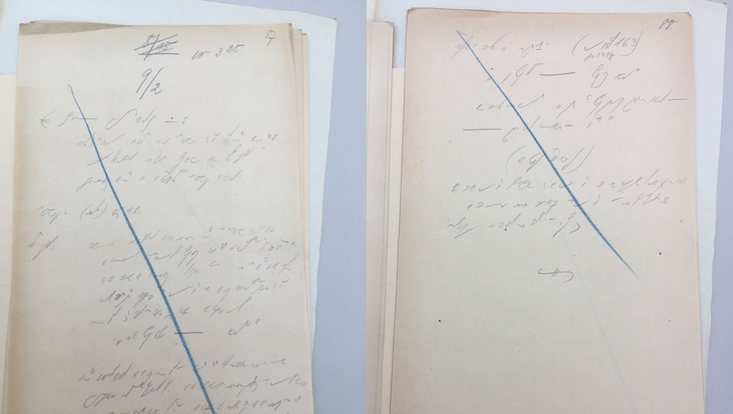
During the 19th century, a new form of written artefacts rapidly grew in popularity in Europe: manuscripts written in shorthand. From the beginning, shorthand was more than a graphic notation system, as it implied a wide range of concomitant changes in writing materials, writing postures, and the storage of writings. Shorthand writing swiftly turned into an indispensable tool for recording parliamentary debates. At the same time, the technical details and conceptual implications of shorthand protocolling political affairs remained contested throughout the 19th century. This debate centred on the materiality of handwriting and it forms a crucial part of the wider changes in political culture towards ‘parliamentarism’ and ‘liberalism’. This project investigates the material culture and political impact of shorthand manuscript cultures as they developed in German Parliaments in the decades between 1819 (first stenographed debate in Germany, Bavaria) and the early 1930s (introduction of the Deutsche Einheitskurzschrift). Thus, it prepares materials for future research, such as comparing the development of shorthand writing in the political sphere to the equally important, yet slightly later rise of shorthand in the modern office.

Within research field C Creating Originals, this study of shorthand writing tackles the competition between immediate shorthand records and longhand versions for the status of the original. While the material object that resulted from shorthand protocolling – a shorthand manuscript – was undoubtedly the most direct (and, one might think, most ‘original’) material trace of the oral debate, officials did not consider it the original. What came to be known as ‘original’ protocols of Parliamentary debates were the longhand versions based on shorthand records revised, compiled, and altered into an authoritative record. Furthermore, where a secondary version became the most authentic record of parliamentary debates, this sparked debates about reliability that draw political frictions in sharp contours. Eventually, shorthand writing as a new material form of handwriting enabled a new form of transmitting information and authenticating processes of political decision-making. The project demonstrates how specific manuscripts cultures emerged in conjunction with political and social changes.

Project Overview

Project lead: Markus Friedrich

Research Associate: Hannah Boedekker

Status: completed (2019–2023)

Project affiliation: Cluster of Excellence Understanding Written Artefacts (UWA I)

Research Field: Creating Originals (RFC) 

Project number: RFC05

  • UWA 2019–2025

Last update: 28 October 2026

  • Feedback
  • Legal notice
  • Privacy statement
  • Accessibility
  • Site map

University of Hamburg

Innovating and Cooperating for a Sustainable Future in a Digital Age

  • Follow us on Instagram.
  • Follow us on Facebook.
  • Connect with us on LinkedIn.
  • Follow us on Mastodon.
  • Follow us on Bluesky.
  • Subscribe to our channel on YouTube.
    • Studies
    • Prospective students
    • Continuing education
    • Research
    • Teaching at UHH
    • Doctoral studies
    • Job opportunities
    • Knowledge exchange
    • University
    • Excellence
    • Faculties
    • Alumni
    • Contact
    • Campus Navigator
    • UHHApp
    • Emergencies, safety and security
    • Antidiscrimination
Go to family-friendly higher education institution audit
Go to internationalisation re-audit
Go to the Sustainability Audit page
Go to Diversity Audit
Go to System accreditation

© 2026 University of Hamburg. All rights reserved