• Zur Metanavigation
  • Zur Hauptnavigation
  • Zur Suche
  • Zum Inhalt
  • Zur Subnavigation
  • Zum Seitenfuß
  • University of Hamburg
  • For journalists
  • Staff Service Portal0
  • STiNE
https://www.kus.uni-hamburg.de/aktuelles.json?recentnews=true
  • Institutions and target groups
    • Einrichtungen
      • Faculties

        • Faculty of Law
        • Faculty of Business, Economics and Social Sciences
        • Faculty of Medicine
        • Faculty of Education
        • Faculty of Humanities
        • Faculty of Mathematics, Informatics and Natural Sciences
        • Faculty of Psychology and Human Movement Science
        • University of Hamburg Business School
      • Services

        • Study Information Net STiNE
        • Surfmail
        • Exchange
        • Staff Service Portal
        • Learning Platforms
        • Katalogplus – Catalogue of Hamburg Libraries
        • SharePoint
      • Student facilities and services

        • Campus Center
        • Career Center
        • PIASTA
        • AStA (student council)
        • University Sports
        • University Music
        • Family Office
        • University Language Center
        • General Languages
        • Office of Affairs for Students with Disabilities or Chronic Diseases
        • Departmental libraries
        • Healthy Campus
      • Further facilities and services

        • The Cluster of Excellence CLICCS
        • The Cluster of Excellence CUI
        • The Cluster of Excellence Quantum Universe
        • The Cluster of Excellence Understanding Written Artefacts
        • Hamburg Research Academy
        • Pier Plus
        • Hamburg Center for University Teaching and Learning (HUL)
        • Hub for Crossdisciplinary Learning (HCL)
        • CEN
        • Museums and collections
        • University Archives (in German)
        • Regional Computing Center (RRZ)
        • University Administration
        • Knowledge Exchange Agency
        • The Unikontor Shop (in German)
    • Target groups

      • Prospective students
      • Students
      • International prospective students
      • Young researchers
      • Researchers
      • Instructors
      • Staff
      • Prospective continuing education students
      • Alumni
      • Journalists
      • Refugees (in German only)
    Close
  • /sitemap.json
University of Hamburg - to research, to teach, to educate and form, to homepage

CSMC

CSMCCentre for the Study of Manuscript Cultures
  • About
    • People
    • News
    • Ethics
    • Equity & Diversity
    • Sustainability
    • Logbook: The CSMC Blog
    • Contact & Newsletter
    • Vacant Positions
    • Intranet
  • Research
    • Concepts & Methods Units
    • Project Groups
    • Individual Research Projects
    • Working Groups
    • Affiliated Projects
    • Fellowships
    • Research Events
    • UWA I (2019–2025)
    • SFB (2012–2020)
  • Core Units
    • Laboratories
    • Graduate School
    • Cultural Heritage
    • Library
  • Collaboration
    • with Research Partners
    • with Archives, Libraries, and Museums
    • with Artists
    • with Companies
    • with Schools
    • within the HALM and PIER Networks
  • Publications
    • manuscript cultures
    • Studies in Manuscript Cultures
    • Occasional Papers
    • Software
    • Research Data and Information Systems
    • Written Artefact Profiling Guide
    • Artefact of the Month
    • Mesopotamian Bulletins
    • Videos
    • More Publications

Photo: CSMC

  1. UHH
  2. CSMC
  3. Registration
  4. Digital Lunch Seminar Series

Digital Lunch Seminar Series

Spring 2024
UHH/Esfandiari

Convenor: Markus Fischer

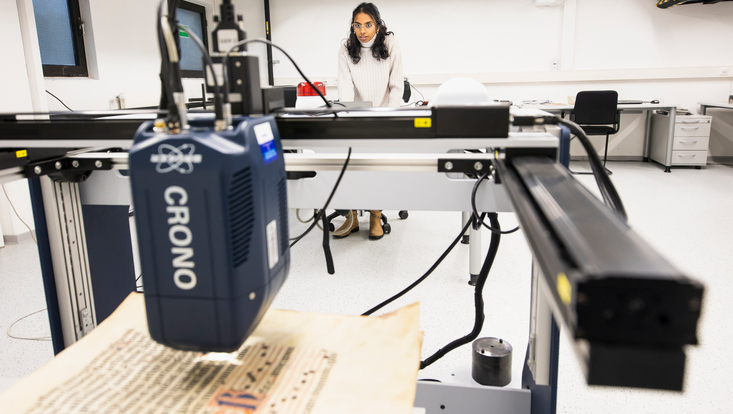
Two researchers, one hour, one topic: the Digital Lunch Seminar Series highlights concrete examples of cooperation between the humanities and the natural sciences at CSMC. This winter semester, the series is back with four lectures.

The fifth edition of the seminar series starts on 13 May with a joint presentation by Alba Fedeli and Sowmeya Sathiyamani. They use three fragments that likely belonged to a larger Qur’anic codex from Cairo to show that analysis of the materials can provide precious information about their relative chronology, which is essential when dealing with undated, unlocated, and fragmentary manuscripts.

On 10 June, Cécile Michel and Christian Schroer provide their highly-anticipated field report about their trip to the Louvre earlier this year, where they used ENCI, the world’s first mobile computer tomograph to analyse cultural heritage objects, for the first time to read sealed cuneiform clay tablets.

On 1 July, Hussein Mohammed and Jost Gippert explain how recent advances in the field of generative artificial intelligence can help to retrieve the undertexts from historical palimpsests – even in cases in which modern imaging techniques reach their limits.

Finally, on 8 July, Stelios Aspiotis, Olivier Bonnerot, and Leah Mascia present the preliminary results of an interdisciplinary study dedicated to a corpus of ancient Egyptian and Egyptianising scarabs and scaraboids part of the collection of the Museum für Kunst und Gewerbe in Hamburg.

The lecture series is open to everyone.


ZOOM link: https://uni-hamburg.zoom.us/j/66042506209?pwd=blZmV1B5NFlUWFBIQ2FDUGQvSG9Ldz09

  • Meeting ID: 660 4250 6209
  • Passcode: 19402924

Schedule: Mondays, 12:00 pm – 1:00 pm

Date Titel Speakers
13 May 2024 Two Inks and a Qur’anic Fragment on Parchment: Insights from a Cross-disciplinary Study

Alba Fedeli and Sowmeya
Sathiyamani

Chair: Olivier Bonnerot

10 June 2024 ENCI - What is there to Report from Paris?

Cecile Michel and Andreas Schropp

1 July 2024 Enhancing the Readability of Palimpsests Using Generative AI

Husein Mohammed and Jost Gippert

Chair: Lucas F. Voges

8 July 2024 Egyptian and Egyptianising Scarabs and Scaraboids: Glazed Delicacies

Leah Mascia, Stylianos
Aspiotis, and Olivier Bonnerot

Chair: Sowmeya
Sathiyamani 

Abstracts and Contributors

Two Inks and a Qur’anic Fragment on Parchment: Insights from a Cross-Disciplinary Study

Monday, 13 May 2024, 12:00 pm – 1:00 pm

When working on (early) Qur’anic manuscripts, the study of their textual contents, production and use cannot be divorced from the study of their materiality, as the layers of the writing system of the manuscripts’ texts convey meaning. The analysis of the materials that constitute these layers can provide precious information about their relative chronology, which is essential when dealing with undated, unlocated and fragmentary manuscripts.

In this work, we share our results from an interdisciplinary study of three fragmentary parchment leaves, currently part of the collection at the Institut für Arabistik und Islamwissenschaft, Universität Münster. These fragments likely belonged to a larger Qur’anic codex from Cairo, and have been dated to around 9th – 10th century C.E. The writing system uses only the consonantal skeleton and consonantal diacritics to distinguish homograph letters. The script is monochromatic and there are traces of reinking of part of the text. Certain sections of the inked areas show deterioration, signalling at ink corrosion. The inks were characterized following the protocol developed at the CSMC and BAM. The results revealed the use of iron-gall ink with different elemental compositions. Two different variants of the ink were used for writing the manuscript, the first one that was used to pen the entire text at the time of its production, and a second one, used for adjusting and re-inking sections of the text. The differentiation of the inks provided insights for the relative chronology of the layers and a novel understanding of the object. The interdisciplinary approach to the study of the parchment leaves - bringing together palaeography, codicology, history of the text, philology and material analysis - revealed its potentialities when the object is addressed in its wholeness.


Alba Fedeli is a research associate at the Cluster of Excellence 'Understanding Written Artefacts' (Universität Hamburg), as PI of the research project ‘What is in a scribe’s mind and inkwell’ and a Research Associate in the Department of Near Eastern Languages and Cultures at Harvard University.

Fedeli earned her Ph.D. from the University of Birmingham, UK, after completing her studies in Italy with Sergio Noja Noseda. Her published work features the edition and reconstruction of the scriptio inferior of the Mingana-Lewis Qur'anic palimpsest and digital edition of other Qur'anic manuscripts. Fedeli has been involved in several projects on Qur'anic manuscripts, including the digitisation of the Sanaa Palimpsest at Dar al-Makhtutat in 2007. She was a research fellow at CEU in Budapest, the John Rylands Research Institute in Manchester, FSCIRE in Bologna and the co-PI of the DFG-AHRC project ‘The intertwined world of the oral and written transmission of sacred traditions in the Middle East’ (InterSaME, 2020-2023) at the University of Hamburg in collaboration with Geoffrey Khan at the University of Cambridge.

Sowmeya Sathiyamani is a doctoral researcher in Chemistry at the Universität Hamburg. She graduated with a master’s in chemistry from the University of Delhi in 2019. She is also a research associate at the CSMC, in the research project RFK 01 ‘The Scribe’s Choice: Writing Supports in Arabic Documents of the Early Islamic Centuries’ since 2022.

ENCI - What is there to Report from Paris?

Monday, 10  June 2024, 12:00 pm – 1:00 pm


Details tba

Enhancing the Readability of Palimpsests Using Generative AI

Monday, 1 July 2024, 12:00 pm – 1:00 pm

Palimpsests are manuscripts that have been scraped or washed for reuse, typically as another document. Recovering the undertext of these manuscripts is of significant interest to scholars in the humanities. Therefore, scholars often employ the multispectral imaging (MSI) technique to render the undertext visible in palimpsests. Nevertheless, this approach might not be sufficient in many cases, given that the undertext in resulting images remains obscured by the overtext. Recent advances in the field of generative artificial intelligence present unprecedented opportunities to discern patterns in highly complex visual data and reconstruct them accordingly. Hence, we framed this challenge as an inpainting task in computer vision, aiming to enhance the readability of the undertext through generative image inpainting. To achieve this objective, we have developed a novel method for generating synthetic multispectral palimpsest images, thereby providing a substantial number of training examples without requiring manual annotation. Furthermore, we employed this dataset in fine-tuning a generative inpainting approach to improve the legibility of palimpsested undertext. The efficacy of this methodology is demonstrated using RGB and MSI images of Georgian-Albanian palimpsests from Mt Sinai.


Hussein Mohammed received his masters degree in informatics engineering from the University of the Algarve and continued his work on shape detection and recognition as a research associate at the computer vision lab of the same university in Portugal. In October 2015, he moved to Hamburg University in order to continue his research in the field of computational document analysis. In March 2019, he received his doctoral degree in computer science from Hamburg University for his work in computational analysis of handwriting styles. Since July 2019, he is a principal investigator at the Cluster of Excellence: Understanding Written Artefacts in Hamburg University. His main research interests are pattern recognition, machine learning and computer vision.

Jost Gippert completed his Philosophical Doctor (Dr.phil.) in Comparative Linguistics (1977) at the Free University Berlin with a thesis on the infinitive syntax of Indo-European languages. He habiliated (Dr.habil.) at the University of Bamberg (1991) with a study on Iranian loanwords in Armenian and Georgian. From 1994 to 2022, he was chair of Comparative Linguistics at Goethe University Frankfurt and since 2022 is a Senior professor at the Centre for Manuscript Studies, University of Hamburg and leader of the ERC project “DeLiCaTe”.

Egyptian and Egyptianising Scarabs and Scaraboids: Glazed Delicacies

Monday, 8 July 2024, 12:00 pm – 1:00 pm

This talk aims to present the preliminary results of an interdisciplinary study dedicated to a corpus of ancient Egyptian and Egyptianising scarabs and scaraboids part of the collection of the Museum für Kunst und Gewerbe in Hamburg. These portable written artefacts are among the oldest rock-based amulets and seals of the ancient Egyptian world. Fashioned in great numbers since the Middle Kingdom (c. 1938-1630 BCE), these objects soon crossed the borders of the Egyptian lands and began to be attested across the Mediterranean basin. The popularity of these artefacts led to the progressive instalment of centres of production outside Egypt, from the Iberian Peninsula to the southern Levant. Despite this wide geographical circulation, scarabs and scaraboids frequently shared common features, namely an outer glazed layer, which hinders their mineral-phase characterisation. The material analysis of these objects has mostly been based on naked-eye observations until now. Considering the uniqueness and historical value of these cultural heritage objects non-destructive and non-invasive methods operating in reflection mode and sensitive to both chemistry and structure are favoured. Therefore, Raman spectroscopy and X-ray fluorescence (XRF) are the best candidates and can provide valuable information about the structure, chemistry, and firing conditions of these glazed objects.

In this lecture, we will discuss the results of our study of (i) the design, the engraved inscriptions, and the figural motifs characterising these historical objects and show (ii) how the combination of Raman spectroscopic and XRF analyses can lead to the determination of the elemental composition within each mineral phase and the separation of different glazing techniques and firing conditions of these written artefacts.


Stelios Aspiotis is a Research Associate at CSMC and is affiliated with MPI (Mineralogical-Petrographical Institute) at the Universität Hamburg, Department of Earth System Sciences. He studied Geology and Geoenvironment at NKUA (National Kapodistrian University of Athens) and graduated with a M.Sc. degree in Mineralogy and Petrology from the University of Hamburg in 2019. Stelios received his PhD degree in Earth System Sciences at the same university in 2023. His current research activities include applied Mineralogy to Cultural Heritage, spectroscopic analyses of minerals, and the development of methodological approaches for the non-destructive crystallochemical characterization of layered silicates. Stelios is a member and principal investigator (project RFA19: 'Painting the Ancient World: crystallochemical characterization of pigments and minerals in ancient written artefacts') of the Cluster of Excellence 'Understanding Written Artefacts' since 2019 and 2023, respectively, and is the author of almost 10 peer-reviewed publications and conference papers.

Olivier Bonnerot studied Chemistry at the École Nationale Supérieure de Chimie de Paris (MSc in Analytical Chemistry, and MEng. In Chemistry). He then did a PhD in Mediterranean Archaeology at the University of Cyprus before joining the Bundesanstalt für Materialforschung und -prüfung to analyse inks as part of the collaboration between the BAM and the CSMC. Since June 2022 he is the PI of project RFK02 “From Carbon to Iron: Evolution of Greek inks from Hellenistic times to Late Antiquity” at the Cluster. He is also the spokesperson of RFK.

Leah Mascia is a postdoctoral researcher at CSMC and spokesperson of ‘Inscribing Spaces’ (Research Field B).

  • .

Last update: 8 May 2024

  • Feedback
  • Legal notice
  • Privacy statement
  • Accessibility
  • Site map

University of Hamburg

Innovating and Cooperating for a Sustainable Future in a Digital Age

  • Follow us on Instagram.
  • Follow us on Facebook.
  • Connect with us on LinkedIn.
  • Follow us on Mastodon.
  • Follow us on Bluesky.
  • Subscribe to our channel on YouTube.
    • Studies
    • Prospective students
    • Continuing education
    • Research
    • Teaching at UHH
    • Doctoral studies
    • Job opportunities
    • Knowledge exchange
    • University
    • Excellence
    • Faculties
    • Alumni
    • Contact
    • Campus Navigator
    • UHHApp
    • Emergencies, safety and security
    • Antidiscrimination
Go to family-friendly higher education institution audit
Go to internationalisation re-audit
Go to the Sustainability Audit page
Go to Diversity Audit
Go to System accreditation

© 2026 University of Hamburg. All rights reserved