CSMC
CSMCCentre for the Study of Manuscript Cultures
Photo: UHH/Denstorf
2 October 2026
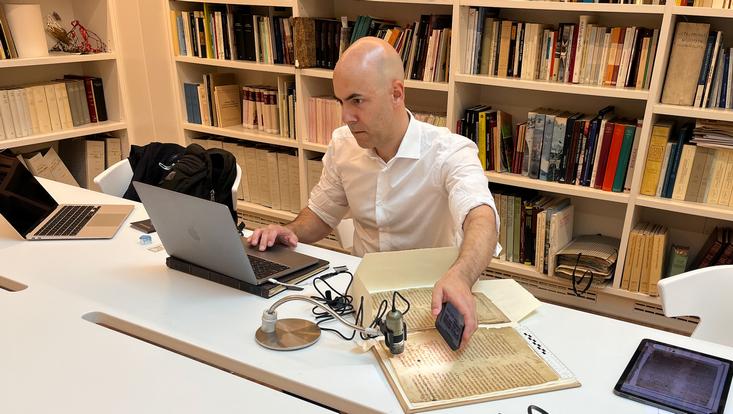
Photo: Brent Nongbri
The German Research Foundation awards over €3 million for the ‘Papyrus Provenance Project’ to be led by the internationally renowned researcher Brent Nongbri, who will join the University of Hamburg. The award marks a major success for the UWA Cluster of Excellence in the ‘Global Minds’ competition.
For around two decades, Nongbri has researched ancient Christian manuscripts, the history of the codex, and papyrology. He focuses on the material properties, dating, production, and transmission of early Christian manuscripts, combining philological and religious-historical questions with archaeological, historical, and material-science approaches.
Nongbri studied Liberal Arts and Classics at the University of Texas at Austin and Religious Studies at Yale University, where he completed his doctorate. His career has taken him to Macquarie University in Australia, Oberlin College, Aarhus University and the MF Norwegian School of Theology, Religion and Society in Oslo.
His 2018 monograph God’s Library: The Archaeology of the Earliest Christian Manuscripts (Yale University Press) won multiple prizes, including the DeLong Book History Prize. In 2025, he published the widely acclaimed textbook Working with Manuscripts: A Guide for Textual Scholars with Liv Ingeborg Lied.
At the heart of his work at UWA will be the ‘Papyrus Provenance Project’. It will systematically investigate the provenance and transmission history of papyri, make provenance data digitally accessible and develop new methods for material analysis. It also aims to feed into current debates on cultural heritage protection, restitution and the responsibilities of research and collections. Together with a team of doctoral and postdoctoral researchers, Nongbri will evaluate acquisition records, personal papers, and digital collection data for thousands of Greek literary papyri to record dealers, buyers, excavators, and transaction details. The resulting data will become a standard part of metadata in existing digital papyrology infrastructures and will be stored in an open, structured database at the University of Hamburg’s research data repository. Case studies will reconstruct the biographies of selected collections, shedding light on the colonial and trade-related contexts of papyrus acquisitions.
In parallel, and in close cooperation with the Mobile Lab and the Visual Manuscript Analysis Lab, as well as with the German Electron Synchrotron DESY, material-analytical and computer-vision-based methods are to be developed in order to identify groups of fragments sharing a common provenance and to detect forgeries. A further objective is the creation of a model provenance dossier, which will serve as a template for transparent acquisition histories and provide a foundation for well-grounded debates on restitution and repatriation.
The ‘Global Minds’ initiative is funded by the Federal Ministry of Research, Technology and Space. It enables Clusters of Excellence and Collaborative Research Centres to recruit outstanding researchers, strengthening international networks and bringing new perspectives into the German research system. In its first funding round, the DFG awarded 15 professorships across all disciplines. Four of these professorships were awarded to the University of Hamburg. In her official statement, DFG President Katja Becker highlighted how competitive the process had been: ‘The fact that the successful candidates come from a total of twelve different countries of origin on four continents also underlines the global reach of the initiative.’