CSMC
CSMCCentre for the Study of Manuscript Cultures
Photo: UHH/Denstorf
23 September 2026
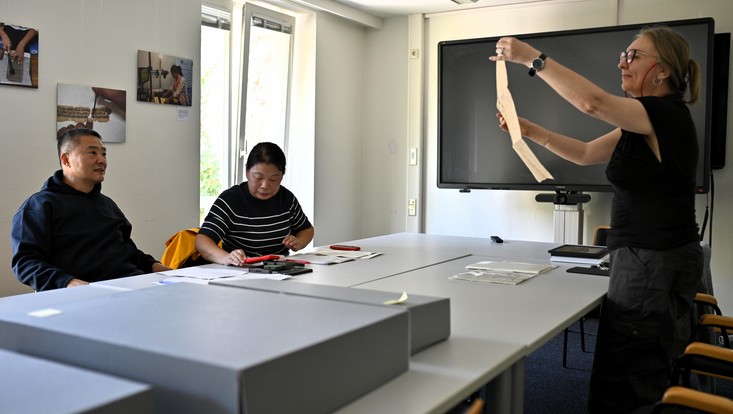
Photo: CSMC
What can paper reveal about the history of technology, cultural exchange, and knowledge transmission? Lingyan Qiu and documentary filmmaker Guang Jin visited the CSMC to discuss these issues with paper specialist Agnieszka Helman-Ważny and the Sinologists Uta Lauer, Ondřej Škrabal, and Thies Staack.
The two visitors are currently conducting an international research and documentary project, entitled ‘Paper and Civilization’. Initiated by Guang Jin, who began filming traditional handmade paper in 2012, the project combines fieldwork, object-based research, and documentary filmmaking. Its investigations have taken the team to papermaking regions across China and to museums and libraries in Europe. Rather than treating paper merely as a carrier of texts and images, they study its fibres, raw materials, production techniques, physical characteristics, uses, and traces of preservation. Their aim is to understand how local environments and practical needs influenced different papermaking traditions, and how these traditions interacted across Eurasia.
These questions made the CSMC a particularly fitting place for an exchange. The visitors were keen to discuss the contrast between Chinese papers commonly made from locally available plant fibres and European handmade papers historically produced from recycled linen and hemp textiles. They also brought samples of contemporary handmade papers from China, representing a range of fibres and regional techniques.
The meeting offered an opportunity to connect this material with several areas of CSMC expertise. Agnieszka Helman-Wazny’s current project investigates paper and papermaking additives at the nano- and atomic scale, using X-ray scattering alongside microscopic, spectroscopic, and imaging methods. It aims to develop ‘fingerprints’ for particular paper types that may support provenance and authentication studies. Together with the expertise of Uta Lauer, Ondřej Škrabal, and Thies Staack in Chinese written artefacts, this provided a rich basis for discussing how material analysis, manuscript studies, and documentary fieldwork can jointly illuminate paper’s history.