CSMC
CSMCCentre for the Study of Manuscript Cultures
Photo: UHH/Denstorf
28 September 2026
Photo: PAMELA Project
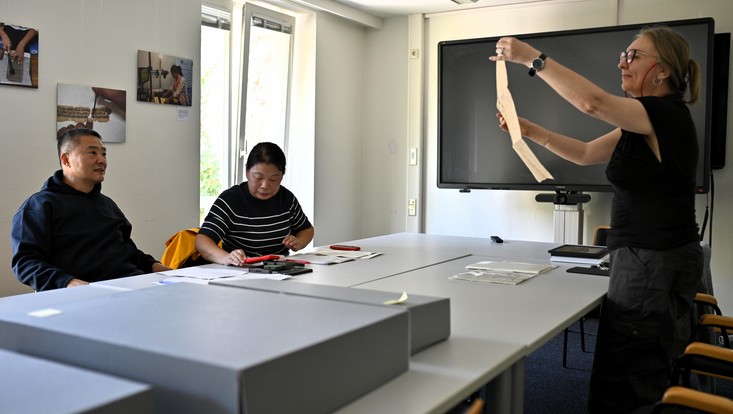
Papyri from antiquity and manuscripts from the Middle Ages are often preserved in the same libraries and archives. Yet they are usually studied separately, divided by disciplinary traditions and specialised methods. A new research project aims to bridge this divide.
The ‘Papyri and Manuscripts: Exploring Layers of Ages’ project (PAMELA) combines papyrology and manuscript studies with conservation science, archaeometry, digital humanities, and artificial intelligence. This interdisciplinary approach will enable researchers to examine the material composition of written artefacts, recognise and compare scripts, reconstruct dispersed collections, and trace the production and transmission of texts. Non-invasive material analysis, AI-assisted palaeography, and digital reconstruction will complement established historical and philological methods.
PAMELA centres on three closely connected areas. One focuses on fragments, with particular attention to the Wessely papyrus collection at the National Library of the Czech Republic. Much of this collection remains unpublished and requires conservation treatment. A second strand examines medieval scribes and will develop a pan-European database of scribes, colophons, and manuscript production. The third strand addresses historical collections, including their virtual reconstruction and the linking of existing digital resources.
In addition to its research goals, PAMELA places strong emphasis on knowledge exchange and training. International secondments, training schools, and hackathons will bring researchers into contact with different collections, methods, and working environments. Early-career researchers will gain skills ranging from the cataloguing and preservation of papyri to digital editing, heritage science, and machine-assisted handwriting recognition. The project will also produce open-access publications and databases, methodological guidelines, exhibitions, and resources for broader audiences.
The CSMC is one of 15 research institutions and libraries collaborating in PAMELA, which stretch over Europe, Asia, Australia, and the Americas. At the CSMC, archaeometrist Claudia Colini contributes methods for examining manuscripts and papyri as physical objects, supporting the project’s work on non-invasive analysis, preservation, and material characterisation. Ancient historian Kaja Harter-Uibopuu contributes expertise in the historical interpretation of papyrological evidence and the contexts in which ancient written documents were produced.