CSMC
CSMCCentre for the Study of Manuscript Cultures
Photo: UHH/Denstorf
20 October 2026

Photo: Rafi Çiçek
Spanning architectural and cultural layers from antiquity to the present, the city of Istanbul preserves a rich record of inscriptions. During a recent Summer Academy in Istanbul, doctoral researchers from the CSMC explored these epigraphic sources on site. In this report, they share their experiences.
Istanbul’s legacy is visibly written across the urban landscape: carved into stone, preserved in mosaics, and embedded in the historic architecture that has witnessed centuries of change. From 21 to 26 September 2026, thirty senior scholars and early-career researchers, including us – Benedetta Giammugnai, Narmeen Idrees, Amir Mahdi Moslehi, and Sandro Tskhvedadze – examined this rich epigraphic heritage directly within its spatial context: We participated in the Summer Academy Reading the City: Epigraphy and Space in Ancient Greek, Byzantine and Ottoman Times. It was co-organised by Professor Kaja Harter-Uibopuu, who introduced us and the entire team to ancient Greek and Latin inscriptions kept in the city, and Christiane Czygan from the Orient Institut Istanbul, with further support of the Austrian Academy of Sciences.
With backgrounds in Greek and Latin philology, Ancient History, Arabic, Iranian Studies, Islamic Calligraphy, and Islamic Studies, we all brought linguistic skills, research interests, and perspectives to our shared exploration of the city’s inscriptions.
The academy combined paper presentations with fieldwork, turning Istanbul into an open-air auditorium. We explored a diverse range of epigraphic sites, from the ancient Serpent Column and the Church of Saints Sergius and Bacchus (now the Little Hagia Sophia Mosque) to the Galata Mevlevihane and the Müftülüğü (the Istanbul Muftis’ Office).
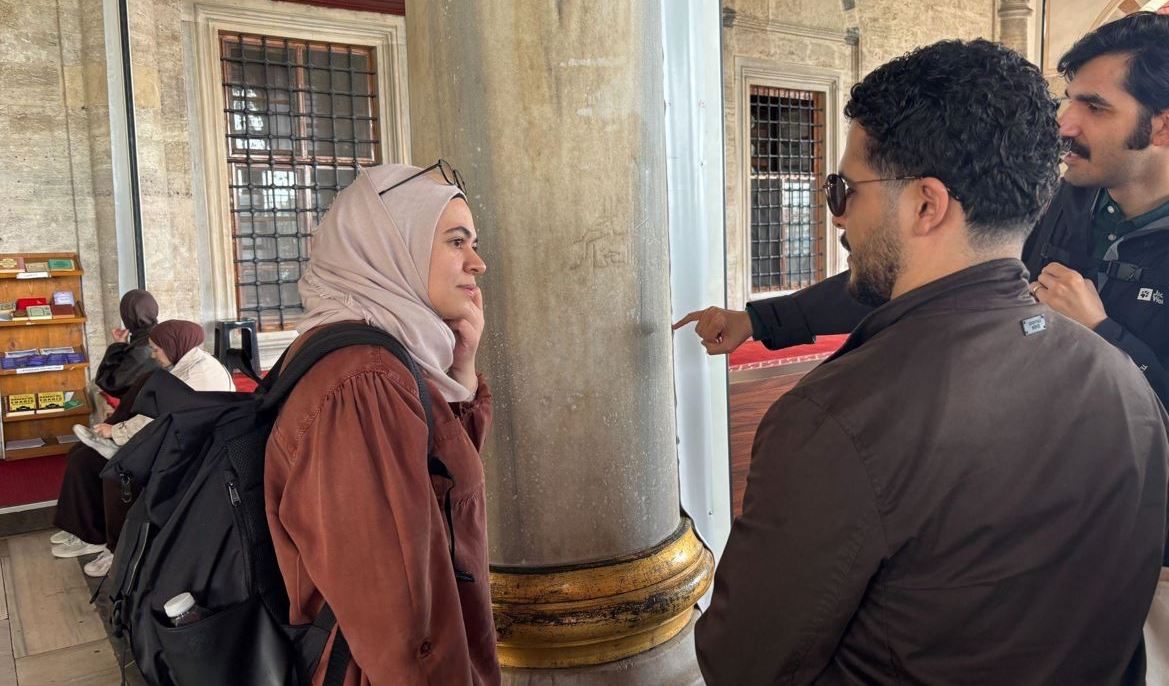
Together with our instructors and fellow participants, we visited some of the city’s most remarkable landmarks, including Topkapi Palace, Süleymaniye, and the historic district of Üsküdar, as well as landmark monuments of Late Antique and Byzantine origin, such as the ancient Hippodrome, Hagia Sophia, the Chora, and Pammakaristos sites. Our group is exceptionally thankful to Professor Mustafa Hamdi Sayar, who enthusiastically and with great passion guided us through many of the sites and who opened many doors with his personal efforts.
Throughout the week, one central question guided our discussions:
‘How do space and the environment interrelate with the inscription, and how do they redefine it?’

We look beyond the written text, examining placement, visibility, and architectural and spatial relationships while contextualising each inscription across diverse cultural periods. Seeing inscriptions in their original settings brought new dimensions to the discussions and showed how writing could express authority, devotion, identity, and memory. Perhaps the most rewarding part of the experience was discovering how much we could learn from one another. Our specific academic backgrounds encouraged lively discussions, unexpected connections, and new ways of delving deep into the familiar historical questions. What began as individual presentations often developed into shared conversations in front of the monuments themselves.
For us, the Summer Academy was more than a week of lectures and city walks. It was an opportunity to experience interdisciplinary research on site in presence, exchange ideas, and see how different approaches could complement one another; the academy made us realise that inscriptions do not simply record the history of a place, which is stuck in one historical age, but that they cover way more dimensions and open up new paths of reinterpreting them.