CSMC
CSMCCentre for the Study of Manuscript Cultures
Photo: UHH/Denstorf
8 September 2026
During fieldwork in ancient Miletus, different eras collide: some of the methods used there to document inscriptions date back to the 19th century. Others are so advanced that the early excavators could not have imagined them. Kaja Harter-Uibopuu describes old and new techniques, rediscoveries, and surprising finds.
Some aspects of inscription hunting are less glamorous than others. Documenting and photographing already known pieces and working in an excavation’s stone depot may seem like tedious tasks. However, they are indispensable elements of epigraphic fieldwork. And not only that: they can also yield exciting new discoveries.
In late summer this year, Kaja Harter-Uibopuu and her team, Ann-Lauren Osthof, Selcen Köroğlu, and Sercan Kılıçkaya, a future MA student at the CSMC, spent a week in ancient Miletus. One focus of their campaign was to explore an area that had been excavated in 2025, to the south of the market in Miletus. Several inscriptions had been uncovered here that had not been seen since the early excavations at the beginning of the twentieth century. Encountering these stones again after more than a hundred years offered an opportunity to examine them with fresh eyes.

Photo: Kaja Harter-Uibopuu
The team
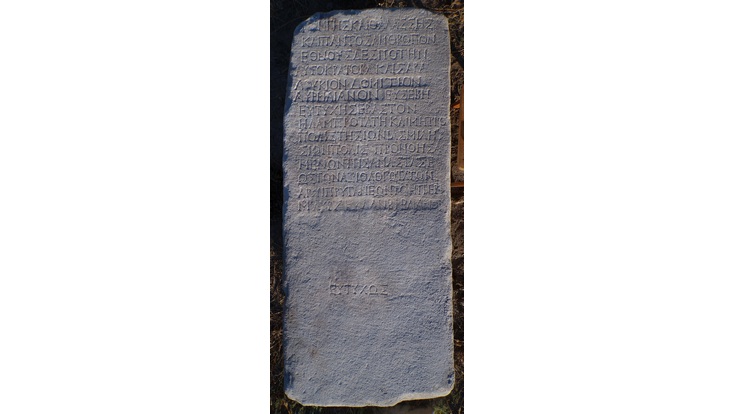
Photo: Kaja Harter-Uibopuu
Honorific decree of the Milesians for the Roman Emperor L. Domitius Aurelianus (270–275 CE)
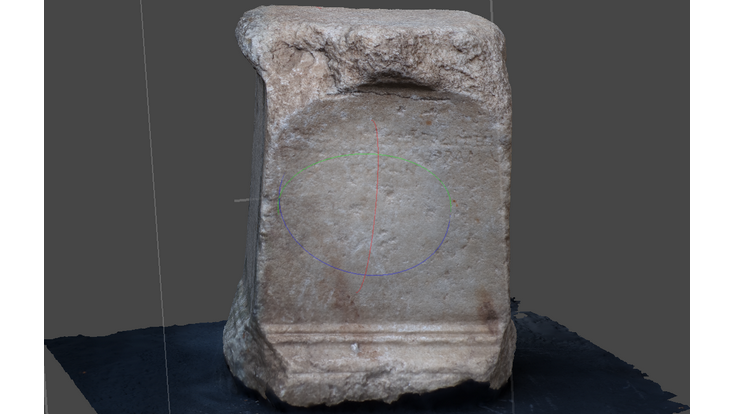
Photo: Kaja Harter-Uibopuu
3D model of the altar for Aphrodite (2nd cent. BCE)
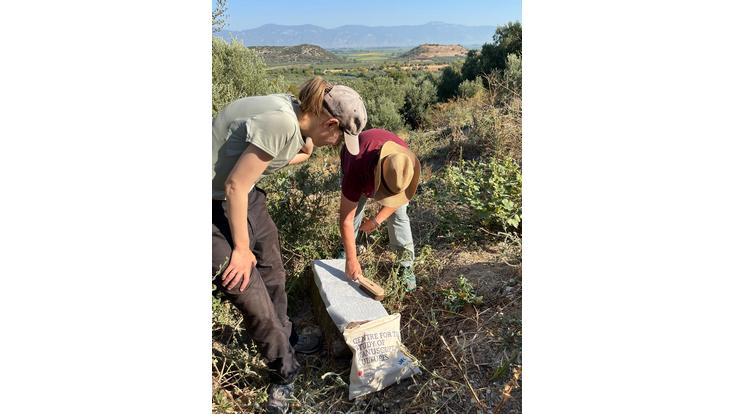
Photo: Christof Berns
K. Harter-Uibopuu and A. L. Osthof producing a squeeze of the newly discovered inscription in the olive garden
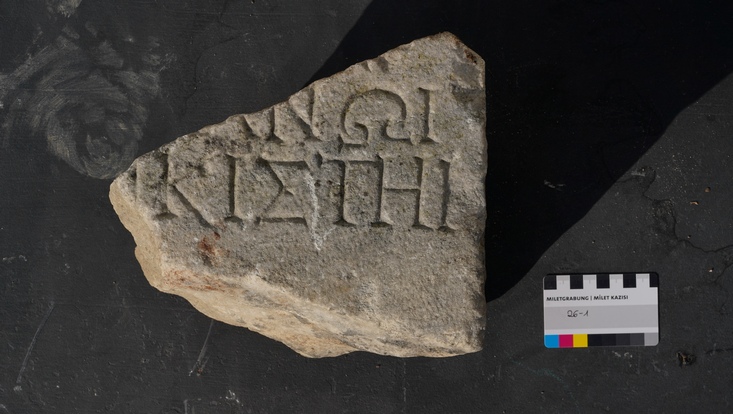
Photo: Kaja Harter-Uibopuu
Inscription for the Roman Emperor P. Aelius Hadrianus (117–139 CE), given the honorary title of oikistes (‘founder’) of Miletus
There were also entirely new texts to investigate. Among these was an honorific decree for the Roman emperor Aurelian, which had been inscribed on a stone that had clearly been reused for this purpose. The Milesians took an older inscription, erased the name of the previously praised emperor, and replaced it with that of Aurelian. A much smaller monument offers a more personal insight into religious life in ancient Miletus: a small altar bearing a dedication to Aphrodite by a Milesian woman named Artemonis, who had received instructions in a dream
The altar then became the object of a methodological experiment. For the first time during the Milesian epigraphic campaigns, the team tested photogrammetry to produce 3D models of inscriptions. At the same time, they continued to make traditional paper squeezes – a technique that has been used by epigraphers since the nineteenth century. The fieldwork thus brought together two very different generations of documentation: paper, water, and brushes on the one hand, digital photography and 3D modelling on the other. Both methods help researchers to preserve and study writing on stone in their own ways.
There was also a fragmentary inscription honouring the Emperor Hadrian. This continues what is becoming something of a Milesian fieldwork tradition: in recent years, hardly a campaign seems to pass without the famous Philhellene Roman emperor making an appearance.
The most unexpected discovery, however, was saved until the very last day. Following the lead of a former member of the excavation workforce, the team visited an olive garden near ancient Miletus. It was there that he had found a Hellenistic inscription containing a list of new citizens. The stone originally belonged to the Delphinion, one of the most important sanctuaries and civic spaces in ancient Miletus. It was a fitting reminder that epigraphic fieldwork does not always end at the edge of the excavation, or even in the stone depot.
The newly documented inscriptions will now be studied in detail and prepared for publication in the journal Philia. They provide further insight into the extraordinarily rich written record of Miletus, shedding light on civic life, imperial representation, religion, and the individual inhabitants of the ancient city, piece by piece — whether that be a fragment, a reused block, a 3D model, or an olive garden.