
CSMC
CSMCCentre for the Study of Manuscript Cultures
Photo: UHH/Denstorf
17 August 2026
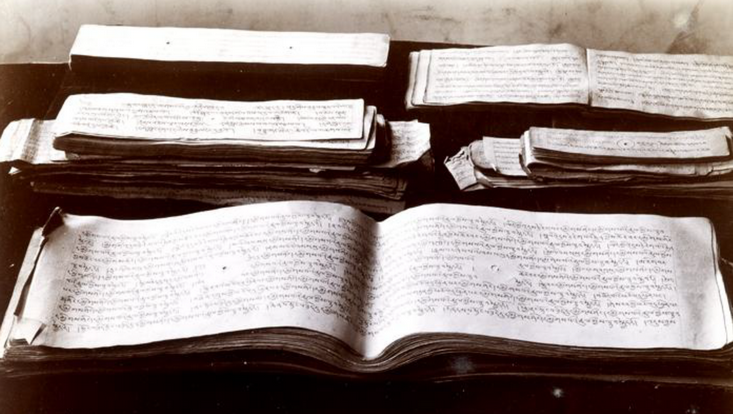
Photo: The British Library
What happens to written artefacts after their initial production? We spoke to Steffen Döll, head of the ‘Phased Transmission’ unit, about material and invisible transformations, provenance, archives, and the challenge of developing concepts that work across cultural contexts.
Steffen Döll, what does it mean for written artefacts to be ‘transmitted’?
Written artefacts are sometimes treated as if they had merely been produced at a particular point in time and then reappeared at another point in time, and also somewhere else. What happens in between is frequently neglected. We shift our focus towards that interval and ask what happens to an artefact as it moves through time and different contexts. For instance, a seal or a possession note may become part of the object’s material history. It may be repackaged, rebound, annotated, acquired, or displaced, and all of these processes possibly leave traces on the object.
At the same time, transmission can involve changes that remain invisible when we only take the object as such into consideration. Tibetan pothi manuscripts, for instance, are typically made up of loose sheets of paper held together by a rope, wooden boards, and a cloth cover. At a particular point, however, some pothi manuscripts at the British Library were rebound in Western-style codices. This is entirely alien to the traditional Tibetan format. Later, some of these codices were dismantled again and the sheets returned to their original loose-leaf form. If we looked only at the final state of the artefacts, we might not see any difference to their original state. Yet the rebinding, the subsequent dismantling, and the institutional reasoning behind both procedures are all part of the artefact’s transmission history.
There seems to be a parallel between your topic and provenance research, which often reconstructs a chain of custody: how an object came into the possession of a particular person or institution and whether its present location can be legitimised.
The ethical and legal dimensions are important, especially in the context of colonial acquisitions and restitution. But they are not the focus of our CMU. We are interested in how an artefact’s functions and meanings develop through these processes. We ask how people have interacted with it, what they have done to it, and how those interventions have affected its status.
One case that illustrates our specific angle concerns the archives of Timbuktu: manuscripts were removed from their original contexts through colonial acquisition, transferred to Paris, stored in a warehouse, and then effectively forgotten for decades before being rediscovered and studied. What we are interested in is the radical recontextualisation that takes place in the artefacts’ transmission histories at this point: an archive, the primary purpose of which is the continued existence of its holdings, may sometimes contribute to their dispersal, concealment, or degradation.
Your group consists of, among others, experts on Japanese documents, Italian Renaissance manuscripts, West African manuscript archives, and material from the Tibetan and wider Central Asian regions. How does such a diverse group approach an abstract topic such as ‘phased transmission’?
We are trying to work from individual observations towards a shared vocabulary. Regarding phenomena such as editing, material addition, repurposing, rebinding, or recontextualisation across several cases, we ask whether they can be described using concepts that are meaningful across cultures. Likewise, a practice that is common in one region or type of institution may not occur in another. Such absences too may be historically significant and tell us something about the social or material conditions in which written artefacts were used.
A striking example is the use of rotating cabinets for Buddhist scriptures in some East Asian monasteries. Such a structure has a practical function: it makes it easier to access the texts. But it also has a symbolic and religious dimension, since turning the cabinet can be associated with the production of merit. There are rotating forms of shelving elsewhere, including in European libraries, but the functions are not identical. At the Herzog August Library in Wolfenbüttel, for instance, a rotating structure was used for a catalogue rather than for the archive itself. These similarities and differences are precisely what a comparative approach can bring to light.
Digitisation can be understood as a form of musealisation: it attempts to stabilise and preserve an artefact, but it also creates a new object with its own history.
Another group at the Cluster, ‘Material Choices’, studies the production of written artefacts. How exactly do you draw the line between production and transmission?
That is one of the most important questions we are facing. The distinction between production and transmission remains useful as a heuristic tool, but it is becoming increasingly difficult to maintain as a strict conceptual separation. We could define transmission as the middle phase between production and musealisation. Or we could take an even broader view and regard the entire period from the first idea of producing an artefact until its disappearance as one extended process of production and transmission. Neither option is entirely satisfactory. The boundaries are partly analytical decisions, and we need to be explicit about why we draw them where we do.
Could you give an example of when this distinction becomes blurred?
One of my favourite examples is a Chinese landscape scroll on which an emperor added observations and poems centuries after the original painting had been produced. The scroll is valuable both because it was made by a famous literati painter and because it carries imperial inscriptions. In this case, the later intervention is not merely a minor note or a record of ownership. It substantially changes the artefact’s materiality and status.
Another example we have already discussed in our meetings are the Buddhist canons compiled in monasteries of the Central Asian highlands. Since a monastery may not have the resources to produce the entire corpus itself, some texts are acquired from elsewhere, some copied locally, and some added years – or even decades – later. The resulting corpus is a composite artefact comprising different materials, provenances, and moments of production stretching over such a long period of time that we would normally call it transmission.
Are there other groups at the Cluster that have links to your work?
There are also strong links to ‘Navigating Crises’. Archives and written artefacts can be fragile, and their histories often contain moments of disruption, displacement, concealment, or destruction. The Timbuktu materials, for example, involve colonial appropriation and disintegration. A manuscript that was hidden because it contained a text condemned by a papal bull also reflects a crisis in its materiality.
Another important connection is to the work on ‘Digital Twins’. In many cases, we do not have direct access to the physical artefact through which we are trying to reconstruct a transmission history. We work with a digital reproduction instead. In a sense, digitisation can be understood as a form of musealisation: it attempts to stabilise and preserve an artefact, but it also creates a new object with its own history. We propose to reflect on what happens when our scholarly engagement is mediated by that new object.
Looking ahead, what would you ideally like to achieve with this group?
For the first three years, we have set ourselves a deliberately modest goal: a co-authored, ideally group-authored paper that develops a conceptual account of transmission processes. We are not trying to produce a handbook or a comprehensive system. A paper gives us enough space to formulate and test concepts without creating unnecessary pressure.
The more ambitious outcome is difficult to measure. We want to change ways of thinking, sharpen concepts, and make it possible to ask better questions about written artefacts. That kind of influence rarely appears immediately as a clearly identifiable result.

