• Zur Metanavigation
  • Zur Hauptnavigation
  • Zur Suche
  • Zum Inhalt
  • Zur Subnavigation
  • Zum Seitenfuß
  • University of Hamburg
  • For journalists
  • Staff Service Portal0
  • STiNE
https://www.kus.uni-hamburg.de/aktuelles.json?recentnews=true
  • Institutions and target groups
    • Einrichtungen
      • Faculties

        • Faculty of Law
        • Faculty of Business, Economics and Social Sciences
        • Faculty of Medicine
        • Faculty of Education
        • Faculty of Humanities
        • Faculty of Mathematics, Informatics and Natural Sciences
        • Faculty of Psychology and Human Movement Science
        • University of Hamburg Business School
      • Services

        • Study Information Net STiNE
        • Surfmail
        • Exchange
        • Staff Service Portal
        • Learning Platforms
        • Katalogplus – Catalogue of Hamburg Libraries
        • SharePoint
      • Student facilities and services

        • Campus Center
        • Career Center
        • PIASTA
        • AStA (student council)
        • University Sports
        • University Music
        • Family Office
        • University Language Center
        • General Languages
        • Office of Affairs for Students with Disabilities or Chronic Diseases
        • Departmental libraries
        • Healthy Campus
      • Further facilities and services

        • The Cluster of Excellence CLICCS
        • The Cluster of Excellence CUI
        • The Cluster of Excellence Quantum Universe
        • The Cluster of Excellence Understanding Written Artefacts
        • Hamburg Research Academy
        • Pier Plus
        • Hamburg Center for University Teaching and Learning (HUL)
        • Hub for Crossdisciplinary Learning (HCL)
        • CEN
        • Museums and collections
        • University Archives (in German)
        • Regional Computing Center (RRZ)
        • University Administration
        • Knowledge Exchange Agency
        • The Unikontor Shop (in German)
    • Target groups

      • Prospective students
      • Students
      • International prospective students
      • Young researchers
      • Researchers
      • Instructors
      • Staff
      • Prospective continuing education students
      • Alumni
      • Journalists
      • Refugees (in German only)
    Close
  • /sitemap.json
University of Hamburg - to research, to teach, to educate and form, to homepage

CSMC

CSMCCentre for the Study of Manuscript Cultures
  • About
    • People
    • News
    • Ethics
    • Equity & Diversity
    • Sustainability
    • Logbook: The CSMC Blog
    • Contact & Newsletter
    • Vacant Positions
    • Intranet
  • Research
    • Concepts & Methods Units
    • Project Groups
    • Individual Research Projects
    • Working Groups
    • Affiliated Projects
    • Fellowships
    • Research Events
    • UWA I (2019–2025)
    • SFB (2012–2020)
  • Core Units
    • Laboratories
    • Graduate School
    • Cultural Heritage
    • Library
  • Collaboration
    • with Research Partners
    • with Archives, Libraries, and Museums
    • with Artists
    • with Companies
    • with Schools
    • within the HALM and PIER Networks
  • Publications
    • manuscript cultures
    • Studies in Manuscript Cultures
    • Occasional Papers
    • Software
    • Research Data and Information Systems
    • Written Artefact Profiling Guide
    • Artefact of the Month
    • Mesopotamian Bulletins
    • Videos
    • More Publications

Photo: CSMC

  1. UHH
  2. CSMC
  3. UWA 2019–2025
  4. Research Fields
  5. Research Field K: Selecting Materials
  6. The Use of Parchment in Arabic Manuscripts of the Early Islamic Centuries

The Use of Parchment in Arabic Manuscripts of the Early Islamic Centuries
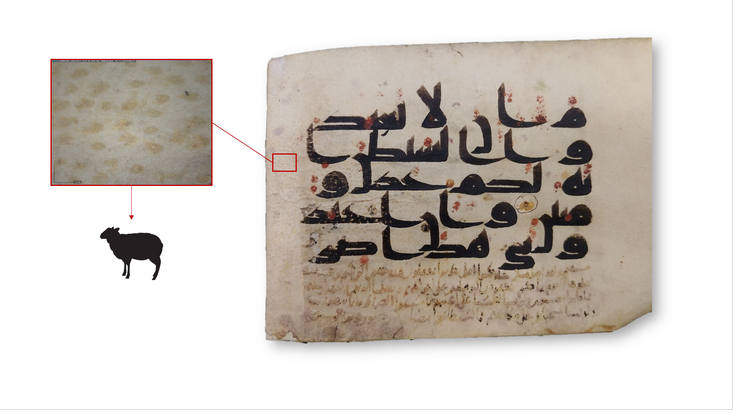
Cod.Orient.41, Staats- und Universitätsbibliothek Hamburg (SUB): Preliminary observation of material characteristics for species identification. Dino-Lite digital microscope images (45 x) of the hair follicle distribution under visible light.

Parchment was employed as writing support, alongside papyrus, at a crucial moment in the development of the Muslim written tradition. Some of the earliest known surviving examples of the Qur’an were written on parchment, but the support was also used to produce private documents and paraliterary texts. [1]

Sources on the production of Arabic parchment provide very limited information:: ‘Parchment will be made from fawn and gazelle till the end of July’, according to the Kitāb al-Anwāʾ (Cordova calendar) written by ʿArīb ibn Saʿīd al-Qurṭūbī (d. 976/365); an account with the prescription to avoid the use of emaciated sheep is reported in the Ḥisbah treaty of Ibn ‘Abdūn  (d. 1135/529);[2] moreover, according to the al-Fihrist by Ibn al-Nadīm (d. ~1000/390), parchment was initially tanned with nawrah (a mixture of lime and arsenic), which was then replaced by the use of dates to make the support more flexible.[3][1] However, no complete description of the Islamic parchment manufacture seems to have survived.[4]

This project identifies markers associated with particular manufacturing techniques, differentiating manuscripts supposedly produced in different areas (Egypt, Maghreb, Persia, Al-Andalus), in different periods of time (7th–11th century), and in different contexts of use (official or personal religious use, legal purposes, paraliterary use).

In addition, we address the following questions:

  • What are the main characteristics of parchment production in the Islamic world compared to other manuscript traditions?
  • From which animals and species was parchment commonly obtained?
  • Which inks were used in the first production phases of the manuscripts and which in the later additions?
  • What kind of traces and degradation processes can shed light on how they were used and preserved?

In 2024, over 50 manuscripts written in Arabic script from various regions of the Middle East and North Africa were analysed using non-destructive and non-invasive techniques.[5][6][7] Our Artefact Lab’s mobile equipment was employed during the analytical campaigns in various European collections, including the Oriental Manuscripts Collection at Leiden University Library, the papyrus collection (Erzherzog Rainer) of the Austrian National Library, and the Islamic Collection of the Chester Beatty Library. Furthermore, fragments from the Institute Arabic and Islamic Studies at WWU Münster and the Hamburg State and University Library were examined at the CSMC, and further campaigns in various collections are planned for 2025.

In addition to the material analyses, we employ a multidisciplinary approach involving philology, codicology, and chemometrics to compare the datasets, thus facilitating a deeper understanding of parchment production and use in the Arabic context. Moreover, examining production techniques and manufacturer choices may also be useful in understanding specific conservative issues, contributing to future research, as in the case of the ongoing Kairouan Manuscript Project.

RFK07

Photo: Giuseppe Marotta

Preliminary ink layers observation at CSMC of HS15c­ (Kufic fragment, probably 700- 750 AD) from the Institut für Arabistik und Islamwissenschaft at WWU Münster. Dino-Lite digital microscope images (40 x) acquired under visible light, UV light (395 nm), and NIR (940 nm).

RFK07

Photo: Giuseppe Marotta

Raman analyses at CSMC on Cod. in Scrin. 153a (Kufic fragment, 800-900 AD) from the Staats- und Universitätsbibliothek Hamburg.

RFK07

Photo: Giuseppe Marotta

Analytical campaign at the Papyrussamlung Österreichische Nationalbibliothek, Wien.

RFK07

Photo: Giuseppe Marotta

Analytical campaign at the Papyrussamlung Österreichische Nationalbibliothek, Wien.

RFK07

Photo: Giuseppe Marotta

Analytical campaign at the Chester Beatty Library, Dublin. FT-IR analyses on CBL Is 1615I, (folios from a Hijazi Qur’an, possibly Medina or Damascus, 675-725 AD).

RFK07

Photo: Giuseppe Marotta

Analytical campaign at the Chester Beatty Library, Dublin. FT-IR analyses on CBL Is 1405B, (folio from the Blue Qur’an, possibly Iraq, 800-900 AD).

Bibliography

Bibliography

[1] Déroche F.,1995, L'emploi du parchemin dans les manuscrits islamiques, Al-Furqān Islamic Heritage Fundation, London, 28-29

[2] Déroche. F., 2006, Islamic Codicology, an introduction to the Study of Manuscript in the Arabic Script, Al-Furqān Islamic Heritage Fundation, London, 35

[3] Dodge B., 1970, The al-Fihrist of al-Nadīm, II, Columbia university press, New York, 40

[4] Bosh G., Carswell J., 1981, Islamic Bindings & Bookmaking, The Oriental Institute, Chicago, 25

[5] Bicchieri M., Sodo A, Rabin I, Kohl A., Piantanida G., 2018, New results in Dead Sea Scrolls non-destructive characterisation. Evidence of different parchment manufacture in the fragments from Reed collection,

[6] Colini, C., Shevchuk, I., Huskin, K. A., Rabin, I., Hahn, O., 2021, A New Standard Protocol for Identification of Writing Media Exploring Written Artefacts: Objects, Methods, and Concepts, Berlin, Boston, 161-182

Project Overview

Project lead: Claudia Colini

Research Associate: Giuseppe Marotta

Status: completed (2023–2025)

Project affiliation: Cluster of Excellence Understanding Written Artefacts (UWA I)

Research Field: Selecting Materials (RFK)

Project number: RFK07

  • UWA 2019–2025

Last update: 28 October 2026

  • Feedback
  • Legal notice
  • Privacy statement
  • Accessibility
  • Site map

University of Hamburg

Innovating and Cooperating for a Sustainable Future in a Digital Age

  • Follow us on Instagram.
  • Follow us on Facebook.
  • Connect with us on LinkedIn.
  • Follow us on Mastodon.
  • Follow us on Bluesky.
  • Subscribe to our channel on YouTube.
    • Studies
    • Prospective students
    • Continuing education
    • Research
    • Teaching at UHH
    • Doctoral studies
    • Job opportunities
    • Knowledge exchange
    • University
    • Excellence
    • Faculties
    • Alumni
    • Contact
    • Campus Navigator
    • UHHApp
    • Emergencies, safety and security
    • Antidiscrimination
Go to family-friendly higher education institution audit
Go to internationalisation re-audit
Go to the Sustainability Audit page
Go to Diversity Audit
Go to System accreditation

© 2026 University of Hamburg. All rights reserved