• Zur Metanavigation
  • Zur Hauptnavigation
  • Zur Suche
  • Zum Inhalt
  • Zur Subnavigation
  • Zum Seitenfuß
  • University of Hamburg
  • For journalists
  • Staff Service Portal0
  • STiNE
https://www.kus.uni-hamburg.de/aktuelles.json?recentnews=true
  • Institutions and target groups
    • Einrichtungen
      • Faculties

        • Faculty of Law
        • Faculty of Business, Economics and Social Sciences
        • Faculty of Medicine
        • Faculty of Education
        • Faculty of Humanities
        • Faculty of Mathematics, Informatics and Natural Sciences
        • Faculty of Psychology and Human Movement Science
        • University of Hamburg Business School
      • Services

        • Study Information Net STiNE
        • Surfmail
        • Exchange
        • Staff Service Portal
        • Learning Platforms
        • Katalogplus – Catalogue of Hamburg Libraries
        • SharePoint
      • Student facilities and services

        • Campus Center
        • Career Center
        • PIASTA
        • AStA (student council)
        • University Sports
        • University Music
        • Family Office
        • University Language Center
        • General Languages
        • Office of Affairs for Students with Disabilities or Chronic Diseases
        • Departmental libraries
        • Healthy Campus
      • Further facilities and services

        • The Cluster of Excellence CLICCS
        • The Cluster of Excellence CUI
        • The Cluster of Excellence Quantum Universe
        • The Cluster of Excellence Understanding Written Artefacts
        • Hamburg Research Academy
        • Pier Plus
        • Hamburg Center for University Teaching and Learning (HUL)
        • Hub for Crossdisciplinary Learning (HCL)
        • CEN
        • Museums and collections
        • University Archives (in German)
        • Regional Computing Center (RRZ)
        • University Administration
        • Knowledge Exchange Agency
        • The Unikontor Shop (in German)
    • Target groups

      • Prospective students
      • Students
      • International prospective students
      • Young researchers
      • Researchers
      • Instructors
      • Staff
      • Prospective continuing education students
      • Alumni
      • Journalists
      • Refugees (in German only)
    Close
  • /sitemap.json
University of Hamburg - to research, to teach, to educate and form, to homepage

CSMC

CSMCCentre for the Study of Manuscript Cultures
  • About
    • People
    • News
    • Ethics
    • Equity & Diversity
    • Sustainability
    • Logbook: The CSMC Blog
    • Contact & Newsletter
    • Vacant Positions
    • Intranet
  • Research
    • Concepts & Methods Units
    • Project Groups
    • Individual Research Projects
    • Working Groups
    • Affiliated Projects
    • Fellowships
    • Research Events
    • UWA I (2019–2025)
    • SFB (2012–2020)
  • Core Units
    • Laboratories
    • Graduate School
    • Cultural Heritage
    • Library
  • Collaboration
    • with Research Partners
    • with Archives, Libraries, and Museums
    • with Artists
    • with Companies
    • with Schools
    • within the HALM and PIER Networks
  • Publications
    • manuscript cultures
    • Studies in Manuscript Cultures
    • Occasional Papers
    • Software
    • Research Data and Information Systems
    • Written Artefact Profiling Guide
    • Artefact of the Month
    • Mesopotamian Bulletins
    • Videos
    • More Publications

Photo: CSMC

  1. UHH
  2. CSMC
  3. UWA 2019–2025
  4. Research Fields
  5. Research Field K: Selecting Materials
  6. Reconstructing the Scope of Old Uyghur Book Forms

Reconstructing the Scope of Old Uyghur Book Forms Based on the Handwritten Remains of Half a Millennium of Literature

A Pilot Study Based on Buddhist Manuscripts
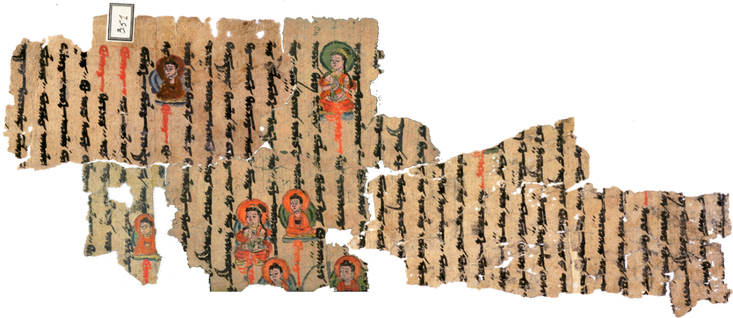
Reconstruction of an Old Uyghur scroll fragment of the Säkiz Yükmäk Yaruk consisting of four fragments (U 7123 + III 550 + III 6323 + U 7124) preserved in the Berlin Turfan collections of the Berlin Brandenburg Academy of Sciences and Humanities (BBAW) and the Museum für Asiatische Kunst, Berlin (AKu, SMB-PK)

Roughly 8,000 fragments of Old Uyghur manuscripts and block prints in the Berlin Turfan collections, as well as the numerous published Old Uyghur manuscript remains preserved in several Central Asian manuscript collections, mainly in St. Petersburg, London, Paris, Stockholm, Kyoto and various locations in China, form the basis for the study of the Old Uyghur book forms. These texts are the written remains of the Uyghurs, who immigrated into the Eastern Tianshan 天山region and the Gansu corridor after the collapse of their nomadic empire in Mongolia in 840. Between the 9th and 13th centuries, they held strong political power in the region (The West Uyghur Kingdom 847-1270, the Ganzhou Uyghur Kingdom 880-1035). The Uyghurs, who were in close relations with the Mongols and became their tutors in several fields like literary culture, were able to maintain their influence still after the rise of the Mongol Empire at the beginning of the 13th century and coming under strict Yuan control in the late 1270s. Besides administrative and economic documents, a small number of medical, astrological and calendar texts, fragments of religious works form the majority among the handwritten artefacts. A main feature of the surviving Old Uyghur manuscripts is their fragmentary state of preservation and the predominant lack of dating. Catalogues and editions of the Old Uyghur fragments brought to light a great diversity in the size and form of the discovered manuscript folios or preserved fragments from them.

The project aims to build the starting point of a comprehensive reconstruction of the great variety of Old Uyghur book forms on the basis of the handwritten remains, which present half a millennium of Old Uyghur literature. Buddhist literature, whose remains make up the majority among the excavated text findings, was chosen for the pilot study on the subject. According to the current state of research, the following main book forms have been proven: scrolls, pothis/pustakas of different size and form (landscape, portrait), codices of different size, and concertinas.

Some particularly popular Buddhist works have survived not only in a very large number of copies, but also in a wide range of book forms used for these copies. The creation of a relative chronology based on the tracing of the transformation of book forms that took place should help to fill the gap of missing dating information in the manuscripts. The preserved written artefacts of the apocryphal Buddhist sutra Säkiz Yükmäk Yaruk, the Old Uyghur translation of the Chinese Bayangjing, form the basis for this case study.

Project Overview

Project lead: Simone-Christiane Raschmann

Status: completed (2023–2025)

Project affiliation: Cluster of Excellence Understanding Written Artefacts (UWA I)

Research Field: Selecting Materials (RFK)

Project number: RFK05

  • UWA 2019–2025

Last update: 28 October 2026

  • Feedback
  • Legal notice
  • Privacy statement
  • Accessibility
  • Site map

University of Hamburg

Innovating and Cooperating for a Sustainable Future in a Digital Age

  • Follow us on Instagram.
  • Follow us on Facebook.
  • Connect with us on LinkedIn.
  • Follow us on Mastodon.
  • Follow us on Bluesky.
  • Subscribe to our channel on YouTube.
    • Studies
    • Prospective students
    • Continuing education
    • Research
    • Teaching at UHH
    • Doctoral studies
    • Job opportunities
    • Knowledge exchange
    • University
    • Excellence
    • Faculties
    • Alumni
    • Contact
    • Campus Navigator
    • UHHApp
    • Emergencies, safety and security
    • Antidiscrimination
Go to family-friendly higher education institution audit
Go to internationalisation re-audit
Go to the Sustainability Audit page
Go to Diversity Audit
Go to System accreditation

© 2026 University of Hamburg. All rights reserved