• Zur Metanavigation
  • Zur Hauptnavigation
  • Zur Suche
  • Zum Inhalt
  • Zur Subnavigation
  • Zum Seitenfuß
  • University of Hamburg
  • For journalists
  • Staff Service Portal0
  • STiNE
https://www.kus.uni-hamburg.de/aktuelles.json?recentnews=true
  • Institutions and target groups
    • Einrichtungen
      • Faculties

        • Faculty of Law
        • Faculty of Business, Economics and Social Sciences
        • Faculty of Medicine
        • Faculty of Education
        • Faculty of Humanities
        • Faculty of Mathematics, Informatics and Natural Sciences
        • Faculty of Psychology and Human Movement Science
        • University of Hamburg Business School
      • Services

        • Study Information Net STiNE
        • Surfmail
        • Exchange
        • Staff Service Portal
        • Learning Platforms
        • Katalogplus – Catalogue of Hamburg Libraries
        • SharePoint
      • Student facilities and services

        • Campus Center
        • Career Center
        • PIASTA
        • AStA (student council)
        • University Sports
        • University Music
        • Family Office
        • University Language Center
        • General Languages
        • Office of Affairs for Students with Disabilities or Chronic Diseases
        • Departmental libraries
        • Healthy Campus
      • Further facilities and services

        • The Cluster of Excellence CLICCS
        • The Cluster of Excellence CUI
        • The Cluster of Excellence Quantum Universe
        • The Cluster of Excellence Understanding Written Artefacts
        • Hamburg Research Academy
        • Pier Plus
        • Hamburg Center for University Teaching and Learning (HUL)
        • Hub for Crossdisciplinary Learning (HCL)
        • CEN
        • Museums and collections
        • University Archives (in German)
        • Regional Computing Center (RRZ)
        • University Administration
        • Knowledge Exchange Agency
        • The Unikontor Shop (in German)
    • Target groups

      • Prospective students
      • Students
      • International prospective students
      • Young researchers
      • Researchers
      • Instructors
      • Staff
      • Prospective continuing education students
      • Alumni
      • Journalists
      • Refugees (in German only)
    Close
  • /sitemap.json
University of Hamburg - to research, to teach, to educate and form, to homepage

CSMC

CSMCCentre for the Study of Manuscript Cultures
  • About
    • People
    • News
    • Ethics
    • Equity & Diversity
    • Sustainability
    • Logbook: The CSMC Blog
    • Contact & Newsletter
    • Vacant Positions
    • Intranet
  • Research
    • Concepts & Methods Units
    • Project Groups
    • Individual Research Projects
    • Working Groups
    • Affiliated Projects
    • Fellowships
    • Research Events
    • UWA I (2019–2025)
    • SFB (2012–2020)
  • Core Units
    • Laboratories
    • Graduate School
    • Cultural Heritage
    • Library
  • Collaboration
    • with Research Partners
    • with Archives, Libraries, and Museums
    • with Artists
    • with Companies
    • with Schools
    • within the HALM and PIER Networks
  • Publications
    • manuscript cultures
    • Studies in Manuscript Cultures
    • Occasional Papers
    • Software
    • Research Data and Information Systems
    • Written Artefact Profiling Guide
    • Artefact of the Month
    • Mesopotamian Bulletins
    • Videos
    • More Publications

Photo: CSMC

  1. UHH
  2. CSMC
  3. UWA 2019–2025
  4. Research Fields
  5. Research Field E: Archiving Artefacts
  6. Bookbindings as Instruments of Classification

Bookbindings as Instruments of Classification

Defining, Ordering, and Transmitting Knowledge in Christian Egypt (4th-12th centuries)
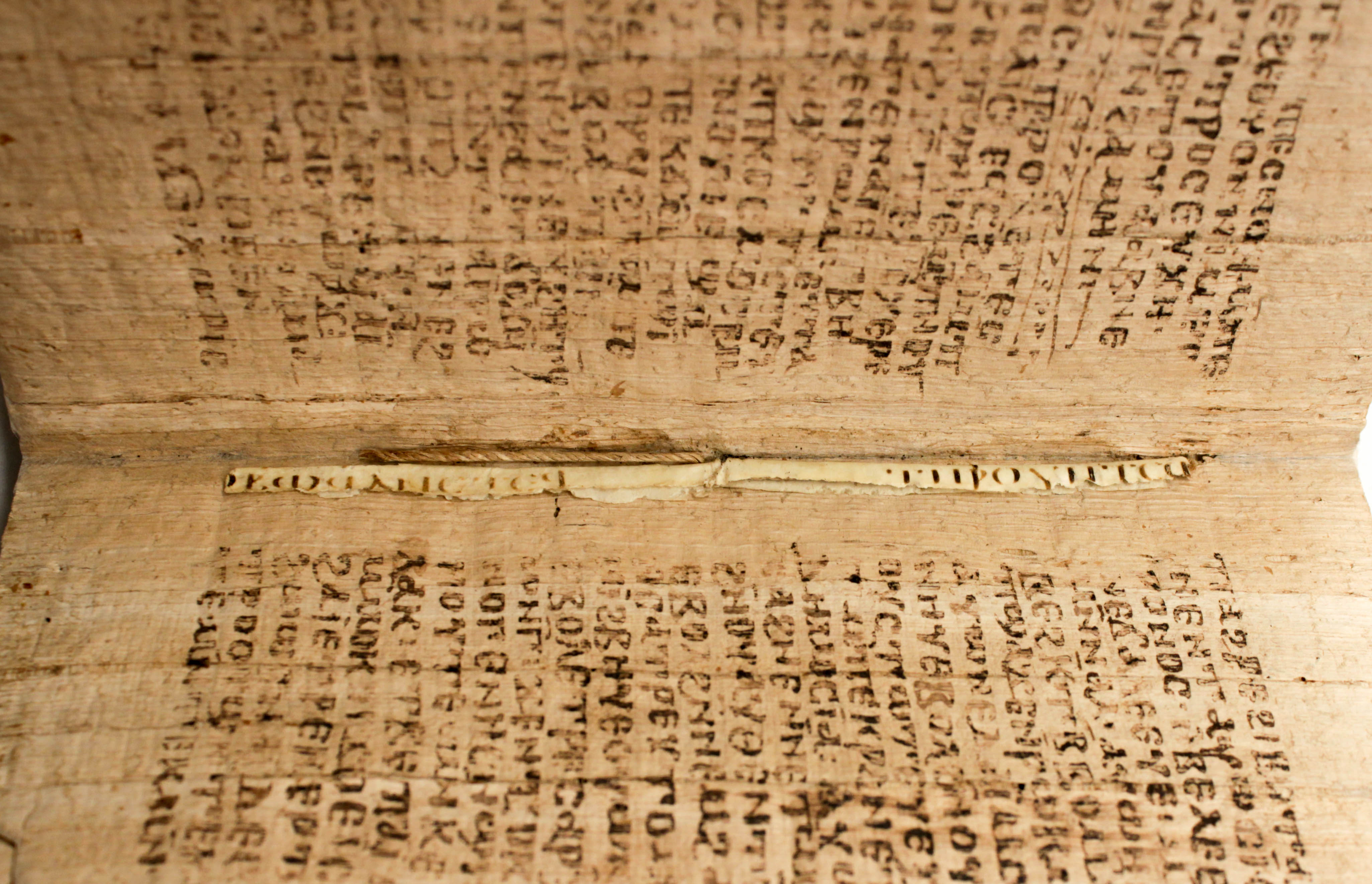
Detail of the sewing of the Coptic papyrus codex AMS9, Rijksmuseum van Oudheden, Leiden.

Bindings capture the onlookers’ gaze, inspiring religious veneration, aesthetical admiration, and manifesting the purpose for which the manuscript has been created. Hence, the materials and techniques adopted in the manufacture of bookbinding bear witness not only to the craftsmanship but also to the prestige of a manuscript, its use, and the context in which it has been produced or transformed. Therefore, apart from protecting the leaves, bindings are used to define, organise, and transmit specific knowledge. Furthermore, bindings bear witness to the events that stratify during the life of a manuscript and show how the perceived value of texts changes during their life cycle. For this reason, the project also studies practices of reuse in which old manuscripts are transformed into functional parts of bindings. For example, the papyrus codex AMS9, Rijksmuseum van Oudheden, Leiden, shows how strips of an old parchment codex were reused to reinforce the central fold at the sewing.

This project examines the relationship between the binding and the context of manuscripts by examining a corpus of Egyptian Christian codices dated between the 4th and 12th centuries. The research aims to understand the role of early Egyptian bindings as tools that, by adding a layer of content beyond the textual one, help to identify the typology of texts and thus to classify them. The questions raised by this study are: what materials and techniques were available for the production of bindings, and what guided the choice of specific solutions? What information does the binding add to the textual content?

Through a systematic description of the characteristics of bindings, this research aims to reveal recurring patterns to propose a typological classification of Egyptian bindings. Furthermore, the material data are linked to the textual content of manuscripts and interpreted in light of the cultural context. Thus, the study aims to identify the criteria behind the choice of binding materials and techniques, thus highlighting their role in classifying manuscripts in Late Antique and Early Medieval Egypt. Finally, the development of good documentation practices, based on standardised terminology and methods, makes it possible to combine binding records from different project databases, in particular PAThs and Beta maṣāḥǝft, thus facilitating research from a comparative perspective.

Project Overview

Project lead: Eliana Dal Sasso

Status: completed (2020–2023)

Project affiliation: Cluster of Excellence Understanding Written Artefacts (UWA I)

Research Field: Archiving Artefacts (RFE)

Project number: RFE09

  • UWA 2019–2025

Last update: 28 October 2026

  • Feedback
  • Legal notice
  • Privacy statement
  • Accessibility
  • Site map

University of Hamburg

Innovating and Cooperating for a Sustainable Future in a Digital Age

  • Follow us on Instagram.
  • Follow us on Facebook.
  • Connect with us on LinkedIn.
  • Follow us on Mastodon.
  • Follow us on Bluesky.
  • Subscribe to our channel on YouTube.
    • Studies
    • Prospective students
    • Continuing education
    • Research
    • Teaching at UHH
    • Doctoral studies
    • Job opportunities
    • Knowledge exchange
    • University
    • Excellence
    • Faculties
    • Alumni
    • Contact
    • Campus Navigator
    • UHHApp
    • Emergencies, safety and security
    • Antidiscrimination
Go to family-friendly higher education institution audit
Go to internationalisation re-audit
Go to the Sustainability Audit page
Go to Diversity Audit
Go to System accreditation

© 2026 University of Hamburg. All rights reserved