• Zur Metanavigation
  • Zur Hauptnavigation
  • Zur Suche
  • Zum Inhalt
  • Zur Subnavigation
  • Zum Seitenfuß
  • University of Hamburg
  • For journalists
  • Staff Service Portal0
  • STiNE
https://www.kus.uni-hamburg.de/aktuelles.json?recentnews=true
  • Institutions and target groups
    • Einrichtungen
      • Faculties

        • Faculty of Law
        • Faculty of Business, Economics and Social Sciences
        • Faculty of Medicine
        • Faculty of Education
        • Faculty of Humanities
        • Faculty of Mathematics, Informatics and Natural Sciences
        • Faculty of Psychology and Human Movement Science
        • University of Hamburg Business School
      • Services

        • Study Information Net STiNE
        • Surfmail
        • Exchange
        • Staff Service Portal
        • Learning Platforms
        • Katalogplus – Catalogue of Hamburg Libraries
        • SharePoint
      • Student facilities and services

        • Campus Center
        • Career Center
        • PIASTA
        • AStA (student council)
        • University Sports
        • University Music
        • Family Office
        • University Language Center
        • General Languages
        • Office of Affairs for Students with Disabilities or Chronic Diseases
        • Departmental libraries
        • Healthy Campus
      • Further facilities and services

        • The Cluster of Excellence CLICCS
        • The Cluster of Excellence CUI
        • The Cluster of Excellence Quantum Universe
        • The Cluster of Excellence Understanding Written Artefacts
        • Hamburg Research Academy
        • Pier Plus
        • Hamburg Center for University Teaching and Learning (HUL)
        • Hub for Crossdisciplinary Learning (HCL)
        • CEN
        • Museums and collections
        • University Archives (in German)
        • Regional Computing Center (RRZ)
        • University Administration
        • Knowledge Exchange Agency
        • The Unikontor Shop (in German)
    • Target groups

      • Prospective students
      • Students
      • International prospective students
      • Young researchers
      • Researchers
      • Instructors
      • Staff
      • Prospective continuing education students
      • Alumni
      • Journalists
      • Refugees (in German only)
    Close
  • /sitemap.json
University of Hamburg - to research, to teach, to educate and form, to homepage

CSMC

CSMCCentre for the Study of Manuscript Cultures
  • About
    • People
    • News
    • Ethics
    • Equity & Diversity
    • Sustainability
    • Logbook: The CSMC Blog
    • Contact & Newsletter
    • Vacant Positions
    • Intranet
  • Research
    • Concepts & Methods Units
    • Project Groups
    • Individual Research Projects
    • Working Groups
    • Affiliated Projects
    • Fellowships
    • Research Events
    • UWA I (2019–2025)
    • SFB (2012–2020)
  • Core Units
    • Laboratories
    • Graduate School
    • Cultural Heritage
    • Library
  • Collaboration
    • with Research Partners
    • with Archives, Libraries, and Museums
    • with Artists
    • with Companies
    • with Schools
    • within the HALM and PIER Networks
  • Publications
    • manuscript cultures
    • Studies in Manuscript Cultures
    • Occasional Papers
    • Software
    • Research Data and Information Systems
    • Written Artefact Profiling Guide
    • Artefact of the Month
    • Mesopotamian Bulletins
    • Videos
    • More Publications

Photo: CSMC

  1. UHH
  2. CSMC
  3. UWA 2019–2025
  4. Research Fields
  5. Research Field D: (Re-)Shaping Written Artefacts
  6. Performance Practice of Viennese Modernism

Performance Practice of Viennese Modernism

Collaboration in Composing and Conducting at the Turn of the Century
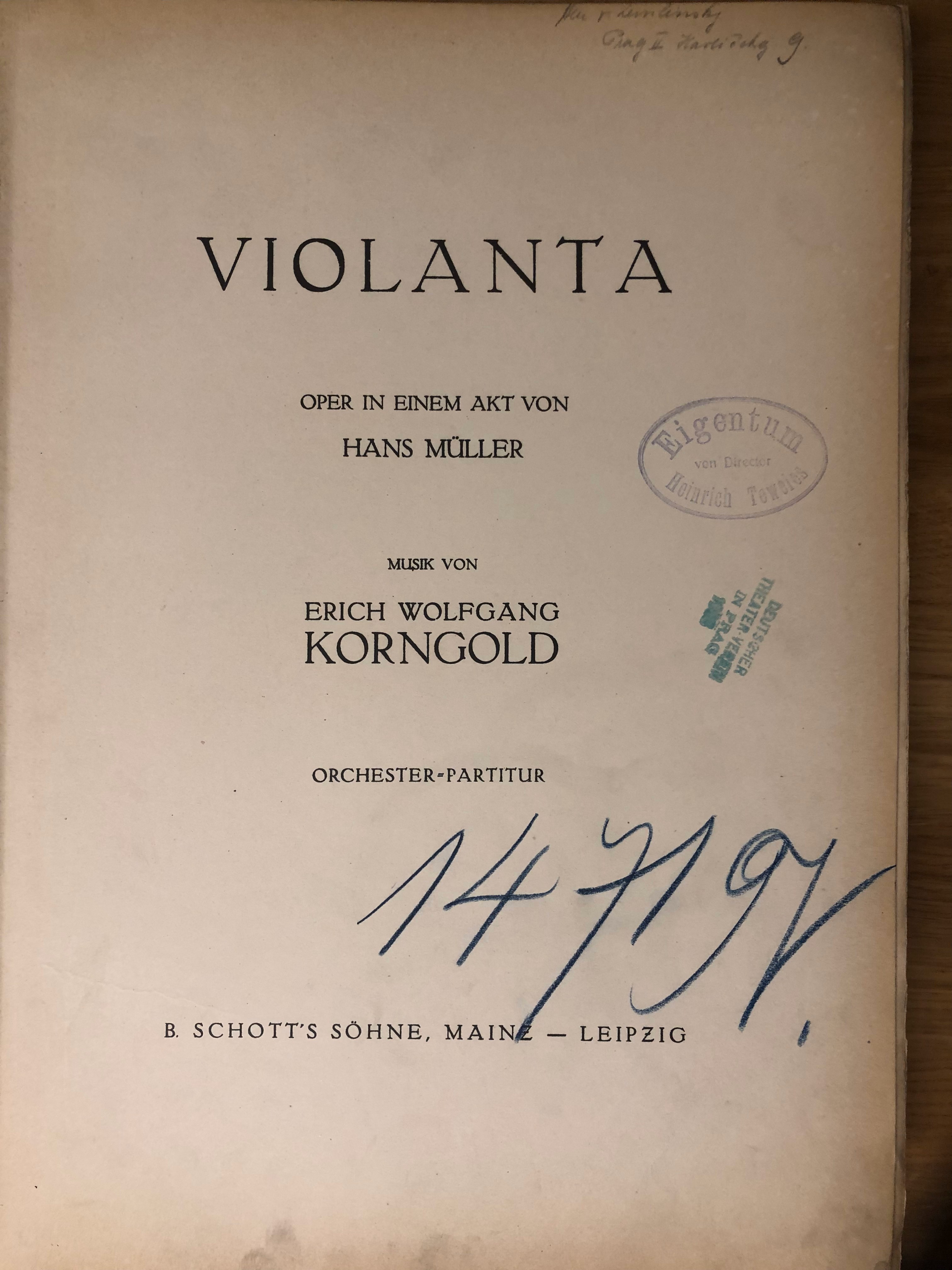
Partitur von Korngolds Oper Violanta mit Besitzvermerk (oben rechts) von Dirigent Alexander Zemlinsky; Erich Korngold, Violanta. Oper in einem Akt von Hans Müller, Orchester-Partitur, Mainz u. Leipzig s. a., CZ-Pnd, Dt O 318/P1.

The source material for this project is drawn from a collection of manuscripts by composers and conductors associated with Viennese Modernism. These manuscripts are not mentioned in prior publications, leaving a significant gap in the academic literature on the topic of performance practice of Viennese Modernism. The contents of these manuscripts allow new insights into an important collaborative network between individuals invested in both musical composition and performance during the early 20th century.

This project looks at the performance material of composers and conductors such as Gustav Mahler, Alexander Zemlinsky, Franz Schreker, Erich Korngold, Artur Bodanzky, Otto Klemperer, Anton Webern, and Arnold Schönberg. It is worth noting that these figures comprised a collaborative network in which composition and performance manuscripts were not only produced by the composers themselves but they were also actively discussed in letters between collaborating conductors and composers. Furthermore, these performance materials never remained in one place. They were reused for later performances by different conductors in new places so that each revision and addition created a performance layer inscribed atop the composer’s autograph. Indeed, these compositions were ‘works-in-progress’, and the composer might add to his own ‘authorised version’ over time either by inscribing the revisions into the autograph or by confirming with the conductor through correspondence. Therefore, it is important to consider not only the composer’s material as a principal source, but also the performance scores and the exchange between the composer and the conductor. In this way we can better understand composition and decisision-making processes. This leads to questions such as: How did this practice change the hierarchy between composing and conducting? Does it constitute a new understanding of performance in the beginning of the 20th century? These questions are especially relevant because the annotation and revision practices that were adopted by the Viennese Modernists led to one of the most important changes in performance history: the rise of the conductor as a standalone figure in the music industry. This research project investigates how collaborative practice could be implemented in edition work as well as how such practices still affect our current understanding of performance. Indeed, it seems that such ideals and their influence on the individual aesthetic approach in conducting and performing are still prevalent in performance practice today.

Project Overview

Project lead: Laura-Maxine Kalbow

Status: completed (2024–2025)

Project affiliation: Cluster of Excellence Understanding Written Artefacts (UWA I)

Research Field: (Re-)Shaping Written Artefacts (RFD)

Project number: RFD19

  • UWA 2019–2025

Last update: 28 October 2026

  • Feedback
  • Legal notice
  • Privacy statement
  • Accessibility
  • Site map

University of Hamburg

Innovating and Cooperating for a Sustainable Future in a Digital Age

  • Follow us on Instagram.
  • Follow us on Facebook.
  • Connect with us on LinkedIn.
  • Follow us on Mastodon.
  • Follow us on Bluesky.
  • Subscribe to our channel on YouTube.
    • Studies
    • Prospective students
    • Continuing education
    • Research
    • Teaching at UHH
    • Doctoral studies
    • Job opportunities
    • Knowledge exchange
    • University
    • Excellence
    • Faculties
    • Alumni
    • Contact
    • Campus Navigator
    • UHHApp
    • Emergencies, safety and security
    • Antidiscrimination
Go to family-friendly higher education institution audit
Go to internationalisation re-audit
Go to the Sustainability Audit page
Go to Diversity Audit
Go to System accreditation

© 2026 University of Hamburg. All rights reserved