• Zur Metanavigation
  • Zur Hauptnavigation
  • Zur Suche
  • Zum Inhalt
  • Zur Subnavigation
  • Zum Seitenfuß
  • University of Hamburg
  • For journalists
  • Staff Service Portal0
  • STiNE
https://www.kus.uni-hamburg.de/aktuelles.json?recentnews=true
  • Institutions and target groups
    • Einrichtungen
      • Faculties

        • Faculty of Law
        • Faculty of Business, Economics and Social Sciences
        • Faculty of Medicine
        • Faculty of Education
        • Faculty of Humanities
        • Faculty of Mathematics, Informatics and Natural Sciences
        • Faculty of Psychology and Human Movement Science
        • University of Hamburg Business School
      • Services

        • Study Information Net STiNE
        • Surfmail
        • Exchange
        • Staff Service Portal
        • Learning Platforms
        • Katalogplus – Catalogue of Hamburg Libraries
        • SharePoint
      • Student facilities and services

        • Campus Center
        • Career Center
        • PIASTA
        • AStA (student council)
        • University Sports
        • University Music
        • Family Office
        • University Language Center
        • General Languages
        • Office of Affairs for Students with Disabilities or Chronic Diseases
        • Departmental libraries
        • Healthy Campus
      • Further facilities and services

        • The Cluster of Excellence CLICCS
        • The Cluster of Excellence CUI
        • The Cluster of Excellence Quantum Universe
        • The Cluster of Excellence Understanding Written Artefacts
        • Hamburg Research Academy
        • Pier Plus
        • Hamburg Center for University Teaching and Learning (HUL)
        • Hub for Crossdisciplinary Learning (HCL)
        • CEN
        • Museums and collections
        • University Archives (in German)
        • Regional Computing Center (RRZ)
        • University Administration
        • Knowledge Exchange Agency
        • The Unikontor Shop (in German)
    • Target groups

      • Prospective students
      • Students
      • International prospective students
      • Young researchers
      • Researchers
      • Instructors
      • Staff
      • Prospective continuing education students
      • Alumni
      • Journalists
      • Refugees (in German only)
    Close
  • /sitemap.json
University of Hamburg - to research, to teach, to educate and form, to homepage

CSMC

CSMCCentre for the Study of Manuscript Cultures
  • About
    • People
    • News
    • Ethics
    • Equity & Diversity
    • Sustainability
    • Logbook: The CSMC Blog
    • Contact & Newsletter
    • Vacant Positions
    • Intranet
  • Research
    • Concepts & Methods Units
    • Project Groups
    • Individual Research Projects
    • Working Groups
    • Affiliated Projects
    • Fellowships
    • Research Events
    • UWA I (2019–2025)
    • SFB (2012–2020)
  • Core Units
    • Laboratories
    • Graduate School
    • Cultural Heritage
    • Library
  • Collaboration
    • with Research Partners
    • with Archives, Libraries, and Museums
    • with Artists
    • with Companies
    • with Schools
    • within the HALM and PIER Networks
  • Publications
    • manuscript cultures
    • Studies in Manuscript Cultures
    • Occasional Papers
    • Software
    • Research Data and Information Systems
    • Written Artefact Profiling Guide
    • Artefact of the Month
    • Mesopotamian Bulletins
    • Videos
    • More Publications

Photo: CSMC

  1. UHH
  2. CSMC
  3. UWA 2019–2025
  4. Research Fields
  5. Research Field B: Inscribing Spaces
  6. Graffiti: Ephemeral Inscriptions in Urban Space

Graffiti: Ephemeral Inscriptions in Urban Space

Style Writing in Hamburg in the 1980s and 1990s
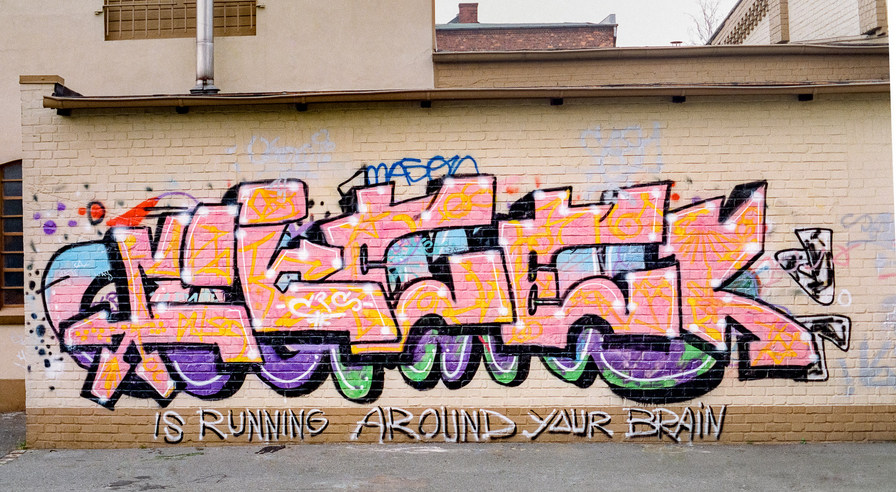
A typical style writing graffiti in Hamburg from the 1990s. (Photo: Mirko Reisser)

Since the 1970s, the modern graffiti form of ‘style writing’ has characterised urban landscapes worldwide. The self-chosen pseudonym of the artist (writer) or his or her associated group (crew) is usually the only element behind this kind of inscription – which is often difficult to decipher due to the strong modification of letters. This, in most circumstances, illicit spraying of typefaces is generally done either spontaneously by quickly writing the artist's signature (tag), or planned and realised as elaborated murals (pieces).

One essential characteristic of graffiti is ephemerality. Because graffiti often disappear from public spaces as quickly as they appear due to ordered removal or weathering, the artists always photograph their piece after completion. In this way, they counteract the transience of this art form, which is why the storing of the photographic documents plays a central role in graffiti art, too. Eventually, it is only through the photograph that graffiti art in public space becomes tangible, archivable and reconstructable.

Against this background, this project investigates the private archive of Mirko Reisser alias DAIM, who has been a key figure in the Hamburg graffiti scene since 1989. Over the past ten years, while continuing as an active artist himself, Reisser has established a graffiti archive, which documents the development of the graffiti scene in Hamburg during the 1980s and 1990s. The main part of his collection consists of about 50,000 photos, several thousands of books and magazines as well as materials from the scene, such as sketchbooks or letter correspondences from artists.

The aim of this project is to illuminate the processes of production, transformation, preservation and also the destruction of the ephemeral materiality of style writing in its social, spatial, historical and cultural contexts in which graffiti are produced, received and archived.

On the one hand, it examines the process of writing graffiti – from sketching to realising, photographing and archiving. On the other hand, Reisser’s archive is investigated in its entirety as a research object of its own with a focus on practices and strategies of archiving, including his digital database as extended archive space. 

Project Overview

Project lead: Sanja Ewald

Status: completed (2019–2023)

Project affiliation: Cluster of Excellence Understanding Written Artefacts (UWA I)

Research Field: Inscribing Spaces (RFB) 

Project number: RFB09

  • UWA 2019–2025

Last update: 28 October 2026

  • Feedback
  • Legal notice
  • Privacy statement
  • Accessibility
  • Site map

University of Hamburg

Innovating and Cooperating for a Sustainable Future in a Digital Age

  • Follow us on Instagram.
  • Follow us on Facebook.
  • Connect with us on LinkedIn.
  • Follow us on Mastodon.
  • Follow us on Bluesky.
  • Subscribe to our channel on YouTube.
    • Studies
    • Prospective students
    • Continuing education
    • Research
    • Teaching at UHH
    • Doctoral studies
    • Job opportunities
    • Knowledge exchange
    • University
    • Excellence
    • Faculties
    • Alumni
    • Contact
    • Campus Navigator
    • UHHApp
    • Emergencies, safety and security
    • Antidiscrimination
Go to family-friendly higher education institution audit
Go to internationalisation re-audit
Go to the Sustainability Audit page
Go to Diversity Audit
Go to System accreditation

© 2026 University of Hamburg. All rights reserved