• Zur Metanavigation
  • Zur Hauptnavigation
  • Zur Suche
  • Zum Inhalt
  • Zur Subnavigation
  • Zum Seitenfuß
  • University of Hamburg
  • For journalists
  • Staff Service Portal0
  • STiNE
https://www.kus.uni-hamburg.de/aktuelles.json?recentnews=true
  • Institutions and target groups
    • Einrichtungen
      • Faculties

        • Faculty of Law
        • Faculty of Business, Economics and Social Sciences
        • Faculty of Medicine
        • Faculty of Education
        • Faculty of Humanities
        • Faculty of Mathematics, Informatics and Natural Sciences
        • Faculty of Psychology and Human Movement Science
        • University of Hamburg Business School
      • Services

        • Study Information Net STiNE
        • Surfmail
        • Exchange
        • Staff Service Portal
        • Learning Platforms
        • Katalogplus – Catalogue of Hamburg Libraries
        • SharePoint
      • Student facilities and services

        • Campus Center
        • Career Center
        • PIASTA
        • AStA (student council)
        • University Sports
        • University Music
        • Family Office
        • University Language Center
        • General Languages
        • Office of Affairs for Students with Disabilities or Chronic Diseases
        • Departmental libraries
        • Healthy Campus
      • Further facilities and services

        • The Cluster of Excellence CLICCS
        • The Cluster of Excellence CUI
        • The Cluster of Excellence Quantum Universe
        • The Cluster of Excellence Understanding Written Artefacts
        • Hamburg Research Academy
        • Pier Plus
        • Hamburg Center for University Teaching and Learning (HUL)
        • Hub for Crossdisciplinary Learning (HCL)
        • CEN
        • Museums and collections
        • University Archives (in German)
        • Regional Computing Center (RRZ)
        • University Administration
        • Knowledge Exchange Agency
        • The Unikontor Shop (in German)
    • Target groups

      • Prospective students
      • Students
      • International prospective students
      • Young researchers
      • Researchers
      • Instructors
      • Staff
      • Prospective continuing education students
      • Alumni
      • Journalists
      • Refugees (in German only)
    Close
  • /sitemap.json
University of Hamburg - to research, to teach, to educate and form, to homepage

CSMC

CSMCCentre for the Study of Manuscript Cultures
  • About
    • People
    • News
    • Ethics
    • Equity & Diversity
    • Sustainability
    • Logbook: The CSMC Blog
    • Contact & Newsletter
    • Vacant Positions
    • Intranet
  • Research
    • Concepts & Methods Units
    • Project Groups
    • Individual Research Projects
    • Working Groups
    • Affiliated Projects
    • Fellowships
    • Research Events
    • UWA I (2019–2025)
    • SFB (2012–2020)
  • Core Units
    • Laboratories
    • Graduate School
    • Cultural Heritage
    • Library
  • Collaboration
    • with Research Partners
    • with Archives, Libraries, and Museums
    • with Artists
    • with Companies
    • with Schools
    • within the HALM and PIER Networks
  • Publications
    • manuscript cultures
    • Studies in Manuscript Cultures
    • Occasional Papers
    • Software
    • Research Data and Information Systems
    • Written Artefact Profiling Guide
    • Artefact of the Month
    • Mesopotamian Bulletins
    • Videos
    • More Publications

Photo: CSMC

  1. UHH
  2. CSMC
  3. UWA 2019–2025
  4. Research Fields
  5. Research Field B: Inscribing Spaces
  6. Inscriptions containing Legal Regulations in Ancient Athens

‘Communicating’ a ‘Code of Conduct’? Inscriptions containing Legal Regulations in Ancient Athens
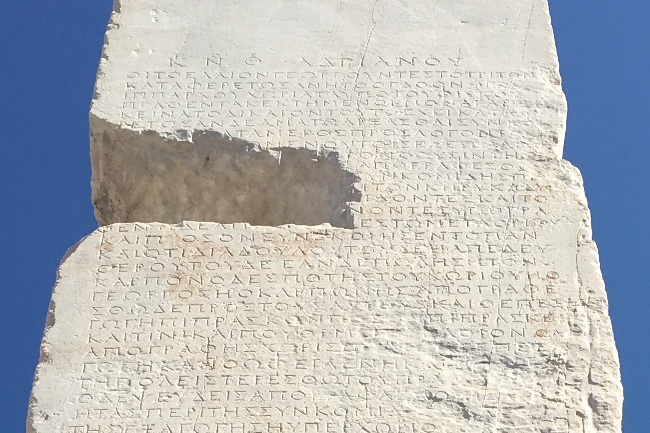
From the early days of the Greek polis onwards (mid-7th century BCE), laws have been recorded on stone or bronze and displayed in various places of the city. They are found on the walls of public buildings, on rocks surrounding open spaces or on artefacts especially produced for the purpose of carrying an inscription, as stelai or blocks. Research questions about literacy in these early communities, as well as in the city-states of Classical and Hellenistic Greece, often consider such texts as manifestations of the self-government of the polis, making it possible for its citizens to consult the laws. Other approaches stress the symbolic character of the written artefacts, denying broad literacy among the citizens of the polis and perceiving them as symbols of elite-power.

The communicative power of inscriptions is largely undisputed in the traditional study of Greco-Roman epigraphy, and often forms the centre-piece of the definition of ‘inscription’. It is one of the aims of Research Field B to challenge this view by scrutinizing evidence from different cultures of writing. This project targets a specific group of written artefacts, which per definitionem could be seen as ‘communicating’: legal regulations that request behaving in a certain way or refraining from certain actions. As ancient Greek law usually concentrates on procedural prescriptions rather than on material law, the formulations raise questions about how these inscribed monuments are perceived. Thus, rather than specifying “Theft is the physical removal of an object without the consent of the owner” we would find “If somebody steals the cattle of the sanctuary, he shall be brought to the court of the city by anybody who volunteers to do so”. Are these texts meant to be a ‘code of conduct’ and read in order to get instructions? In order to determine in which ways such a rule of law would be conceived when inscribed within the realm of a Greek polis, the material qualities of the carrier must be taken into account: the properties of the writing, the placing of the object and therefore the principal visibility, readability and comprehensibility of the written artefact.

The prominent Greek polis Athens serves as a case study for this project. It provides the largest range of epigraphic, literary and well-documented archaeological sources. The evidence for the phenomenon starts at the 7th century BCE and is to be found until late imperial times (3rd/4th century CE), which allows for tracing developments in the use of written artefacts over an extended period of time. Against this background, this project establishes ways to describe what could and could not be read, understood and followed by Athenian citizens as well as foreigners.

Project Overview

Project lead: Kaja Harter-Uibopuu

Research Associate: Jan Trosien

Status: completed (2020–2023)

Project affiliation: Cluster of Excellence Understanding Written Artefacts (UWA I)

Research Field: Inscribing Spaces (RFB) 

Project number: RFB07

  • UWA 2019–2025

Last update: 28 October 2026

  • Feedback
  • Legal notice
  • Privacy statement
  • Accessibility
  • Site map

University of Hamburg

Innovating and Cooperating for a Sustainable Future in a Digital Age

  • Follow us on Instagram.
  • Follow us on Facebook.
  • Connect with us on LinkedIn.
  • Follow us on Mastodon.
  • Follow us on Bluesky.
  • Subscribe to our channel on YouTube.
    • Studies
    • Prospective students
    • Continuing education
    • Research
    • Teaching at UHH
    • Doctoral studies
    • Job opportunities
    • Knowledge exchange
    • University
    • Excellence
    • Faculties
    • Alumni
    • Contact
    • Campus Navigator
    • UHHApp
    • Emergencies, safety and security
    • Antidiscrimination
Go to family-friendly higher education institution audit
Go to internationalisation re-audit
Go to the Sustainability Audit page
Go to Diversity Audit
Go to System accreditation

© 2026 University of Hamburg. All rights reserved