
Artefacts from excavation sites in Thailand - Recognizable geometric patterns
2019–2025
RFA23
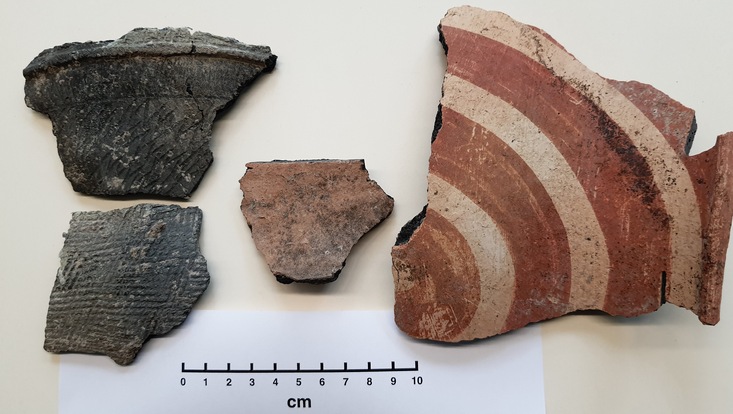
Photo: Ulrich Bismayer
Ceramic shards from Ban Chiang, Thailand. Left: Pre-metal age (ca. 3700 BP), middle: Bronze Age (ca. 3000 - 2300 BP) and right: Iron Age (ca. 2300 - 1800 BP).

Photo: Ulrich Bismayer
Iron-age pottery, Ban Chiang National Museum, Thailand.

Photo: Ulrich Bismayer
Iron-age pottery, Ban Chiang National Museum, Thailand.
Photo: Ulrich Bismayer
U. Bismayer at the Synchrotron Light Research Institute, Nakhon Ratchasima, 30000 Thailand – emphasising continued cooperation.
In 1992 the archeological excavation site Ban Chiang in Northeast Thailand, Udon Thani Province, became a UNESCO world heritage site. Meanwhile a few more related sites have been discovered on the same Khorat plateau. Mineralogy is the cornerstone of many disciplines and its diversity of methods helps to solve a wide range of questions in archaeology,. Therefore, mineralogical analytical approaches were applied on excavated ancient ceramics from Ban Chiang in order to better understand their bulk texture and surface patterns as well as material aspects of the symbols. Depending on their production period ceramic artefacts from Ban Chiang show characteristic, symmetric surface patterns which may be interpreted as typical and recognizable motifs for the site.
People
Project Lead: Ulrich Bismayer