
Re-Centring Central Asia (ReCent)
A Global Microhistory of the Silk Road between the 9th and 15th Centuries
ERC Consolidator Grant
2026–2030
The ReCent project transforms the historiographical framework of the Silk Road through a global microhistorical approach. Focusing on the period from the ninth to the fifteenth centuries, it highlights the pivotal role of the Uyghurs in cultural, material, and knowledge exchange across Eurasia, challenging both Eurocentric and Sinocentric paradigms.
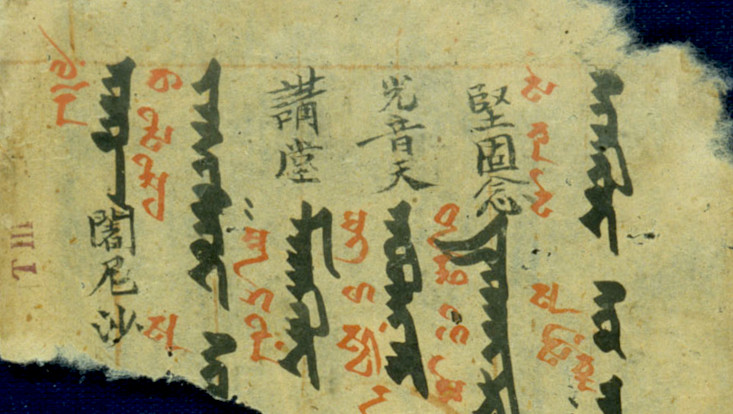
Although Old Uyghur documents survive in an extensive corpus, they have remained marginalised in broader Silk Road historiography. ReCent addresses this oversight by integrating local documentary sources into the study of Silk Road history. In doing so, the project reconstructs this history from within and demonstrates the centrality of Central Asia and its peoples. Through innovative collaboration across disciplines, ReCent offers a new model for overcoming the limitations of area studies. Its findings will reshape Silk Road historiography, illuminate premodern globalisation, and provide fresh and widely applicable insights into intercultural exchange.
ReCent focuses on three core objectives: first, reconstructing mechanisms of knowledge transfer, material exchange, and cultural exchange; second, re-evaluating the functionality of the Silk Road during periods of political fragmentation; and third, reframing diaspora networks through comparative analyses of Central Asian, Chinese, and Middle Eastern sources.
The project employs a highly interdisciplinary methodology, combining traditional and material philology, microhistory, historical contact linguistics, and social network analysis. Within this framework, hitherto marginalised Old Uyghur documents will be systematically analysed and compared with other Silk Road sources and external literary narratives.
A further key innovation is the development of an open-access digital prosopographical database of Uyghurs along the Silk Road. This database will make it possible to identify individuals and connections across multiple sources and will provide a tool for studying processes of cultural, material, and knowledge exchange extending well beyond the duration of the project.
Interview
Toward a Bottom-Up History of the Silk Road
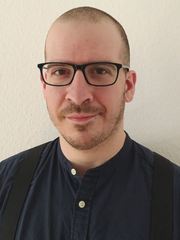
In the historiography of the Silk Road, Central Asian peoples such as the Uyghurs have so far played only a minor role. Wrongly so, argues historian Márton Vér. In his ERC project, he challenges Eurocentric and Sinocentric perspectives and turns the history of the complex supra-network on its head.
Contact
University of Hamburg
Warburgstraße 28
20354 Hamburg
Office
Room: 5004
Contact
Email: marton.ver"AT"uni-hamburg.de