CSMC
CSMCCentre for the Study of Manuscript Cultures
Photo: UHH/Denstorf
14 August 2026

Photo: CSMC
CSMC researchers have published the first scientific study of microbiota associated with damaged parchment manuscripts from Kairouan’s historical library, marking a milestone in the cooperation with the National Heritage Institute and National Laboratory for the Preservation and Conservation of Parchment and Manuscripts in Tunisia.
Kairouan is home to what scholars of Islamicate written heritage regard as the oldest near-intact historical collection of Islamicate manuscripts. Today, the collection is preserved at the National Laboratory for the Preservation and Conservation of Parchment and Manuscripts (NLPCPM), a division of Tunisia’s National Heritage Institute (NHI). It includes 23 of the 30 known surviving non-Qurʾanic Islamicate manuscripts dating to 900 CE or earlier, as well as early Qurʾanic codices. With an estimated 42,500 disbound parchment leaves, it is the largest known collection of Islamic parchment manuscripts in the world, and an exceptional body of written heritage.
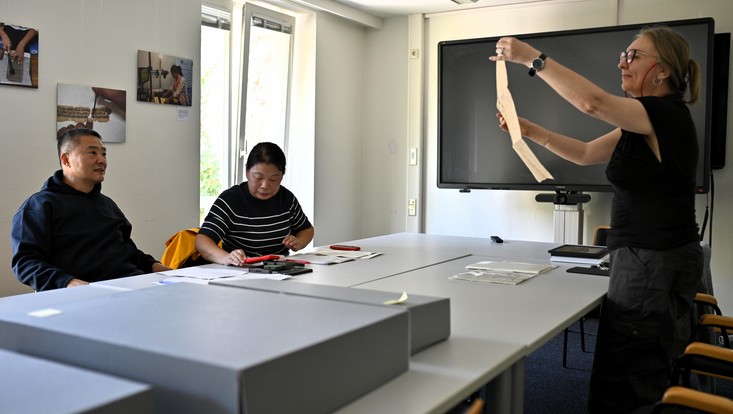
Some of these parchment manuscripts show a distinctive form of deterioration: they are severely distorted and their edges are darkening and gelatinising, eventually becoming brittle and translucent. Experienced conservators have described the degradation as ‘quite unusual’ and ‘notably different’ to that seen in other parchment Islamic manuscripts and have found it difficult to determine the cause. To investigate, a four-member Tunisian delegation travelled to Hamburg in late 2024 with 15 parchment fragments. Together with CSMC researchers and members of the Kairouan Manuscript Project team, they examined 12 of the fragments in the Artefact Lab. The analysed material comes from ninth- to eleventh-century manuscripts that once belonged to the library of the Great Mosque of Kairouan.
The new study, published open access in International Biodeterioration & Biodegradation, uses high-throughput DNA sequencing to analyse the bacterial and fungal communities on the fragments. Among the authors are Jennifer Griese, Davidson MacLaren, Claudia Colini, and Agnes Weiß. The team identifies a putative ‘core microbiota’ of parchment, comprising salt-tolerant bacteria, such as Bacillus and Metabacillus, alongside microorganisms associated with the human microbiota, including Streptococcus and Staphylococcus. The study also identifies several fungal genera – including Aspergillus, Alternaria, Cladosporium, Fusarium, and Penicillium – as potential components of a core mycobiota.
Bacillus, in particular, appeared most commonly on the parchments in general. Because members of the genus are known to produce collagen-degrading enzymes, this may indicate a relationship between their presence and the observed deterioration. The authors stress, however, that experiments on contemporary parchment are needed to test whether there is a causal link between the presence of Bacillus and the parchments’ decay.
The study also shows that each parchment carries a highly individual microbiota shaped by its production, storage, and use. The presence of bacterial or fungal DNA alone does not necessarily mean that active decay is currently taking place. The authors therefore conclude that the National Laboratory’s parchment holdings do not require decontamination, disinfection, or sterilisation as a general, collection-wide measure. Instead, good preventive conservation practices, especially the maintenance of stable environmental conditions, including appropriate relative humidity levels, remain the most effective way to limit microbial growth or germination.
By improving understanding of the microbial communities associated with parchment and identifying taxa potentially involved in biodegradation, the study can help inform future conservation strategies at the NLPCPM for protecting Kairouan’s manuscript heritage.