CSMC
CSMCCentre for the Study of Manuscript Cultures
Photo: UHH/Denstorf
18 June 2026
How can X-rays help us understand cultural heritage objects? What can they reveal about how objects were made and transmitted? A workshop organised by DESY and the CSMC brought together scientists, humanities scholars, and heritage professionals to discuss the use of X-ray-based methods in cultural heritage research.

Photo: Gesa Braun/DESY
The participants of the workshop ‘Exploring Cultural Heritage with X-Rays’ .
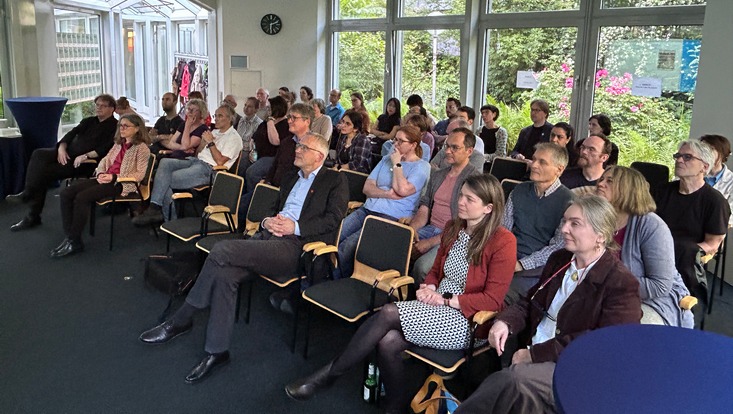
Photo: Katrin Zerbe/DESY
The keynote lecture took place at the CSMC on the evening of 16 June.
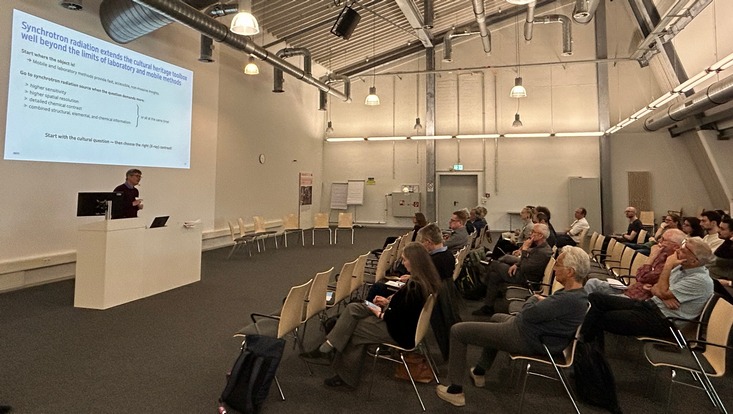
Photo: Katrin Zerbe/DESY
The second day of the workshop: Christian Schroer giving his presentation in the FLASH building on the DESY campus.
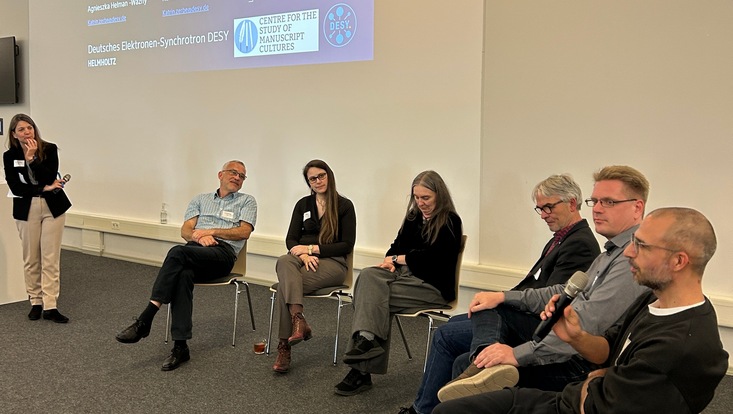
Photo: Katrin Zerbe/DESY
Workshop participants during the concluding discussion.
X-rays can reveal information hidden beneath the surface of an object without causing any damage. They can be used to identify materials, trace manufacturing techniques, detect later alterations, study degradation processes and address questions of provenance and authenticity. This means that, for researchers and professionals at museums and collections alike, X-ray analysis can provide crucial insights into an object’s history and inform decisions regarding conservation and exhibition practices.
Held on 16 and 17 June, the workshop ‘Exploring Cultural Heritage with X-Rays’ brought together experts and stakeholders from different fields to discuss the potential of X-ray-based methods for cultural heritage research. It was the second workshop of this kind jointly organised by DESY and the CSMC. The event opened on Tuesday evening with a keynote lecture by Matthias Alfeld, who outlined both the possibilities and the limitations of synchrotron-based methods in this field. On Wednesday morning, Christian Schroer, lead scientist at DESY and co-spokesperson of the Cluster of Excellence Understanding Written Artefacts, gave an overview of PETRA III and the range of X-ray methods available there, including imaging, tomography, X-ray fluorescence, diffraction, scattering, and spectroscopy. He stressed that such methods are most valuable when they are used in response to a clearly defined research question, ideally developed collaboratively by experts in synchrotron radiation and scholars from the humanities.
Several presentations then illustrated how these methods are being applied in concrete research projects. For example, Laura Gallardo Dominguez presented work on palm-leaf manuscripts, combining SAXS, WAXS, and XRF to study their material composition and microstructure. Frank Meissner from TÜV NORD presented two case studies: a portrait of Johann Sebastian Bach and early landscape paintings by the Morisot sisters. Using X-radiography, infrared and ultraviolet examination, and macroscopic XRF, he explored questions of attribution and authenticity. Another contribution, by Agnieszka Helman-Wazny and Sebastian Bosch, introduced the CSMC Mobile Lab’s investigation into a forgery that was central to the widely reported Graw affair.
The workshop also highlighted the methodological and ethical questions that arise when working with written artefacts, especially manuscripts. Claudia Colini and Konrad Hirschler discussed issues such as mobility, sampling and long-term preservation based on a case study of Arabic manuscripts of questionable authenticity, underlining the need for careful handling and close collaboration between researchers and custodians of the objects.
A plenary discussion on Wednesday afternoon turned to the broader state of the field. One recurring concern was that research on cultural heritage with X-rays remains rather fragmented in Germany, with too few regular opportunities for exchange between X-ray scientists, humanities scholars, conservators, and curators. This makes it harder to build lasting collaborations and reduces international visibility, despite the strong expertise that exists.
Hamburg is exceptionally well placed to help change this. DESY offers world-leading expertise in synchrotron research, while the CSMC brings together extensive knowledge of written artefacts and manuscript cultures. The city also has a rich network of museums, archives, and collections that provide ideal conditions for future collaborative projects. With the SR2A conference scheduled to take place in Hamburg in 2027, there is a real opportunity to strengthen Hamburg’s position as a leading hub for cultural heritage science.