CSMC
CSMCCentre for the Study of Manuscript Cultures
Photo: UHH/Denstorf
15 December 2025

Photo: ISCMI
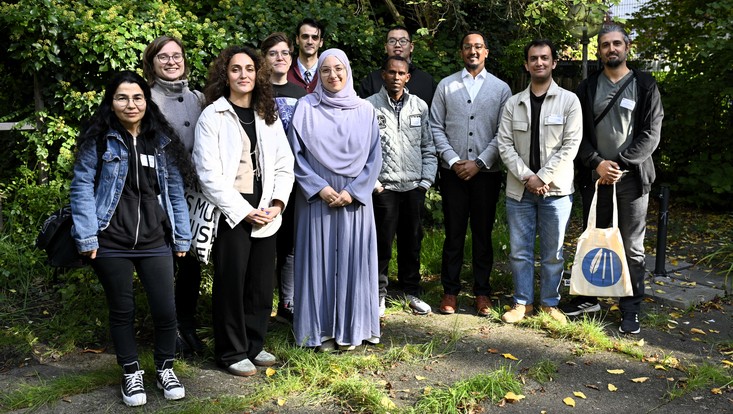
The CSMC Computer Scientist has won an Excellent Oral Presentation Award at the 12th IEEE International Conference on Soft Computing & Machine Intelligence (ISCMI) 2025, held in Rio de Janeiro, Brazil.
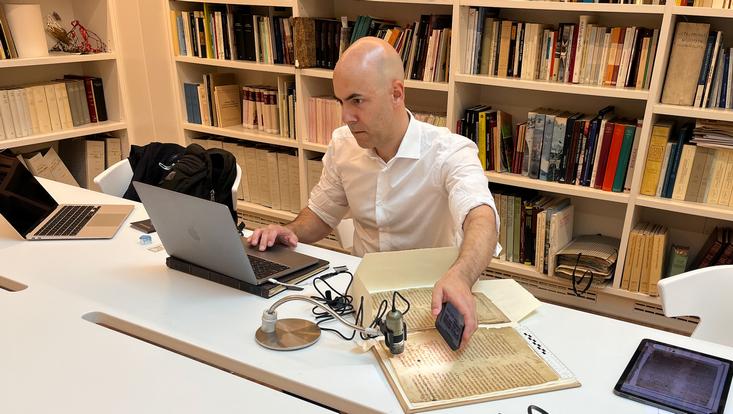
Mahdi Jampour received the award for his paper on ‘Character Localization in Degraded Historical Documents via Heatmap-guided UNet3+ with Application on Palimpsests’. Palimpsests are manuscripts where original writing was partly erased and written over again. They pose unique challenges for automated transcription due to degradation, overlapping scripts, and complex backgrounds. The paper introduces a new method to automatically locate characters in multispectral images of these documents, which is an essential step before the text can be transcribed. It uses an advanced image‑analysis model that highlights areas likely to contain letters, even when the writing is faint or obscured. It also includes a system to check and remove regions that do not actually contain characters. Tested on both real and simulated palimpsest images, the method performs well under challenging conditions and supports efforts to make damaged historical texts more accessible and to preserve cultural heritage.
At the CSMC, Mahdi Jampour leads a project on ‘Generative AI for Revealing Palimpsests’ (RFA22). The outcomes of this research are already being applied by members of the project on ‘The Development of Literacy in the Caucasian Territories’ (DeLiCaTe) to reveal undertexts in Georgian and Armenian manuscripts. They are also being used in the ‘Recovery of Writing in Large Collections’ project (RFA21) to support text retrieval and the development of MSI‑based methods. In addition, this research has broader value for libraries, academic institutions, and scholars, offering advanced techniques for the analysis and restoration of historical manuscripts.
The International Conference on Soft Computing & Machine Intelligence (ISCMI) is an annual academic conference focused on research in soft computing, artificial intelligence, and related computational methods. It typically features work in areas such as machine learning, fuzzy systems, evolutionary computation, pattern recognition, optimisation techniques, and their practical applications. ISCMI aims to bring together researchers, practitioners, and industry experts to discuss recent advances, present new findings, and explore emerging trends in intelligent systems.