CSMC
CSMCCentre for the Study of Manuscript Cultures
Photo: UHH/Denstorf
8 June 2026
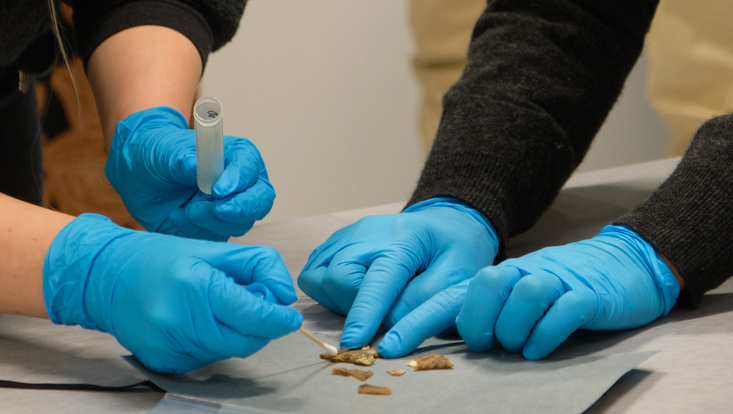
Photo: CSMC
Invasive versus non-invasive, destructive versus non-destructive: analytical methods are often described in binary terms. On closer look, these distinctions become questionable. Claudia Colini, head of ‘Ethical Analysis’, explains why even careful research can have unintended effects and what this means in practice.
Claudia Colini, in the 19th century, historical written artefacts were sometimes treated with harsh chemicals in an attempt to make the text legible again. Modern methods are far more cautious. Could it nevertheless happen that artefacts are damaged, for example because the effects of an analytical method were not, after all, accurately predicted?
In general, the methods we use today have been tested, and we have a very good understanding of what is going to happen. But that does not mean there cannot be surprises, especially when we are dealing with materials that may react in ways we did not anticipate.
I had that experience myself while working on Arabic manuscripts for my MA thesis. We had taken samples and were analysing them with variable-pressure scanning electron microscopy coupled with energy-dispersive X-rays. We decided not to coat the samples, because the plan was to return them to the manuscript afterwards as part of a conservation project. We used the parameters that were standard in a conservation centre. But when we came back to the same area, we could see that the surface had melted slightly. The material had reacted differently because the paper had been treated in a particular way, and in retrospect we should have used different parameters.
What did you take away from that example?
Even careful, well-informed analysis can leave traces. Sometimes you only understand the impact of a method when you encounter a specific object with a specific material and conservation history. With Raman spectroscopy, for example, we always use the lowest power possible because we want to avoid burning the surface. But if a substance is particularly sensitive, you may still trigger a reaction. Sometimes the effect is visible immediately, but at other times it may only become apparent years down the line. To minimise this risk, we prepare for the materials we are likely to encounter by testing our parameters on reference materials, including aged ones, to mimic these substances’ conditions.
Does that mean that invasive methods should be avoided whenever possible?
We often work with this binary: destructive versus non-destructive, invasive versus non-invasive. But in practice, things are far more nuanced. That is why ethical analysis cannot simply mean choosing the method that sounds safest in abstract terms. We often speak as if ‘non-destructive’ or ‘non-invasive’ automatically settled the matter. However, these terms do not always capture what happens when that technique is applied to a particular object under particular conditions. A non-invasive technique may still put considerable stress on the object because of heat, light, pressure, positioning, or handling. And sometimes the reverse is true. A tiny sample taken from an already damaged edge may in fact be less harmful than forcing a fragile written artefact into a difficult position so that an allegedly gentler method can be applied.
What actually is the difference between a ‘destructive’ and an ‘invasive’ method?
These terms are often treated as synonyms, but they do not mean the same. A destructive method destroys part of the object or the sample. An invasive method alters the object in some way: it may involve touching, pressure, sampling, or another kind of intervention.
Problematically, there is no universally accepted definition of these terms. Some people already consider touching to be invasive. Others would only use the term if there is a permanent mark, and then the next question is what kind of mark counts: visible to the eye, or only visible at a microscopic level? One of the basic conceptual problems is that the vocabulary itself is too coarse-grained to capture these subtle differences.
What would be an example of a method that is commonly considered non-invasive?
Methods such as XRF or multispectral imaging are often described that way, because they do not involve direct contact and usually do not leave visible permanent traces. But even in those cases, the issue is not entirely clear. Light can catalyse chemical reactions, infrared irradiated with halogen lamps can bring heat – this can have an impact on the object. The real issue, therefore, is not whether a method has a certain label, but what kind of impact the overall analytical process has on the object. That includes not only the method and the specific instrument used, but also everything around them. One of our ideas to evaluate all the different parameters that are involved in such a process is to use a ‘stress scale’: how the manuscript is positioned, how much it has to be opened, whether it has to be flattened, how long it is exposed, how much light is involved, et cetera. This would also have practical benefits, providing curators and conservators with a clearer basis for decision-making.
Who needs to be involved? What are the expectations? What are the risks?
The name of your CMU is ‘Ethical Analysis’. Is it correct to assume that you are not primarily concerned with the question of what it means to analyse objects ethically, but rather with how ethical analyses can be implemented?
Yes, our aim is always to be as respectful as possible toward the object and toward the communities connected to it. Our core task as a group is to work out how this aim can be translated into practical guidance that is general enough to be useful across many situations, but still concrete enough to help with real decisions. For this reason, one of our first major goals is to develop a workflow. There is already a useful model in the sampling guidelines published by the Institute of Conservation in the UK, which can serve as a starting point. But the idea is to expand this from sampling to analysis more generally, also focusing, for example, on communication. Who needs to be involved? What are the expectations? What are the risks? Those questions are just as important as the technical setup of the analysis itself and should be discussed among conservators, curators, natural scientists, humanities researchers, and also the public: museum visitors, library users, or the community to which an object belongs and which may have a legitimate voice in what happens to it.
Does such a conversation also involve even broader aspects, such as the sustainability of measurement campaigns?
For a mobile lab in particular, the ecological footprint can be considerable. Equipment is shipped by truck, people fly. If one looked only at environmental cost, it might often seem preferable to take a small sample and ship that instead. But again, there is no simple answer. Preservation of the object, scientific value, the wishes of communities, availability of techniques, and ecological footprint all have to be weighed together. Sometimes those values are in tension, and not all of them are commensurable. Ethical analysis means making those tensions visible rather than pretending that one single metric can decide everything.
Before your group started working, an Ethics Working Group already existed at the CSMC, and it still exists today. What is the origin of your group, and how does it relate to the Ethics Working Group?
The origin lies in debates we’ve had over the past few years, especially around artefact profiling and sampling. Sampling was one of the most discussed issues during our previous funding phase, because it always raised the question of how much material could be taken and whether the information gained justified the intervention. From there, the discussion widened into a broader reflection on harm, stress, and the hidden assumptions behind our usual categories.
There was also a sense that these questions did not quite fit into the existing ethics discussions at the cluster. The Ethics Working Group was focused more on provenance, on whether research may be done on an object at all, and on issues such as data ownership and publication. The space in between — once it is clear that research may proceed, but before one decides how to do it — was still missing. That is where this CMU comes in.
How does your CMU connect to other groups in the cluster?
With the CMU on Navigating Crises, for example, there are shared questions about danger, perception, and the role of communities and conservators in decision-making. Analysis can itself be perceived as a form of danger, especially when sacred or symbolically charged objects are involved. There are also links to work on digital twins and data sustainability, because analytical projects produce images, spectra, tables, and other forms of representation that have to be managed and preserved.
Looking ahead, what would you need to accomplish in the coming years to consider your group’s work a success?
A success would be to change the way people talk about analysis. Too often, labels such as ‘non-destructive’ close the discussion before it has really started. We want to provide researchers with the conceptual tools to be more precise about what they are doing to objects, more transparent about risks, and more attentive to the wider implications of their work.