
Metal
Ümit Grüder
Metals are naturally occurring elements that can either be found in their native state or extracted from ore minerals through various metallurgical processes. Once obtained, metals can be shaped into objects through processes such as casting, hammering, and other forms of hot or cold working. The properties of metals vary considerably, including their durability, resistance to corrosion, and mechanical strength. Consequently, the suitability and performance of metal as a writing support depend on a variety of factors, including the type of metal, how it was produced and worked, how the surface was inscribed, and the environmental conditions to which the object was exposed over time.
Instead of being applied to the surface, the text is physically produced on or in the metal. It may be incised into the surface with an engraving tool, punched as individual signs, letters, or sequences of dots, or raised from the reverse by repoussé. In cast objects, the inscription may be produced as part of the casting process, either by incorporating the text into the pattern or by inscribing or otherwise modifying the mould itself, so that the text is reproduced on the cast surface. Alternatively, the inscription may be added after the object has been cast or otherwise manufactured, for example by incision or punching.
Metal writing supports are often thin hammered sheets, ranging from relatively rigid tablets and plaques to foil-thin strips. However, inscriptions also occur on finished objects whose primary function was not writing, such as weapons and vessels. On such objects, the text may have been incorporated during casting or added subsequently to the finished surface.
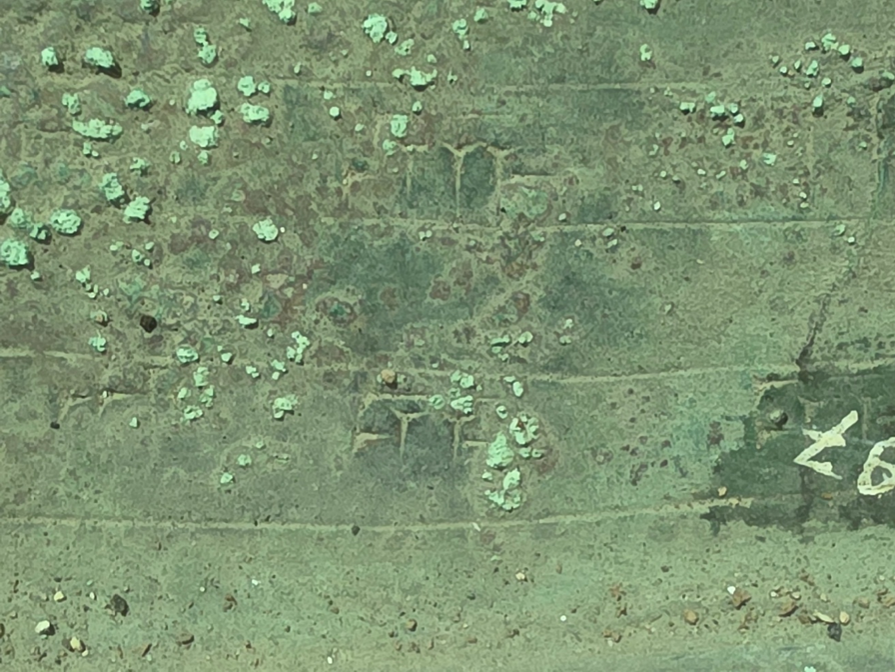
The choice of metal influenced both the technique used to produce an inscription and its subsequent survival. Gold, being soft and highly resistant to corrosion, was well suited to thin sheets that could be incised or punched and can preserve inscriptions remarkably well. Silver was similarly suitable for thin sheets and other forms of inscription, although its surface is more susceptible to tarnishing and corrosion, which can affect the readability of the text over time. Copper and its alloys were more readily available than the precious metals and could be produced in substantial quantities and a wide range of forms, making them particularly practical writing supports. They are, however, susceptible to corrosion, and the resulting corrosion products may obscure, distort, or in severe cases destroy the inscribed surface (see image). Unlike copper alloys, lead is soft enough to be inscribed with a metal stylus rather than a chisel or punch; that same softness, however, means the text can be smoothed away or altered with little effort. Iron was also used for inscriptions, although considerably less frequently than copper alloys, gold, silver, or lead. Inscriptions on tin are uncommon, and largely confined to regions with ready access to the ore.
Writing on metal is nearly as old as writing itself. It was permanent, and mostly reserved for texts meant to outlast their writers: foundation deposits, laws, treaties, land grants and the curses that protected them. From the third millennium BCE, Mesopotamian and later Achaemenid rulers buried inscribed gold, silver and bronze plaques beneath temples and palaces; the foundation tablets of Ashurnasirpal II (ninth century BCE; New Haven, Yale Babylonian Collection, YBC 2398), likely buried beneath the palace at Apqu, record foundations laid ‘with tablets of silver and gold’ (Stephens 1953). Hittite records name tablets of gold, silver, bronze and iron, made for treaties and oaths; the only such tablet to survive is the Bronze Tablet of Hattuša (Bo 86/299, thirteenth century BCE; Ankara, Museum of Anatolian Civilisations), a treaty of Tudhaliya IV, 35 × 23.5 cm and 5 kg, one of seven copies (Otten 1988). In Urartu, royal inscriptions on helmets, shields and harness dedicated in temples made the equipment itself the document, as on the votive shield from Ayanis, whose rim carries the name of Rusa, son of Argishti, and a curse calling on Haldi against anyone who damages the shield or erases that name (Salvini 2001; 2012). Greek and Roman cities published statutes on bronze tablets set up in public space, while lead sheets, far less costly, carried letters, records and curses (Williamson 1987; Eidinow and Taylor 2010). In Western Zhou China (eleventh–eighth centuries BCE), inscriptions on ritual bronzes, many of them dedicated to ancestors, were typically modelled in clay on the mould and cast with the vessel rather than cut into the metal (Škrabal 2019; 2021).
Relevant analytic methods include:
- XRF for the identification of alloy composition, though readings taken at different points on a corroded object may diverge widely (Güder et al. 2026).
- Raman spectroscopy and FTIR to identify the corrosion products obscuring the text (Bouchard and Smith 2003).
- Reflectance Transformation Imaging (RTI) to read shallow or corroded inscriptions (Bevan, Lehoux and Talbert 2013).