• Zur Metanavigation
  • Zur Hauptnavigation
  • Zur Suche
  • Zum Inhalt
  • Zur Subnavigation
  • Zum Seitenfuß
  • University of Hamburg
  • For journalists
  • Staff Service Portal0
  • STiNE
https://www.kus.uni-hamburg.de/aktuelles.json?recentnews=true
  • Institutions and target groups
    • Einrichtungen
      • Faculties

        • Faculty of Law
        • Faculty of Business, Economics and Social Sciences
        • Faculty of Medicine
        • Faculty of Education
        • Faculty of Humanities
        • Faculty of Mathematics, Informatics and Natural Sciences
        • Faculty of Psychology and Human Movement Science
        • University of Hamburg Business School
      • Services

        • Study Information Net STiNE
        • Surfmail
        • Exchange
        • Staff Service Portal
        • Learning Platforms
        • Katalogplus – Catalogue of Hamburg Libraries
        • SharePoint
      • Student facilities and services

        • Campus Center
        • Career Center
        • PIASTA
        • AStA (student council)
        • University Sports
        • University Music
        • Family Office
        • University Language Center
        • General Languages
        • Office of Affairs for Students with Disabilities or Chronic Diseases
        • Departmental libraries
        • Healthy Campus
      • Further facilities and services

        • The Cluster of Excellence CLICCS
        • The Cluster of Excellence CUI
        • The Cluster of Excellence Quantum Universe
        • The Cluster of Excellence Understanding Written Artefacts
        • Hamburg Research Academy
        • Pier Plus
        • Hamburg Center for University Teaching and Learning (HUL)
        • Hub for Crossdisciplinary Learning (HCL)
        • CEN
        • Museums and collections
        • University Archives (in German)
        • Regional Computing Center (RRZ)
        • University Administration
        • Knowledge Exchange Agency
        • The Unikontor Shop (in German)
    • Target groups

      • Prospective students
      • Students
      • International prospective students
      • Young researchers
      • Researchers
      • Instructors
      • Staff
      • Prospective continuing education students
      • Alumni
      • Journalists
      • Refugees (in German only)
    Close
  • /sitemap.json
University of Hamburg - to research, to teach, to educate and form, to homepage
Kairouan Manuscript Project
  • About
    • About
    • History of the KMP
    • Contact
    • KMP Team
  • The Manuscripts
    • The Manuscripts
    • Access to the collection
    • History of the NLPCPM
    • Bibliography
  • KMP News
  • Partners
  • Back to CSMC

Photo: kmp

  1. UHH
  2. CSMC
  3. Kairouan Manuscript Project
  4. The Manuscripts
  5. The Manuscripts

The Manuscripts

Kairouan, Tunisia, is one of the oldest Islamic cities in the world. Founded in 670 CE as a garrison town by ʿUqba b. Nafiʾ, it quickly grew in size and stature. In the ninth century, Kairouan was already home to important scholars of Islamic law, theology, Qurʾanic studies and other fields. By the time Cairo was built in 969, Kairouan was attracting students from as far away as Iraq and Spain.

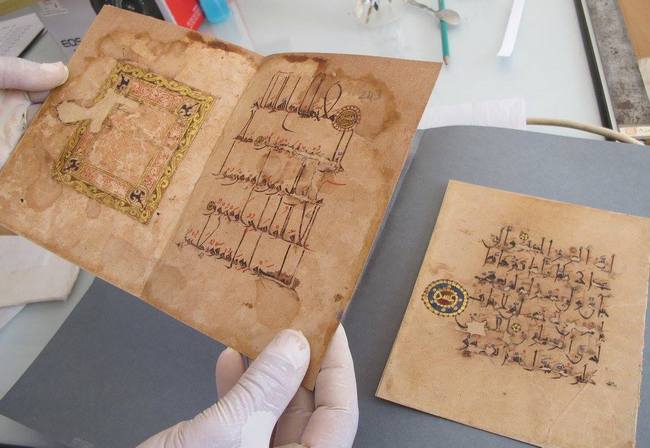
The National Laboratory for the Preservation and Conservation of Parchment and Manuscripts (NLPCPM) in Raqqada, Kairouan, holds several manuscript collections, but the oldest of these is the legacy of the ancient teaching mosque in Tunisia’s holiest city. Originally stored in the maqṣūra, an enclosed space near the front of the mosque, these artefacts are of unparalleled importance for understanding early Islamic history. To the best of our knowledge the NLPCPM holds the oldest near-intact collection of Islamic manuscripts in the world, containing 23 of the 30 Islamic literary manuscripts that can be confidently dated to 900 CE or earlier. 

These include a fragment of the Mudawwana by Sahnun b. Saʿid that was studied with the master himself in the year AH 235 (849-850 CE), five years before his death in 240/854. There are also two dated fragments on paper, centuries before this material was used in Europe, and many beautiful ancient Qurʾan manuscripts. 

A new inventory is being constructed, but altogether, the NLPCPM’s collection appears to comprise

    • more than 40,000 disbound leaves from Qurʾanic manuscripts, both parchment and paper; 
    • more than 2,500 disbound leaves from non-Qurʾanic manuscripts, primarily parchment; 
    • some 179 loose manuscript bindings; 
    • about 2,200 paper manuscript codices; 
    • around 150 papyri.

Text by Jonathan Brockopp

  • The Manuscripts

  • The Manuscripts
    • Access to the collection
    • History of the NLPCPM
    • Bibliography

    Last update: 4 July 2025

    • Feedback
    • Legal notice
    • Privacy statement
    • Accessibility
    • Site map

    University of Hamburg

    Innovating and Cooperating for a Sustainable Future in a Digital Age

    • Follow us on Instagram.
    • Follow us on Facebook.
    • Connect with us on LinkedIn.
    • Follow us on Mastodon.
    • Follow us on Bluesky.
    • Subscribe to our channel on YouTube.
      • Studies
      • Prospective students
      • Continuing education
      • Research
      • Teaching at UHH
      • Doctoral studies
      • Job opportunities
      • Knowledge exchange
      • University
      • Excellence
      • Faculties
      • Alumni
      • Contact
      • Campus Navigator
      • UHHApp
      • Emergencies, safety and security
      • Antidiscrimination
    Go to family-friendly higher education institution audit
    Go to internationalisation re-audit
    Go to the Sustainability Audit page
    Go to Diversity Audit
    Go to System accreditation

    © 2026 University of Hamburg. All rights reserved